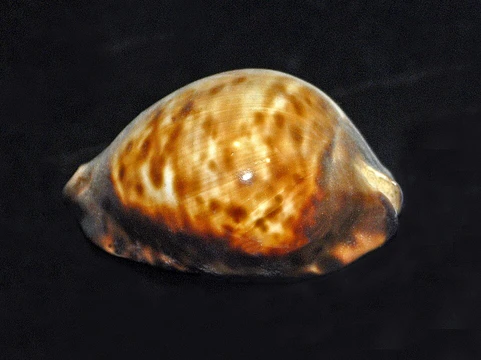
Naria miliaris
A common cowry with white-edged shell and spotted dorsum.

Naria miliaris, also called the millet cowry, the inocellate cowry, or the military cowry, is a marine gastropod mollusk in the family Cypraeidae. This very common cowry has a shell that typically measures 32 to 38 mm in length, though it can be as small as 17 mm or as large as 56 mm. The smooth, shiny upper surface is usually pale brown or yellowish, dotted with many small white spots. The underside is white or pink and lined with fine teeth. In living animals, the mantle is pale brown and greyish, with long, tree-shaped sensory papillae. This species closely resembles *Naria lamarckii*, but in *Naria miliaris* the shell edges are white and spotless. Its range spans the Indian Ocean near Madagascar and Tanzania, and extends across the western Pacific to Australia, Japan, East China, Taiwan, Vietnam, eastern Thailand, eastern Malaysia, Flores, northern Borneo, Java, the Philippines, and northwestern Australia.
Quick Facts
- Taxon
- Naria miliaris
Facts from the source article.
Lore & Background
The shells of Naria miliaris are smooth and shiny, typically reaching 32 to 38 mm in length, though specimens range from 17 mm to 56 mm. The dorsum surface is generally pale brown or yellowish, adorned with several small white spots. The base is white or pink, with several fine teeth. In living individuals, the mantle is pale brown and greyish, featuring long tree-shaped sensorial papillae. This species closely resembles Naria lamarckii, but can be distinguished by the edges of the shell, which are white and lack any spots. The species is distributed across the Indian Ocean along Madagascar and Tanzania, and extends into the western Pacific Ocean to Australia, including Japan, East China, Taiwan, Vietnam, East Thailand, East Malaysia, Flores, North Borneo, Java, the Philippines, and northwestern Australia.
Reader's Guide
Naria miliaris is a widely distributed and very common cowry, noted for its distinctive white-edged shell and spotted dorsum. Its range spans from the Indian Ocean off Madagascar and Tanzania to the western Pacific, including many regions of East and Southeast Asia and Australia. The species is recognized by its smooth, shiny shell, which is typically pale brown or yellowish with small white spots, and a white or pink base with fine teeth. The living animal's mantle is pale brown and greyish, with long tree-shaped sensorial papillae. Its similarity to Naria lamarckii is notable, but the absence of spots on the white edges of the shell serves as a key distinguishing feature. The species has been documented in several malacological works, including studies on cowries of the East African coast and marine mollusks of Madagascar, reflecting its importance in regional biodiversity assessments. Its common names—millet cowry, inocellate cowry, and military cowry—reflect different aspects of its appearance or historical perception.
Did You Know?
- The shell length ranges from 17 mm to 56 mm, with an average of 32–38 mm.
- The dorsum is pale brown or yellowish with several small white spots.
More in Cowries, Part 2 1-24
Spotted an error? Know more?
Reader corrections go straight into our review queue. Suggest an edit · How this site is sourced