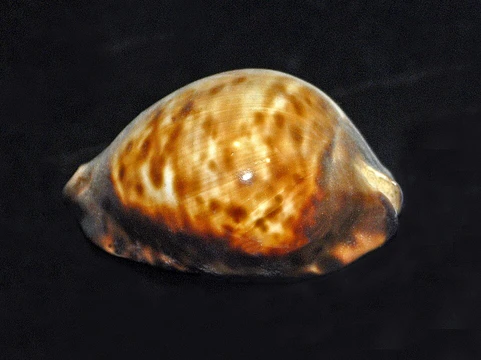
Mauritia eglantina
A common cowry with a brown dorsum and clear longitudinal lines.

Mauritia eglantina, called the dog-rose cowry or eglantine cowry, is a marine gastropod mollusk in the cowry family Cypraeidae. These shells are fairly common, elongated, smooth, and glossy. They typically measure 44 to 52 mm in length, though they can reach up to 80 mm and as small as 27 mm. The dorsal surface is brown with pale spots and many thin longitudinal lines, and a lighter band runs lengthwise near the center. The base is white, pale pink, or pale brown, and the edges have several brown dots. The aperture teeth are well developed. This species is easily mistaken for Mauritia arabica. In living specimens, the mantle is thin and brown. Its range spans the eastern Indian Ocean and western Pacific, from eastern Polynesia and Micronesia, the Samoa Islands, and New Caledonia, through Southeast Asia, Indonesia, the Philippines, and northern Australia. It lives in shallow waters, lagoon reefs, and coral rocks at depths of 2 to 15 meters. One subspecies is Mauritia eglantina huberi.
Quick Facts
- Genus
- Mauritia (gastropod)
- Species
- eglantina
Facts from the source article.
Lore & Background
Mauritia eglantina reaches an average length of 44 to 52 mm, with a maximum of 80 mm and a minimum of 27 mm. The shell is rather elongated, smooth, and shiny. The basic color of the dorsum is brown, with clear spots and many thin longitudinal lines; almost in the middle of the dorsum there is a clearer longitudinal band. The base may be white, pale pink, or pale brown, and the edges show several brown dots. The teeth of the aperture are well developed. In the living cowry, the mantle is brown and thin. This species can be easily confused with Mauritia arabica. A subspecies, Mauritia eglantina huberi, was described in 2018.
Reader's Guide
Mauritia eglantina is distributed across the Eastern Indian Ocean and Western Pacific Ocean, ranging from eastern Polynesia and Micronesia, the Samoa Islands, and New Caledonia up to Southeast Asia, Indonesia, the Philippines, and Northern Australia. It prefers rather shallow waters, lagoon reef habitats, and coral rocks at depths of 2 to 15 meters. As a quite common species, its shells are frequently encountered in these regions. The species is part of the family Cypraeidae, which includes many other cowries. Its resemblance to Mauritia arabica is noted, requiring careful examination to distinguish the two. The subspecies Mauritia eglantina huberi was recognized in 2018, indicating ongoing taxonomic refinement within the group. The shell's brown dorsum with clear spots and longitudinal lines, along with the clearer central band, are key identifying features. The well-developed teeth of the aperture and the brown dots along the edges further characterize this cowry.
Did You Know?
- The shell can reach a maximum size of 80 mm.
- The living cowry has a brown and thin mantle.
More in Cowries, Part 2 1-24
Spotted an error? Know more?
Reader corrections go straight into our review queue. Suggest an edit · How this site is sourced