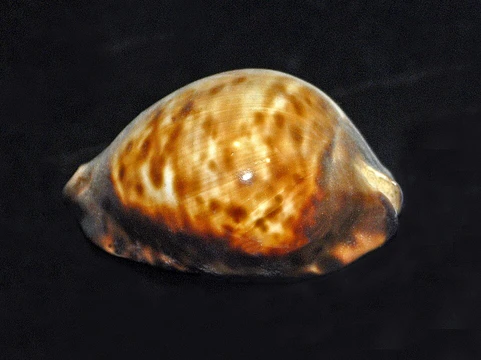
Macrocypraea cervus
One of the largest cowries, with fawn-like spotted shell.

The Atlantic deer cowry, *Macrocypraea cervus*, is a marine gastropod mollusk belonging to the cowry family Cypraeidae. This large sea snail is among the biggest cowries, with a shell that can reach up to 190 mm in length, though specimens as small as 40 mm occur. Its elongated shell is light brown, marked on the dorsum with small whitish spots that resemble the coat of a young fawn—hence the species name *cervus*, meaning "deer." A few faint, lighter transverse bands cross the dorsum, along with a longitudinal line where the two edges of the mantle meet. The apertural teeth are dark brown, and the living cowry’s mantle is dark grayish and densely covered in short fringes. Juveniles lack the spotted pattern. Found mainly in the tropical Atlantic, including the Caribbean, this species also occurs off South Carolina, Florida, Mexico, Brazil, Cuba, and the Bermudas. It lives in shallow waters up to 35 meters deep, typically under corals and rocks, where it feeds on algae.
Quick Facts
- Genus
- Macrocypraea
- Species
- cervus
Facts from the source article.
Lore & Background
Macrocypraea cervus is distributed mainly in the tropical Atlantic Ocean, including the Caribbean Sea, and in waters off South Carolina, Florida, Mexico, Brazil, Cuba, and the Bermudas. The shell is elongated, with a basic color of light brown and small whitish ocellated spots on the dorsum, resembling a young fawn—hence the Latin name cervus, meaning 'deer'. Juveniles lack these spots. The dorsum also shows a few transverse clearer bands and a longitudinal line where the two edges of the mantle meet. The apertural teeth are dark brown. The mantle of the living cowry is dark grayish and completely covered in short fringes. This species is quite similar in shape and color to Macrocypraea cervinetta, but it is much larger.
Reader's Guide
Macrocypraea cervus holds significance as one of the largest cowry species, with a maximum recorded shell length of 190 mm. Its shell morphology and coloration—light brown with whitish ocellated spots—make it a distinctive member of the Cypraeidae family. The species is found across a broad tropical Atlantic range, from the Caribbean Sea to waters off South Carolina, Florida, Mexico, Brazil, Cuba, and the Bermudas. Living cowries are mainly encountered under corals and rocks in shallow waters at a maximum depth of 35 m, where they feed on algae. The dark brown apertural teeth and the dark grayish, fringed mantle of the living animal add to its biological interest. Its similarity to Macrocypraea cervinetta, though much larger, places it within a complex of related cowries. The species' common name, Atlantic deer cowry, directly references the fawn-like spotting on the shell, linking its appearance to its Latin epithet. The shell's elongated form and the presence of transverse clearer bands and a longitudinal mantle line are consistent features noted in specimens ranging from about 40 mm to 190 mm in length.
Did You Know?
- The Latin name cervus means 'deer', referring to the shell's fawn-like spots.
- Juveniles of this species have no spots on the dorsum.
- The maximum recorded shell length is 190 mm, making it one of the largest cowries.
More in Cowries, Part 2 1-24
Spotted an error? Know more?
Reader corrections go straight into our review queue. Suggest an edit · How this site is sourced