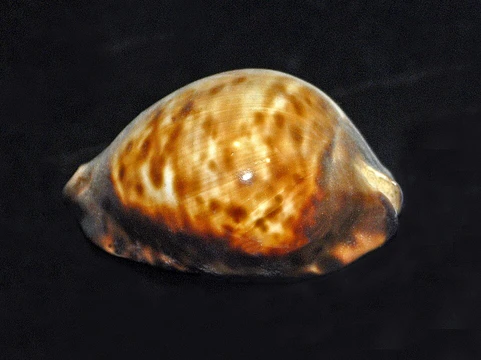
Lyncina sulcidentata
A Hawaiian cowry with a grooved base and nocturnal habits.

The square-toothed cowry, or groove-toothed cowry, is a marine gastropod mollusk in the Cypraeidae family. This species is found only in the Hawaiian Islands. Its shell, which is smooth and shiny, ranges from 20 to 75 mm in length, with most specimens measuring 27 to 35 mm. The shell’s base is white or light brown and features long grooves, which give the animal its Latin name *sulcidentata*. The dorsal surface is reddish or brown-orange, crossed by three wide blue-gray bands. The shell closely resembles those of *Lyncina schilderorum*, *Lyncina carneola*, and *Lyncina ventriculus*. The living cowry has a brownish mantle with long, bluish, tree-shaped sensory papillae. Both the mantle and foot are well developed, with external antennae; the mantle’s lateral flaps can completely cover the shell and retract quickly. These cowries inhabit coral reefs in tropical intertidal and subtidal waters up to 40 meters deep, hiding in ledges and small coral caves during the day and emerging to feed only after dusk. A known subspecies is *Cypraea sulcidentata* var. *xanthochrysa* Melvill, 1888.
Quick Facts
- Genus
- Lyncina
- Species
- sulcidentata
Facts from the source article.
Lore & Background
The shells of Lyncina sulcidentata are smooth and shiny, with a basic color of reddish or brown-orange marked by three wide blue-gray transversal bands. The base is white or light brown, and the long teeth furrowing the base give the species its Latin name sulcidentata. The shell is quite similar to Lyncina schilderorum, Lyncina carneola, and Lyncina ventriculus. In living specimens, the mantle is brownish with long bluish tree-shaped sensorial papillae; the mantle and foot are well developed, with external antennae. The lateral flaps of the mantle may hide the shell completely and can be quickly retracted into the shell. These cowries live on coral reef in tropical intertidal and subtidal water up to 40 metres, and they can be found on ledges and in small coral caves at night, as they start feeding only at dusk. A subspecies, Cypraea sulcidentata var. xanthochrysa Melvill, 1888, has been recorded.
Reader's Guide
Lyncina sulcidentata is a quite uncommon cowry endemic to the Hawaiian Islands, where it inhabits coral reefs from the intertidal zone down to 40 metres. Its nocturnal feeding behavior and ability to retract the mantle quickly into the shell are characteristic of the family. The species is distinguished by the long teeth furrowing the base, a feature reflected in its scientific name. Its similarity to other Lyncina species—L. schilderorum, L. carneola, and L. ventriculus—places it within a complex of related cowries. The subspecies Cypraea sulcidentata var. xanthochrysa, described by Melvill in 1888, adds to the taxonomic history of the group. The species is referenced in major works on cowries, including Lorenz & Hubert's guide to worldwide cowries, and is listed in the World Register of Marine Species. Its restricted range and distinctive morphology make it a notable subject for malacologists and shell collectors.
Did You Know?
- The species name sulcidentata refers to the long teeth furrowing the base of the shell.
- The mantle of the living cowry is brownish with long bluish tree-shaped sensorial papillae.
- These cowries are endemic to the Hawaiian Islands.
- They feed only at dusk and can be found in ledges and small coral caves at night.
More in Cowries, Part 2 1-24
Spotted an error? Know more?
Reader corrections go straight into our review queue. Suggest an edit · How this site is sourced