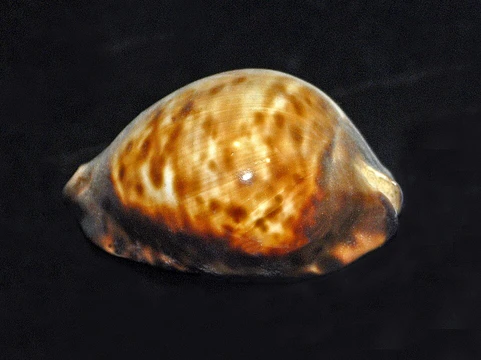
Lyncina schilderorum
A tropical cowry named for two German cowry biologists.

Lyncina schilderorum, called the sandy cowry or Schilder's cowry, is a marine gastropod mollusk in the cowry family Cypraeidae. Its Latin name honors Franz and Maria Schilder, two German cowry biologists. The shell is smooth and shiny, typically 28–33 mm long (ranging from 22 to 43 mm), with a brown-orange base color and three to five wide, light blue bands across the shell. The underside is whitish or bluish, lined with fine white teeth. This species resembles *Lyncina sulcidentata*, *Lyncina carneola*, and *Lyncina ventriculus*. In living animals, the mantle is whitish with long, tree-shaped sensory papillae; the mantle and foot are well developed, with external antennae. The lateral flaps can fully cover the shell and retract quickly into the shell opening. These cowries live in the northern and central Pacific Ocean, including the Philippines, Melanesia, Guam, Micronesia, Polynesia, the Tuamotu Islands, and Hawaii, but not the Galapagos. They inhabit tropical intertidal waters, usually 2–10 meters deep, hiding under rocks or coral slabs during the day. At night, they emerge on reefs or in small caves to feed on sponges or corals.
Quick Facts
- Genus
- Lyncina
- Species
- schilderorum
Facts from the source article.
Lore & Background
The shells of Lyncina schilderorum are smooth and shiny, averaging 28–33 mm in length, with a minimum of 22 mm and a maximum of 43 mm. Their basic color is brown-orange, overlaid with three to five wide light blue transversal bands. The base is whitish or bluish and bears fine white teeth. The shell closely resembles those of Lyncina sulcidentata, Lyncina carneola, and Lyncina ventriculus. In living specimens, the mantle is whitish with long tree-shaped sensorial papillae; the mantle and foot are well developed, with external antennae. The lateral flaps of the mantle can completely hide the shell surface and are quickly retracted into the shell opening.
Reader's Guide
Lyncina schilderorum is a quite uncommon cowry found in the northern and central Pacific Ocean, including the seas around the Philippines, Melanesia, Guam, Micronesia, Polynesia, the Tuamotu Islands, and Hawaii, but notably absent from the Galapagos. It inhabits tropical intertidal waters, typically at depths of 2 to 10 meters, where it hides under rocks or coral slabs during the day. At night, it emerges onto the reef or into small caves to feed on sponges or corals. The species was named to honor Franz and Maria Schilder, two German cowry biologists, and its Latin name Schilderorum means 'Schilders'. Its similarity to other Lyncina species underscores the taxonomic challenges within the genus. The cowry's smooth, banded shell and nocturnal habits contribute to its interest among malacologists and shell collectors, though it remains relatively rare in collections.
Did You Know?
- The species name Schilderorum means 'Schilders' and honors Franz and Maria Schilder, two German cowry biologists.
- The shell reaches a maximum length of 43 mm and a minimum of 22 mm.
- This cowry is found in the northern and central Pacific Ocean but is absent from the Galapagos.
More in Cowries, Part 2 1-24
Spotted an error? Know more?
Reader corrections go straight into our review queue. Suggest an edit · How this site is sourced