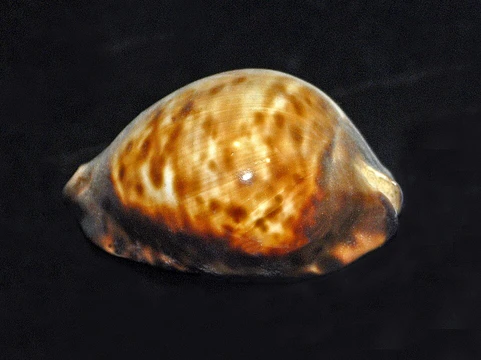
Lyncina leucodon
A cowry once known from only two specimens, now more regularly found.

Lyncina leucodon, commonly known as the white-toothed cowry, is a species of sea snail, a marine gastropod mollusk in the family Cypraeidae. The species was known from only two specimens until rather recently, one held in the National Museum of London, England, and one in the Harvard University Museum of Comparative Zoology. Its distinctiveness was sufficient to consider it a new species.
Quick Facts
- Taxon
- Lyncina leucodon
Facts from the source article.
Lore & Background
The white-toothed cowry was initially documented from just two specimens, one at the National Museum of London and another at Harvard University's Museum of Comparative Zoology. The shell's distinctiveness was enough to recognize it as a new species. In the late 1960s and early 1970s, the third and fourth specimens were discovered. By the 1980s, specimens were being found with regular frequency and became available on the market for about $5000. By 2000, they were common enough to be offered for about $1500 in gem state and under $1000 for lower quality examples.
The shell color varies from chocolate-brown to butterscotch, with whitish spots of varying size and contrast. The dorsal mantle stripe is very distinctive to the species. The living animal has a mottled mantle (blackish-brown and light tan) with short and long colorless papillae, a blackish siphon, and a tan foot. Several subspecies and forms have been described: leucodon (pyriform nominate); angioyna (slight tooth differences); tenuidon (smaller, heavily spotted and rounder); and escotoi (small, dark and very round).
Reader's Guide
The white-toothed cowry's significance lies in its transition from extreme rarity to relative availability, illustrating how deep-water or cryptic species can become better known as collecting and diving techniques improve. Initially represented by only two museum specimens, the species was considered a great rarity. The discovery of additional specimens in the late 1960s and early 1970s, followed by regular finds in the 1980s, shifted its status. By 2000, it was common enough to be sold for about $1500 in gem condition and under $1000 for lower quality shells. This trajectory reflects broader patterns in malacology where new species are described from few shells, then gradually become accessible as their habitats are explored. The described subspecies and forms—leucodon, angioyna, tenuidon, and escotoi—indicate morphological variation within the species, particularly in shell shape, spotting, and tooth structure. The living animal's distinctive mottled mantle and papillae, along with the dorsal mantle stripe, provide field identification cues. The species remains a notable example of how a once-legendary cowry became a regularly encountered shell in the trade.
Did You Know?
- One of the early specimens was housed in the National Museum of London, England.
- Described subspecies include leucodon, angioyna, tenuidon, and escotoi.
More in Cowries, Part 2 1-24
Spotted an error? Know more?
Reader corrections go straight into our review queue. Suggest an edit · How this site is sourced