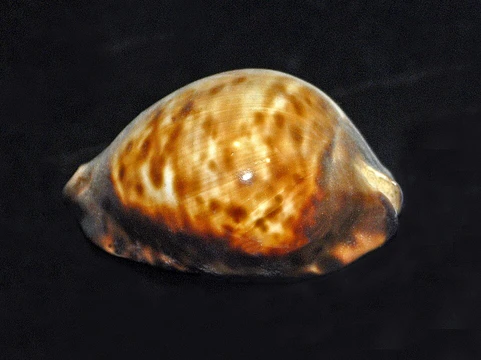
Contradusta walkeri
A common cowry with a pale brown shell and dark band.

Contradusta walkeri is a marine gastropod mollusk, specifically a cowry, belonging to the family Cypraeidae. Three subspecies are recognized: *Contradusta walkeri continens*, *Contradusta walkeri surabajensis*, and *Contradusta walkeri walkeri*. These common cowries typically have shells measuring 19 to 23 mm in length, though they can range from 14 mm to 39 mm. The shell is generally oval, with a smooth, shiny surface. Its base color is pale brown, marked by a broad, darker brown transverse band and a few small, irregular brown patches on top. The margins are white and dotted with brown spots. The base can be white, purple, or cream, and the wide, sinuous aperture features long labial teeth, while the interior of the shell may be purple. In living specimens, the mantle is transparent and covered with short sensory papillae. This species is found in the Red Sea, the Indian Ocean near the Seychelles, and the West Pacific, including Southeast Asia, the Philippines, Melanesia, and Australia. They inhabit tropical subtidal waters and the continental shelf at depths of about 5 to 25 meters, typically on coral reefs or beneath rocks.
Quick Facts
- Genus
- Contradusta
- Species
- walkeri
Facts from the source article.
Lore & Background
The shells of Contradusta walkeri are usually oval, smooth, and shiny. Their basic color is pale brown, with a wide darker brown transversal band and some small irregular brown patches on the top. The margins are white with several brown dots, and the base may be white, purple, or cream. The wide and sinuous aperture shows long labial teeth, and the interior of the shell may be purple. In living individuals, the mantle is transparent with short sensorial papillae. This species is distributed in the Red Sea, the Indian Ocean along the Seychelles, and the West Pacific along Southeast Asia, the Philippines, Melanesia, and Australia. They live in tropical subtidal waters and on the continental shelf at about 5–25 m of depth, usually on coral reef or under rocks.
Reader's Guide
Contradusta walkeri is a notable cowry species due to its wide distribution across the Red Sea, Indian Ocean, and West Pacific, including the Seychelles, Southeast Asia, the Philippines, Melanesia, and Australia. Its commonness in these regions makes it a frequently encountered cowry among collectors and researchers. The shell's distinctive pale brown color with a darker transversal band and brown dots on white margins, along with a base that can be white, purple, or cream, gives it a recognizable appearance. The species inhabits tropical subtidal waters and continental shelf areas at depths of 5–25 m, typically on coral reefs or under rocks. Its three recognized subspecies—Contradusta walkeri continens, Contradusta walkeri surabajensis, and Contradusta walkeri walkeri—reflect geographic variation within its range. The transparent mantle with short sensorial papillae in living specimens is a characteristic feature of the cowry family. Overall, Contradusta walkeri contributes to the biodiversity of coral reef ecosystems and is a representative example of the Cypraeidae family in tropical marine environments.
Did You Know?
- The shells reach an average length of 19–23 mm, with a maximum of 39 mm.
- Three subspecies are recognized: C. w. continens, C. w. surabajensis, and C. w. walkeri.
More in Cowries, Part 2 1-24
Spotted an error? Know more?
Reader corrections go straight into our review queue. Suggest an edit · How this site is sourced