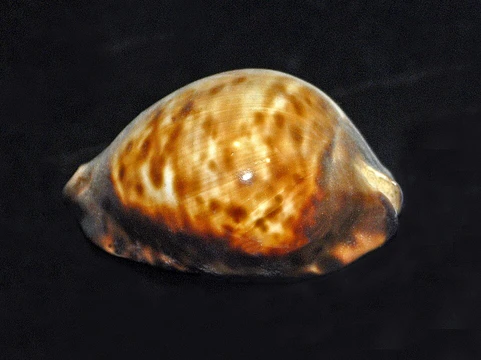
Callistocypraea leucodon
A rare cowry known from only two specimens until the late 1960s.

Callistocypraea leucodon, commonly known as the white-toothed cowry, is a rare species of sea snail, a marine gastropod mollusk in the family Cypraeidae. Its shell color ranges from chocolate-brown to butterscotch with whitish spots, and the dorsal mantle stripe is very distinctive.
Quick Facts
- Taxon
- Callistocypraea leucodon
Facts from the source article.
Lore & Background
Until the late 1960s, the white-toothed cowry was known from only two specimens: one held in the National Museum of London, England, and one in the Harvard University Museum of Comparative Zoology. In the late 1960s and early 1970s, the third and fourth specimens were found. By the 1980s, specimens were being found with regular frequency and were available on the market for about $5000. By 2000, they had become 'common' enough to be available for about $1500 in gem condition, and less than $1000 for lower quality specimens.
The shell color varies from chocolate-brown to butterscotch with whitish spots of varying size and contrast. The living animal has a mottled (blackish-brown and light tan) mantle with short and long colorless papillae, a blackish siphon, and a tan foot. Several subspecies and forms have been described, including C. leucodon leucodon (pyriform nominate), angioyna (slight tooth differences), tenuidon (smaller, heavily spotted and rounder), and escotoi (small, dark and very round).
Reader's Guide
The white-toothed cowry holds a notable place in malacology due to its extreme rarity in the early 20th century, when only two specimens were known. Its gradual emergence in the shell trade from the late 1960s onward illustrates how deep-water or rarely collected species can shift from near-mythical status to relatively accessible collectibles. The species' distinctive dorsal mantle stripe and variable shell coloration have made it a prized item among cowry enthusiasts. The described subspecies and forms—such as the heavily spotted tenuidon and the very round escotoi—reflect the morphological diversity within the species. Its distribution from the Philippines and New Guinea to the Indian Ocean suggests a wide but patchy range. The price drop from about $5000 in the 1980s to under $1000 for lower quality specimens by 2000 indicates that increased collecting and possibly improved deep-water dredging techniques made the species more available. The Cowrie Genetic Database Project has included this species in its studies, contributing to the understanding of its genetics and relationships within Cypraeidae.
Did You Know?
- Until the late 1960s, only two specimens of Callistocypraea leucodon were known.
- One of the first two specimens was housed in the National Museum of London, the other at Harvard University.
- By 2000, a gem-quality specimen could be bought for about $1500.
More in Cowries, Part 2 1-24
Spotted an error? Know more?
Reader corrections go straight into our review queue. Suggest an edit · How this site is sourced