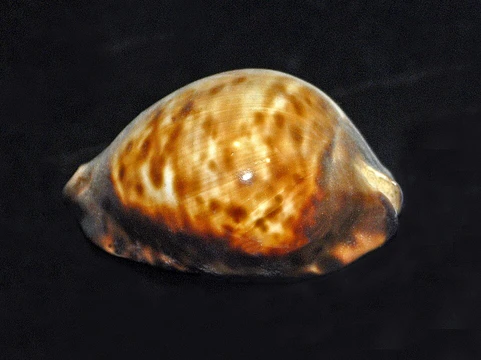
Callistocypraea aurantium
A rare cowry once worn by Fijian chieftains as a symbol of rank.

Callistocypraea aurantium, formerly classified inside the genus Lyncina, is a species of sea snail, a cowry, a marine gastropod mollusk in the family Cypraeidae. Commonly known as the golden cowrie, it is an uncommon-to-rare species found in the tropical waters of the west-central to south-central Pacific Ocean.
Quick Facts
- Taxon
- Callistocypraea aurantium
Facts from the source article.
Lore & Background
The golden cowrie is usually found on the ocean side of islands, on the reef, at depths of 30 to 100+ feet. It normally hides in the coral during daylight and comes out to feed at night. The shell is large, 80 to 100 mm long, with a dorsum that is yellowish brown to reddish orange and white to cream colored margins. The mantle of the golden cowry is a combination of dark gray with translucent spots and patches that the orange color of the shell shows through, and its scattered branching papillae are brownish gray, often white at the bases and tips.
Reader's Guide
In the past, on the Fiji Islands, this shell—known as 'bulikula'—was drilled at the ends and worn on a string around the neck by chieftains as a symbol of rank or privilege. Because the shells are rare, they are prized by collectors. The species is uncommon to rare in its distribution across the tropical waters of the west-central to south-central Pacific Ocean. Its habitat on the ocean side of islands, hiding in coral during daylight and emerging at night, contributes to its elusiveness. The golden cowrie's striking coloration and historical use as a chiefly adornment have made it a notable object in both natural history and cultural contexts, though its rarity ensures it remains a sought-after specimen rather than a common find.
Did You Know?
- The golden cowrie was formerly classified inside the genus Lyncina.
- Its common name is the golden cowrie.
- On the Fiji Islands, the shell was called 'bulikula' and worn by chieftains as a symbol of rank.
- The mantle is dark gray with translucent spots and patches that let the orange shell color show through.
More in Cowries, Part 2 1-24
Spotted an error? Know more?
Reader corrections go straight into our review queue. Suggest an edit · How this site is sourced