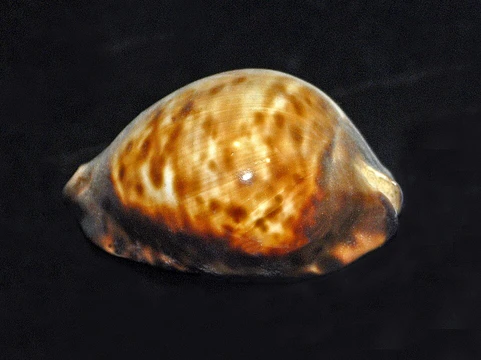
Bistolida erythraeensis
A small, uncommon cowry of the Red Sea and nearby coasts.

Bistolida erythraeensis, also called the Red Sea cowry, is a marine gastropod mollusk belonging to the cowry family Cypraeidae. Its shells, which are fairly uncommon, range from 12 to 22 mm in length, with a maximum of 32 mm. The shell has a smooth, glossy surface. The upper side is grey or pale bluish, marked with small, irregular brown blotches and spots, one or more transverse bands, and two brown spots at each end. The underside is whitish-grey with several brown spots. The shell is elongated and oval, with a long, narrow opening; both the outer and inner lips bear fine teeth, and the radula is tongue-shaped. In the living animal, the mantle and foot are well developed, usually with external antennae. The mantle is thin, transparent, and greyish-white, covered with many white papillae, and it nearly envelops the shell entirely. This species is found in the Red Sea and in waters off Aden, Eritrea, Somalia, Tanzania, and Zanzibar. It inhabits warm tropical and subtropical waters, from the intertidal zone to shallow reefs, at depths of about 5 to 25 meters, primarily on coral reefs, in caves, under rock slabs, or on sandy seabeds. It avoids daylight and feeds at dawn or dusk on algae, sponges, coral polyps, and small crustaceans.
Quick Facts
- Genus
- Bistolida
- Species
- erythraeensis
Facts from the source article.
Lore & Background
The shell of Bistolida erythraeensis is elongated oval in shape, with a long and narrow aperture. Both the outer and inner lips bear fine teeth, and the radula is tongue-shaped. The dorsum is grey or pale bluish with small brown irregular blotches and spots, one or more transversal bands, and two brown spots at each end, while the base is whitish-grey with several brown spots. In the living animal, the mantle and foot are well developed, usually with external antennae. The mantle is thin, transparent, and greyish-white, with many white papillae, and it covers almost the entire shell. These cowries live in warm tropical and subtropical waters, from the intertidal zone to the shallow reef, at about 5 to 25 meters of depth. They are found mainly on coral reefs, in caves, under rock slabs, or on sandy seabed. They fear daylight and feed at dawn or dusk.
Reader's Guide
Bistolida erythraeensis holds significance as a distinctive cowry species within the Cypraeidae family, recognized for its uncommon occurrence and specific regional distribution. Its presence in the Red Sea and along the coasts of Aden, Eritrea, Somalia, Tanzania, and Zanzibar marks it as a characteristic element of these warm tropical and subtropical waters. The species' habitat preferences—coral reefs, caves, under rock slabs, and sandy seabed—reflect its adaptation to shallow reef environments, where it forages at dawn or dusk on algae, sponges, coral polyps, and small crustaceans. The shell's smooth, shiny surface and patterned dorsum, with brown blotches, transverse bands, and terminal spots, contribute to its identification among cowries. The living animal's thin, transparent mantle with white papillae, which covers the shell, is a typical feature of the group. As a marine gastropod mollusk, it represents the biodiversity of the Cypraeidae family in the Red Sea region, though it remains quite uncommon. Its ecological role as a grazer on algae and small invertebrates ties it to the health of coral reef systems, while its nocturnal feeding behavior and daylight avoidance highlight its behavioral adaptations.
Did You Know?
- The shell surface is smooth and shiny, with a grey or pale bluish dorsum.
- It reaches a maximum size of 32 mm in length.
More in Cowries, Part 2 1-24
Spotted an error? Know more?
Reader corrections go straight into our review queue. Suggest an edit · How this site is sourced