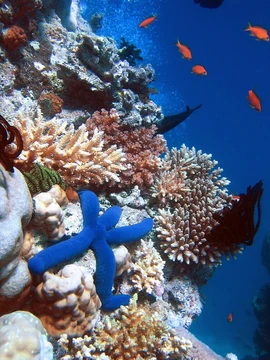
Fringing reef
Fringing reefs are the most common type of coral reef.

A fringing reef is one of the three major types of coral reef. What sets it apart from barrier reefs and atolls is that its backreef zone, or lagoon, is either very shallow or completely absent. When a fringing reef grows right up against the shoreline, the reef flat meets the beach directly, leaving no backreef at all. In other situations, such as in much of the Bahamas, these reefs can sit hundreds of yards offshore and have sizable backreef areas. The world’s largest fringing reef is the Ningaloo Reef, which runs roughly 260 kilometers along the coast of Western Australia.
Barrier reefs and fringing reefs share many similarities, but the key difference lies in the lagoon depth behind the back reef: barrier reefs have deeper lagoons, while fringing reefs do not. Barrier reefs also tend to be located much farther from the shore.
A fringing reef has two main parts: the reef flat and the reef slope. The reef flat is the broad, flat area closest to land, sitting in shallow water that may be exposed at low tide. It slopes only slightly toward the open ocean. Because it lies next to land, it suffers the most from runoff and sediment, so few living corals are found there; instead, seagrasses, seaweeds, and soft corals are common. The reef slope, or fore reef, forms the outer edge bordering the open ocean. It is usually steep, dropping either to a shallow sandy bottom or to depths where coral cannot grow. With less runoff and sediment, this slope hosts more corals and a greater variety of species. Stronger wave action here helps disperse pollutants and brings in nutrients. Spur-and-groove formations often develop on the fore reef, moving sediment downhill through the grooves. The upper part of this slope, called the reef crest, gets the best mix of sunlight and wave action, so coral grows fastest there. The base of the slope receives the least sunlight and has the slowest growth.
Fringing reefs are the most common type of reef, found near shore in tropical waters where temperatures range from 18 to 30 °C. Many reefs in the Great Barrier Reef system are actually fringing reefs—760 out of nearly 3,400 individual reefs. They are especially common in the Philippines, Indonesia, Timor-Leste, the western coast of Australia, the Caribbean, East Africa, and the Red Sea.
- Largest fringing reef
- Ningaloo Reef, ~260 km (160 mi) along Western Australia coastline
- Number of fringing reefs in great barrie
- 760 out of close to 3,400 individual reefs
- Common locations
- Philippines, Indonesia, Timor-Leste, western coast of Australia, Caribbean, East Africa, Red Sea
- Water temperature range
- 18 to 30 °C (64 to 86 °F)
Lore & Background
Charles Darwin believed that fringing reefs are the first kind of reefs to form around a landmass in a long-term reef growth process. There are few differences between fringing reefs and barrier reefs; distinguishing them involves assessing the depth of the lagoon behind the back reef. Barrier reefs feature deeper sections within the lagoon, while fringing reefs lack such depths, and barrier reefs are typically located much farther from the coastline.
A fringing reef has two main components: the reef flat (back reef) and the reef slope (fore reef). The reef flat is the shoreward, flat, broadest area, found in fairly shallow water and can be uncovered during low tide. It sustains the most damage from runoff and sediments, and few of its corals are alive. The reef slope is at the outer edge, bordering the open ocean, usually with a steep inclination. The upper segment of this slope is the reef crest, which enjoys optimal sunlight and wave action, fostering the fastest coral growth. The base of the slope receives the least sunlight and exhibits the slowest growth.
The most important determinant of reef growth is available space as determined by sea level changes, mostly from glaciation or plate tectonics. Tectonic activity can have detrimental effects; an earthquake on Ranongga in the Solomon Islands moved 80% of its fringing reef permanently above sea level. Reefs can develop vertically, expand seaward, grow atop muddy sediments, form in a gradual sporadic manner, or develop when an offshore reef grows to sea level forming a barrier.
Reader's Guide
Fringing reefs are the most common reef type, located near shore in the tropics. Many of the Great Barrier Reef's components are actually fringing reefs, with 760 of its close to 3,400 individual reefs being fringing reefs. The largest fringing coral reef in the world is the Ningaloo Reef, stretching about 260 km along the coastline of Western Australia. Fringing reefs are found in the Philippines, Indonesia, Timor-Leste, the western coast of Australia, the Caribbean, East Africa, and the Red Sea.
As with other types of reefs, fringing reefs face destruction from various sources: destructive fishing practices (cyanide fishing, blast fishing, bottom trawling, muro-ami), overfishing, careless tourism, sewage and waste from resorts, marine pollution, erosion from construction and farming, mining of live coral, and climate change causing increased coral bleaching. The backreef area has the least species diversity, which increases seaward towards the reef crest. Some of this difference results from eutrophication from increased nutrients, sediments, and toxicity from domestic and industrial wastes.
More in Coral Reefs 1-24
Spotted an error? Know more?
Reader corrections go straight into our review queue. Suggest an edit · How this site is sourced