Angria Bank
A shallow sunken atoll and platform coral reef off Maharashtra.

Angria Bank is a shallow sunken atoll located on the continental shelf off the west coast of India, 105 kilometres west of Vijaydurg, Maharashtra. It is a platform type coral reef, notable for its biodiversity and for being one of the few coral reefs in the region that had not yet bleached as of late 2019.
Quick Facts
- Unit Pref
- Metric
- Postal Code Type
- PIN
- Area Code Type
- Telephone code
Facts from the source article.
Lore & Background
The name Angria Bank derives from Kanhoji Angre, a successful naval admiral of the Maratha Empire, whose name was spelled Conajee Angria by the British. The bank is steep-to on all sides, with great depths surrounding it. Its bottom is composed of sand, shells, and coral. In November 1964, the Department of Fisheries, Maharashtra, conducted a two-week survey as part of the Indian Ocean Expedition, using seven departmental mechanical vessels and three private fishing vessels, catching 9019 kg of fish representing 60 different species. The chief scientist was Dr. M. R. Ranade, accompanied by 12 other scientists from the Department of Fisheries, Maharashtra, and two scientists from Bhabha Atomic Research Station, Mumbai.
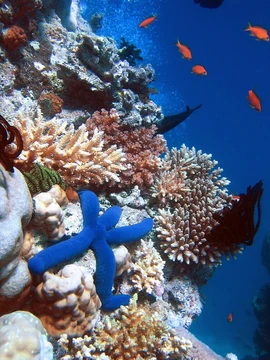
In late December 2019, the Wildlife Conservation Society of India launched an expedition to Angria Bank, discovering a coral reef that had not yet bleached. During the 8-day expedition starting 18 December, over 150 species of corals and algae were documented with no visible signs of bleaching. The government of India plans to designate Angria Bank as a marine protected reserve. The bank is known to have at least one laced moray eel, a school of schooling bannerfish, and a red knob sea star. Common dolphins and Indo-Pacific bottlenose dolphins inhabit the deeper waters of the coast.
Reader's Guide
Angria Bank holds significance as a relatively undisturbed coral reef ecosystem on India's west coast. The 2019 expedition by the Wildlife Conservation Society of India documented over 150 species of corals and algae with no visible signs of bleaching, making it a rare example of a healthy reef in a region where many reefs have suffered bleaching. The government of India's plan to designate it as a marine protected reserve underscores its conservation value. The bank's history includes a 1964 survey that recorded 60 fish species and 9019 kg of fish, indicating its long-recognized biological richness. The first ever underwater scientific expedition was carried out by the National Institute of Oceanography in 1985, revealing significant biodiversity, though results remain unpublished. As of 2008, the bank was accessible by a two-hour boat ride from Malvan, Maharashtra, and the state government announced a ₹50 million initiative to explore its feasibility for marine tourism. The bank's steep-to sides and surrounding great depths contribute to its distinct underwater topography.
Did You Know?
- Angria Bank is named after Maratha naval admiral Kanhoji Angre, whose name was spelled Conajee Angria by the British.
- The bank is 200 kilometres north of Adas Bank, a similar submerged feature off Goa.
- In 1964, a two-week survey caught 9019 kg of fish from 60 different species.
Geography & Physical Form
Angria Bank is a shallow, sunken atoll resting on the continental shelf along India's western coastline, situated roughly 105 kilometres west of the town of Vijaydurg in Maharashtra. Classified as a platform-type coral reef, the formation stretches approximately 40 kilometres from north to south and 15 kilometres from east to west, giving it a substantial footprint beneath the Arabian Sea. Its average depth hovers around 35 metres, yet the seafloor is far from uniform: in some areas the water column is as shallow as 23 metres, while in others the bottom plunges to 400 metres below the surface. The substrate is a mosaic of sand, broken shells, and living coral. What makes the bank geologically striking is its steep-to profile on every side, meaning the relatively flat platform drops abruptly into much deeper water, creating a natural amphitheatre of depths. About 200 kilometres to the south, a similar submerged feature called Adas Bank lies off the coast of Goa, suggesting the region hosts a chain of shallow marine platforms.
Marine Life & Biodiversity
The waters above and around Angria Bank support a remarkably diverse community of marine organisms. In November 1964, a two-week survey conducted by the Department of Fisheries in Maharashtra, using seven government mechanical vessels and three private fishing boats, hauled in nearly 9,000 kilograms of fish representing some 60 different species. The expedition was led by chief scientist Dr. M. R. Ranade alongside eleven colleagues from the fisheries department and two researchers from the Bhabha Atomic Research Station in Mumbai. Decades later, in late December 2019, the Wildlife Conservation Society of India mounted its own eight-day expedition beginning on the 18th. Their team documented more than 150 species of corals and algae and, crucially, observed no visible signs of bleaching. Among the animals recorded were at least one laced moray eel, a school of schooling bannerfish, and a red knob sea star. In the deeper waters fringing the bank, common dolphins and Indo-Pacific bottlenose dolphins have been noted as regular inhabitants.
Historical Naming & Maritime Heritage
The name Angria Bank carries a direct link to one of the most celebrated naval commanders in Indian history. The bank is named after Kanhoji Angre, a Maratha admiral widely regarded as one of the most successful naval admirals the Maratha Empire ever produced. During the era of British colonial presence in India, his name was rendered in English records as "Conajee Angria," a transliteration that stuck in nautical and cartographic usage. It is this anglicised form that gave the submerged atoll its modern designation. The naming thus preserves a memory of Maratha maritime power in a region where the British East India Company and later the Crown maintained a heavy naval presence. For a feature that sits quietly on the continental shelf, the name serves as a reminder that the waters off Maharashtra's coast were once contested by formidable indigenous fleets, and that the legacy of commanders like Kanhoji Angre endures in the very geography of the Indian Ocean.
Scientific Exploration & Conservation Outlook
Angria Bank has attracted scientific attention for decades, yet much of its story remains untold. The first underwater scientific expedition to the site was carried out in 1985 by the National Institute of Oceanography, which revealed significant biodiversity; however, the findings from that survey have still not been formally published, leaving a gap in the public scientific record. More recently, the 2019 Wildlife Conservation Society expedition provided updated data on coral health and species composition. On the policy front, the Government of India has expressed plans to designate Angria Bank as a marine protected reserve, a step that would formalise conservation protections for its reef ecosystem. Tourism interest is also growing: as of 2008, the bank was reachable by a roughly two-hour boat ride from Malvan, and that same year Maharashtra's Finance Minister Jayant Patil announced a 50-million-rupee initiative to study the feasibility of developing marine tourism around the site. Together, these threads point toward a future in which Angria Bank is both scientifically understood and ecologically safeguarded.
More in Coral Reefs 1-24
Spotted an error? Know more?
Reader corrections go straight into our review queue. Suggest an edit · How this site is sourced