Coral
Colonial marine animals that build tropical and deep-sea reefs.

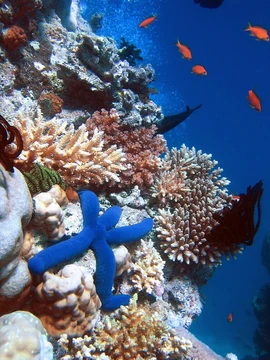
Corals are animals, not plants or rocks, despite centuries of confusion on the matter. They belong to the phylum Cnidaria and the subphylum Anthozoa, and they live as colonies made up of many identical, genetically identical polyps. Each polyp is a tiny, sac-like creature, just a few millimeters wide and a few centimeters tall, with a ring of tentacles around a central mouth. At its base, each polyp secretes a hard exoskeleton made of calcium carbonate. Over many generations, the colony builds up a large, species-specific skeleton that can reach several meters in size.
Colonies grow when polyps reproduce asexually, creating more identical polyps. But corals also reproduce sexually: polyps of the same species release their gametes into the water at the same time, usually overnight around a full moon. The fertilized eggs become free-swimming larvae called planulae, which eventually settle and grow into a new colony.
Most corals get most of their energy and nutrients from tiny, single-celled algae called zooxanthellae (genus *Symbiodinium*) that live inside their tissues. These algae photosynthesize, which is why such corals need sunlight and are found in clear, shallow water—typically less than 60 meters deep, though some *Leptoseris* corals have been found as deep as 172 meters. The algae also give the coral its color. When stressed by high water temperatures or toxins, polyps may expel the algae, causing the coral to turn white—a process known as bleaching. These reef-building corals are major architects of tropical and subtropical reefs, like Australia’s Great Barrier Reef.
Other corals don’t rely on zooxanthellae and can live in much deeper, colder water. The cold-water genus *Lophelia*, for example, survives as deep as 3,300 meters. Such corals have been found as far north as the Darwin Mounds off Scotland, and off the coasts of Washington state and the Aleutian Islands.
People have argued for millennia about what corals actually are. Theophrastus, a student of Aristotle, called red coral *korallion* and described it as both a mineral and a deep-sea plant. Pliny the Elder thought sea nettles and sponges were a third kind of thing, neither animal nor plant. In 1535, Petrus Gyllius coined the term *zoophyta* for this third group.
- Depth range shallow
- less than 60 metres (200 feet; 33 fathoms)
- Deepest known coral genus
- Leptoseris at 172 metres (564 feet; 94 fathoms)
- Cold water depth max
- 3,300 metres (10,800 feet; 1,800 fathoms) for genus Lophelia
- Endangered species percentage
- approximately 33%
- Largest hard coral genus species count
- over 120 species in Acropora
Lore & Background
The classification of corals has been discussed for millennia, owing to similarities to both plants and animals. Aristotle's pupil Theophrastus described red coral as a mineral in one work and as a deep-sea plant in another. Pliny the Elder stated that several sea creatures including sea nettles and sponges 'are neither animals nor plants, but are possessed of a third nature (tertia natura).' Petrus Gyllius introduced the term zoophyta for this third group in 1535. The Persian polymath Al-Biruni classified sponges and corals as animals, arguing they respond to touch. People believed corals to be plants until the eighteenth century when William Herschel used a microscope to establish that coral had the characteristic thin cell membranes of an animal.
Corals are presently classified as species of animals within the sub-classes Hexacorallia and Octocorallia of the class Anthozoa in the phylum Cnidaria. Hexacorallia includes stony corals with polyps that generally have a 6-fold symmetry. Octocorallia includes blue coral and soft corals with polyps having an eightfold symmetry. The group of corals is paraphyletic because sea anemones are also in the sub-class Hexacorallia. There are two main classifications: hard coral (scleractinian and stony coral) which form reefs by a calcium carbonate base, and soft coral (Alcyonacea and ahermatypic coral) which are pliable and formed by a colony of polyps with eight feather-like tentacles.
Reader's Guide
Corals are notable as the primary architects of coral reefs, which develop in tropical and subtropical waters. Most reef-building corals obtain the majority of their energy and nutrients from photosynthesis of symbiotic unicellular dinoflagellates of the genus Symbiodinium (zooxanthellae) that live within coral tissues and give coral its color. Such corals require sunlight and grow in clear, shallow water, typically at depths less than 60 metres, though the genus Leptoseris has been found as deep as 172 metres. Other corals, such as the cold-water genus Lophelia, do not rely on zooxanthellae and can survive as deep as 3,300 metres, found as far north as the Darwin Mounds off Scotland and off the coast of Washington state and the Aleutian Islands.
Corals are increasingly at risk of bleaching events where polyps expel the zooxanthellae in response to stress such as high water temperature or toxins. Approximately 33% of coral species are on the International Union for Conservation of Nature's endangered species list. Ocean acidification threatens continued species growth and differentiation. Mutation rates of the reef pathogen Vibrio shilonii, responsible for coral bleaching, heavily outweigh typical reproduction rates of coral colonies when pH levels fall, meaning corals cannot mutate their heat shock proteins and other climate change preventative genes at a competitive rate, resulting in species loss.
Did You Know?
- Each coral polyp is a sac-like animal typically only a few millimeters in diameter and a few centimeters in height.
- Most corals obtain the majority of their energy from symbiotic zooxanthellae (dinoflagellates of the genus Symbiodinium).
- The cold-water coral genus Lophelia can survive as deep as 3,300 metres (10,800 feet).
- The Persian polymath Al-Biruni classified corals as animals because they respond to touch.
The Rosen Brothers and the Birth of a Planned City
In 1957, Baltimore real-estate developers Leonard and Jack Rosen flew over a peninsula called Redfish Point, across the Caloosahatchee River from present-day Fort Myers. With a small circle of partners, they bought a 103-square-mile tract for roughly 678,000 dollars and set about creating a planned community. By May 1958 the first four homes were finished on Riverside and Flamingo Drives, and the Rosens' sales office—now the location of George's Auto at Cape Coral and Coronado Parkways—stood as the city's first building. Kenny Schwartz, their general manager, became the first permanent resident. The Gulf American Land Corporation, which oversaw development, abandoned conventional listings for a dinner-party sales model. Prospects received a free dinner for two at hotel banquet rooms, where a trained team could close a contract in about ninety minutes. Buyers had six months to visit the property and could cancel if unsatisfied. The strategy was so effective that offices opened in twenty-four states and Gulf American Airlines arranged flights from Miami to bring visitors to the site. Rather than taking bank loans, the developers financed canals and streets by factoring those sales contracts, a rapid build-out that would define the city's character.
A City Carved by Water
Cape Coral occupies a large peninsula in Lee County, bordered to the south and east by the Caloosahatchee River and to the west by Matlacha Pass. Fort Myers sits across the river to the east, while Matlacha and Pine Island lie beyond the pass to the west, where the Matlacha Pass National Wildlife Refuge and Aquatic Preserve protect sensitive habitat. Of the city's 120-square-mile total area, roughly nine percent is open water, a proportion that reflects the defining feature of the place: more than four hundred miles of navigable canals, a total that exceeds any other city on the planet. The canal network was not ancient. The Calusa people, who inhabited the area during the Spanish expedition of Juan Ponce de León, are believed to have dug a canoe canal linking Matlacha Pass to Yellow Fever Creek, but post-1950s development erased every trace of that waterway. The modern canals were excavated in the late 1950s and early 1960s, and by 1963 some 160 miles had been cut. A critical piece of infrastructure, the 3,400-foot Cape Coral Bridge across the Caloosahatchee, opened in early 1964, replacing a twenty-mile detour via Del Prado Boulevard and the Edison Bridge to reach Fort Myers.
From Incorporation to Hurricane Season
Cape Coral officially incorporated on August 18, 1970, after years of explosive growth that had already produced a population of 2,850 by 1963, along with 1,300 buildings, eighty miles of road, and a working yacht club, golf course, medical clinic, and shopping center. The city continued to swell through the decades, becoming the ninth-most populous municipality in Florida, with 194,016 residents recorded in the 2020 census—a twenty-six percent jump over the 154,309 counted a decade earlier. It also anchors the Cape Coral-Fort Myers Metropolitan Statistical Area as its largest and principal city, and it holds the distinction of being the biggest city between Tampa and Miami in both population and land area. That growth, however, was not immune to disruption. A regional real-estate slowdown beginning in 2008 temporarily checked the upward curve. Then, on September 28, 2022, Hurricane Ian made landfall in the vicinity, inflicting major damage on the community. The city's exposed peninsula geography, while the source of its canal-rich identity, also leaves it squarely in the path of the hurricane season that runs from June 1 onward.
Wildlife, Invasives, and a Sun-Drenched Climate
The peninsula's blend of freshwater canals, saltwater passes, and upland parks supports a wide range of species. Waterfowl, wading birds, and migrant songbirds are common, while gopher tortoises, dolphins, and various reptiles round out the native fauna. Rotary Park draws raptors, butterflies, and foxes; the Lake Kennedy boardwalk offers views of exotic birds and native fish; and at Sirenia Vista Park, visitors can watch West Indian manatees glide through the water. Cape Coral is also home to Florida's largest population of burrowing owls. Three non-native reptiles have established footholds here: the green iguana, the spiny-tailed iguana, and the Nile monitor, first spotted in 2009. The iguanas are widespread across southern Florida and generally harmless, but the Nile monitor is a three-to-seven-foot carnivore with a broad diet that includes fish, fowl, and small mammals. The city's dense canal network makes capturing these monitors particularly difficult. Climatically, Cape Coral sits on the border between tropical savanna and tropical monsoon zones, enjoying about 355 days of sunshine annually and receiving roughly fifty-six inches of rain, most of it between June and September, when brief but intense afternoon thunderstorms are the norm.
More in Coral Reefs 1-24
Spotted an error? Know more?
Reader corrections go straight into our review queue. Suggest an edit · How this site is sourced