Bar Reef
A pristine coral reef system with the highest biodiversity in Indian waters.

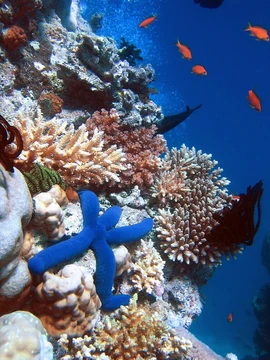
Just off Sri Lanka’s Kalpitiya peninsula lies the Bar Reef, a coral reef system that boasts the highest biodiversity of any reef in the waters surrounding India. It is also one of the few remaining pristine coral reef systems in the country. The reef complex runs parallel to the coast, stretching from the northern tip of the Kalpitiya peninsula to the islands that separate Portugal Bay from the Gulf of Mannar. Ecologically, biologically, and aesthetically significant, it hosts 156 coral species and 283 fish species. In 1992, the Bar Reef was designated a marine reserve covering 306.7 square kilometres.
For years, the reef received little management and faced threats from both natural sources—such as crown-of-thorns starfish, coastal erosion, and sedimentation—and human activities. In 1999, the Asian Development Bank funded a Coastal Resources Management Project in Sri Lanka aimed at integrated coastal resource management to improve sustainability. This project tackled coastal erosion, pollution, unregulated fishing, resource over-exploitation, and poverty in coastal areas. The Bar Reef became part of a Special Management Area that includes the northern Kalpitiya peninsula and the islands in Portugal Bay, where human activity directly affects the reef ecosystem. Key threats identified were overfishing (with a noticeable decline in fish numbers), destructive fishing methods like deep purse seining that damage coral and deplete fish stocks, and pollution from prawn farms and agriculture.
Quick Facts
- Location
- North Western Province, Sri Lanka
- Nearest City
- Puttalam & Kalpitiya
- Established
- 1992
- Governing Body
- Department of Wildlife Conservation
Facts from the source article.
Lore & Background
Bar Reef is a complex of reefs which stretch parallel to the coast from the northern end of the Kalpitiya peninsula to the islands which separate Portugal Bay from the Gulf of Mannar. It has high ecological, biological and aesthetic significance, being home to 156 species of coral and 283 species of fish. The Bar Reef was declared a marine reserve in 1992, covering 306.7 square kilometres (118.4 mi2).
For many years there was hardly any management of the Bar Reef and it was under threat both from natural enemies—crown-of-thorns starfish, coastal erosion and sedimentation—as well as from human activity. In 1999, the Asian Development Bank (ADB) decided to fund a Coastal Resources Management Project (CRMP) in Sri Lanka, to establish integrated management of coastal resources. The Bar Reef was declared part of a Special Management Area (SAM) composed of the northern part of the Kalpitiya peninsula and the islands in Portugal Bay; all areas where human activity impinges directly on the welfare of the reef ecosystem.
The threats to the ecosystem of the Bar Reef were identified as over-exploitation of fish resources (with an observable decline in the number of fish), unsuitable fishing methods (such as deep purse seining, which damage the coral and deplete fish resources) and pollution from human activities (prawn farms and agriculture).
Reader's Guide
Bar Reef is notable as the most biodiverse coral reef in the waters around India and one of the few pristine coral reef systems in Sri Lanka. Its declaration as a marine reserve in 1992 marked an early step toward protection, but for many years management was minimal. The reef faced threats from natural sources such as crown-of-thorns starfish, coastal erosion, and sedimentation, as well as from human activities including over-exploitation of fish, damaging fishing methods like deep purse seining, and pollution from prawn farms and agriculture. In 1999, the Asian Development Bank funded a Coastal Resources Management Project to address these issues, leading to the creation of a Special Management Area covering the northern Kalpitiya peninsula and Portugal Bay islands. The project aimed to improve sustainability of coastal resources by tackling coastal erosion, pollution, unmanaged fishing, over-exploitation, and poverty. The reef's significance lies in its high ecological and biological value, hosting 156 coral species and 283 fish species, and its role as a case study in integrated coastal management. Its legacy includes the recognition that human activity directly impinges on reef welfare, and the ongoing need to balance conservation with local livelihoods.
Did You Know?
- Bar Reef has the greatest biodiversity of any coral reef in the waters around India.
- Threats include crown-of-thorns starfish, coastal erosion, sedimentation, and pollution from prawn farms and agriculture.
Evolutionary Survival Strategies
Coral reefs are the product of millions of years of coevolution among algae, invertebrates, and fish, producing environments so crowded and intricate that inhabitants have had to develop remarkably ingenious survival tactics. Most reef-dwelling species belong to the ray-finned group, recognizable by the sharp bony rays and spines embedded in their fins. When threatened, many of these fish can lock their spines in an erected position, and some carry venom, making them a genuinely dangerous meal. Beyond physical defenses, reef fish rely heavily on behavioral adaptations. Small species shelter in crevices or form tight shoals for collective safety. Many claim a small home territory where every hiding spot is memorized and instantly accessible. Triggerfish take concealment to an extreme, squeezing into narrow gaps and wedging themselves in place by spreading their spines wide. Even herbivorous surgeonfish, which graze on benthic turf algae and offer cleaning services to sea turtles, will not tolerate another fish sharing their color or body shape, and when alarmed they slash opponents with rapid sideways tail movements.
Biodiversity and Geographic Range
Coral reef ecosystems harbor the most species-rich fish communities found anywhere on the planet, with estimates ranging from six thousand to eight thousand distinct species across the world's oceans. This extraordinary concentration is remarkable given that reefs cover less than one percent of the ocean surface yet support roughly a quarter of all marine fish species. Two principal regions of reef development are recognized: the vast Indo-Pacific, spanning the Pacific, Indian, and Red Sea waters, and the tropical western Atlantic, commonly called the greater Caribbean. Each region hosts a completely separate fauna with no natural species overlap between them. The Indo-Pacific is by far the richer, sheltering an estimated four to five thousand reef-associated fish species, while the greater Caribbean supports another five hundred to seven hundred. Scientists have debated for over fifty years what mechanisms initially drove and continue to sustain such dense assemblages. No single consensus exists, though likely contributors include the sheer structural complexity of reef habitats, the breadth and seasonal availability of food, larval settlement dynamics, and still-unresolved interactions among all these factors. The bulk of this diversity is filled by tiny, bottom-dwelling species.
Visual Language and Deception
Where open-water fish tend toward uniform silvery countershading, coral reef fish display a dazzling array of colors and patterns that serve multiple purposes. Some coloration provides camouflage against specific reef backgrounds, while others facilitate species recognition during mating. Bold contrasting markings can also function as warnings, signaling to would-be predators that the fish possesses venomous spines or toxic flesh. The foureye butterflyfish offers a masterclass in visual deception. A large dark spot ringed in brilliant white sits on the rear of each side, mimicking a false eye, while a black vertical bar runs through the true eye on the head, effectively erasing it. This dual trick can make a predator misjudge the fish's size and confuse front from back. When threatened, the butterflyfish's instinct is to flee, which places the false eyespot closer to the attacker than the real head. Most predators aim for the eyes, so the ruse tricks them into believing the fish will retreat tail-first. If escape fails, the butterflyfish may pivot to face its aggressor, head lowered and spines fully raised, resembling a bull preparing to charge. This posture either intimidates the predator or reminds it that the fish is too spiny to swallow comfortably.
Ecological Weight and Vulnerability
The ecological footprint of coral reefs is wildly disproportionate to their physical size. These structures occupy less than one percent of the world ocean surface, yet they shelter approximately twenty-five percent of all marine fish species, creating a stark contrast with the open-water habitats that fill the remaining ninety-nine percent. The richness of reef life is built on the tiny, bottom-dwelling fish that populate every nook and cranny of the coral structure, alongside the hundreds of species that can crowd a single healthy patch of reef, many of them hidden or expertly camouflaged. Yet this extraordinary concentration of life is under serious pressure. Habitat loss and degradation, rising pollution levels, and overfishing—including destructive fishing practices—are all threatening the survival of coral reefs and the fish communities that depend on them. The coevolutionary relationships forged over millions of years among algae, invertebrates, and fish have produced ecosystems of remarkable complexity, but the very specializations that make reef fish so successful in their confined world also make them vulnerable when that world is disrupted. The loss of reef area can cascade through a community, stripping away hiding places, food sources, and the behavioral routines that hold these populations together.
More in Coral Reefs 1-24
Spotted an error? Know more?
Reader corrections go straight into our review queue. Suggest an edit · How this site is sourced