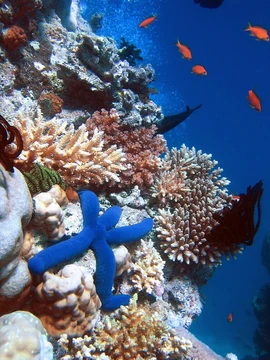
African coral reefs
African coral reefs span eastern, southern, and northwestern African coasts.

African coral reefs are the coral reefs present in Africa, primarily found along the eastern and southern coasts, extending from the Red Sea to Madagascar. They are notable as an important resource for fishers in Kenya, Tanzania, Mozambique, and Madagascar, and some cold-water reefs also exist off northwestern Africa near the Azores, Madeira, Canary Islands, and Cape Verde.
- East coast average temperature
- 26 °C (79 °F)
- East coast highest rainfall period
- January to April, about 300 mm (12 in)
- East coast lowest rainfall period
- August to November, about 100 mm (3.9 in)
- Coral mortality in 1997 98 el nino
- 90 percent
- Trawling ban region
- Azores, Canary Islands, Madeira
- Trawling ban regulation
- EU's Regulation (EC) No 2287/2003
Lore & Background
The east coast corals extend from the Red Sea to Madagascar, with average temperatures around 26 °C over the year. Rainfall peaks between January and April at about 300 mm, and is lowest from August to November at about 100 mm. These reefs support species such as the mantis shrimp, potato grouper, humphead wrasse, maxima clam, and many seaweeds and corals, being more biologically diverse than the surrounding ocean.
Western African reefs near the Azores, Canary Islands, and Madeira have a trawling ban initially set by EU's Regulation (EC) No 2287/2003. Multiple threats affect the eastern and southern reefs, including tourist diving, coral damage, sample taking, industrial run-offs, pollutants, untreated sewage, and increasing sediment flows in rivers. Climate change also threatens the reefs; a severe El Niño in 1997/98 killed 90 percent of corals. The CORDIO NGO has set up an East African task force to monitor reef management.
Reader's Guide
The significance of African coral reefs lies in their ecological and economic roles along the eastern and southern coasts, where they support fisheries for Kenya, Tanzania, Mozambique, and Madagascar. Their biological diversity exceeds that of the surrounding ocean, hosting species like mantis shrimp, potato grouper, humphead wrasse, and maxima clam. However, they face multiple threats: tourist activities, industrial run-offs, pollutants, untreated sewage, and increased sediment flows. Climate change, particularly the 1997/98 El Niño event that killed 90 percent of corals, underscores their vulnerability. In response, the CORDIO NGO established an East African task force to monitor reef management. Additionally, some western African reefs near the Azores, Canary Islands, and Madeira are protected by a trawling ban under EU Regulation (EC) No 2287/2003. The legacy of these reefs is tied to their ongoing degradation and the efforts to monitor and manage them, as documented by the source article.
Biological Foundations and Ecological Richness
Coral reefs are underwater ecosystems built from colonies of coral polyps cemented together by calcium carbonate. The primary architects are stony corals, whose polyps aggregate into tight clusters. Taxonomically, corals belong to the class Anthozoa within the phylum Cnidaria, a group that also includes sea anemones and jellyfish. What distinguishes corals from anemones is their secretion of hard carbonate exoskeletons that reinforce and protect the colony. They flourish in warm, shallow, clear, sunlit, and agitated waters. Their evolutionary history reaches back approximately 485 million years to the Early Ordovician, when they displaced the microbial and sponge reefs that had dominated the Cambrian.
Frequently called the rainforests of the sea, shallow reefs occupy a startlingly small footprint—less than 0.1% of the world's ocean area, roughly half the size of France—while harboring at least 25% of all marine species. This diversity encompasses fish, mollusks, worms, crustaceans, echinoderms, sponges, tunicates, and other cnidarians. These ecosystems thrive in ocean waters that offer few nutrients. Although most reefs are found at shallow tropical depths, smaller deep-water and cold-water reef communities persist in other regions.
Formation, Geology, and Darwin's Legacy
Most coral reefs are geologically young, the majority forming after the Last Glacial Period, when melting ice raised sea levels and flooded continental shelves. Corals survive only within a limited depth range just below low tide, so they grow upward to track rising seas; those that lag become drowned, starved of light needed by their symbiotic zooxanthellae. Most reefs are under 10,000 years old.
Charles Darwin, building on observations from the Beagle voyage, articulated his atoll-formation theory in The Structure and Distribution of Coral Reefs. He described a three-stage sequence: a fringing reef encircles a volcanic island as the island and ocean floor subside; further subsidence converts it into a barrier reef with an enclosed lagoon; and once the island sinks below sea level, a roughly circular atoll persists. Darwin predicted a bedrock base beneath every lagoon, a claim later confirmed by research.
The Great Barrier Reef demonstrates these principles on a continental shelf. About 20,000 years ago, sea level stood 120 metres lower; as waters rose, corals overgrew coastal hills to form the world's largest barrier reef, stretching 2,000 kilometres. Healthy tropical reefs grow 1–3 cm horizontally and 1–25 cm vertically per year, but only at depths shallower than 150 metres.
Decline and the Web of Threats
Shallow tropical coral reefs have lost roughly half their extent since 1950, a decline driven by their acute sensitivity to changes in water conditions. Among the most pressing threats is the influx of excess nutrients, particularly nitrogen and phosphorus, which disrupt the delicate balance these nutrient-poor ecosystems depend upon. Rising ocean heat content and progressive acidification further stress coral physiology, while overfishing—whether through blast fishing, cyanide fishing, or spearfishing by scuba divers—strips the reefs of the species that maintain their ecological integrity.
Human activity on land compounds these pressures. Runoff and seeps from injection wells and cesspools carry pollutants into coastal waters, degrading the clarity and chemistry corals require. Even sunscreen use by swimmers and snorkelers has been identified as a contributing factor to reef degradation.
The combination of these pressures paints a sobering picture: the very conditions that allowed reefs to flourish for millennia—warm, clear, agitated, nutrient-poor water—are being eroded from multiple directions simultaneously, outpacing the slow growth rates of one to three centimetres per year that healthy tropical reefs achieve.
Economic Value and Ecosystem Services
Coral reefs deliver ecosystem services that underpin human livelihoods worldwide, supporting tourism, sustaining fisheries, and providing natural shoreline protection. The economic significance of these services is staggering, though estimates vary widely depending on methodology and year.
Early assessments from 1997 and 2003 placed the annual global economic value of coral reefs between US$30 billion and US$375 billion. A 2014 estimate pushed that figure to US$9.9 trillion, while a 2020 assessment settled at US$2.7 trillion. The enormous spread reflects the difficulty of quantifying services that are diffuse, long-term, and often invisible until lost.
What is unambiguous is the disproportionate value these ecosystems generate relative to their footprint. Covering less than 0.1% of the ocean—roughly half the area of France—coral reefs nonetheless shelter at least a quarter of all marine species. Their loss would cascade through tourism revenue, the fisheries that depend on reef habitats, and the natural coastal defence they provide. The halving of shallow tropical reefs since 1950 thus represents not merely an ecological tragedy but a measurable contraction of global wealth.
More in Coral Reefs 1-24
Spotted an error? Know more?
Reader corrections go straight into our review queue. Suggest an edit · How this site is sourced