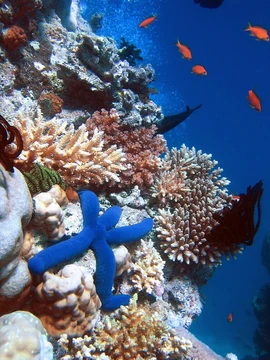
Aquaculture of coral
Coral farming cultivates corals for restoration and trade.

Coral aquaculture—also called coral farming or coral gardening—involves raising corals for commercial use or to restore damaged reefs. This method is emerging as a promising way to help revive coral reefs, which are declining worldwide. It shields young corals during their most vulnerable stage. Small corals are grown in nurseries and later transplanted onto reefs. Scientists also farm corals for research, businesses supply the live ornamental coral trade, and private aquarium hobbyists cultivate them.
The process, often called the "gardening method," begins by taking a fragment of a coral colony or free-floating larvae from a reef. These are raised in a nursery until they are ready for successful outplanting. This approach has been compared to silviculture, as it mimics natural ecosystems. Adult corals can be moved onto a reef, typically in areas that have been damaged. For conservation purposes, coral farming takes place in the Philippines, Israel, Solomon Islands, Palau, Fiji, Marshall Islands, and Japan. Land-based coral farming occurs in public aquariums across North America and Europe.
Healthy reefs support a wide range of biodiversity, including many coral species. They rely on herbivores like parrotfish and collector urchins to graze on algae. Most corals need clear, nutrient-poor water, known as oligotrophic conditions. Corals get nutrients from zooxanthellae symbionts, as well as from plankton and other floating particles. Zooxanthellae require a mix of white and blue light, depending on the coral type. Some corals, such as the orange cup coral, do not need light and survive on plankton or free-floating nutrients. Coral reefs also protect coastlines from erosion and storm damage. As foundation species, they boost biodiversity by providing nursery grounds and habitat for nearly one-third of saltwater fish species, including ten percent of fish caught for human consumption—even though reefs cover less than one percent of the ocean's surface.
Reefs face many threats: severe weather like cyclones, temperature shifts of 1–2 degrees from the average over weeks, predation by crown-of-thorns starfish, and competition with algae. Algae can overtake coral habitats when water has excess nitrogen and phosphorus, or when fishing depletes herbivorous fish that normally control algae.
- Percentage of world reefs under threat a
- 58%
- Reef cover percentage of ocean surface
- less than one percent
- Percentage of saltwater fish species tha
- nearly one-third
- Percentage of fish captured for human co
- ten percent
- Recommended nursery depth in metres
- 6
- Time in nursery before transplantation i
- 8 to 24
- Survival rate of stylophora pistillata a
- more than 89%
Lore & Background
Coral reef farming involves extracting a part of a coral colony or free-floating larvae from a reef, and growing them in a nursery until outplanting would be successful. It is commonly referred to as the 'gardening method' and has been compared to silviculture as a management practice that mimics natural ecosystems. Adult corals can be transplanted onto a reef, usually in a damaged area. Coral is farmed for conservation reasons in the Philippines, Israel, Solomon Islands, Palau, Fiji, Marshall Islands, and Japan. Land-based coral farming occurs in public aquariums in North America and Europe.
Oceanographer Baruch Rinkevich coined the term active restoration to describe coral reef farming, in contrast with what he described as passive restoration efforts focused on mitigation of stressors by means such as the designation of marine protected areas (MPAs). Coral reefs are often placed in MPAs in the hope that reducing human activity will allow the coral to recover. Coral propagation can improve coral cover, biodiversity, and structural heterogeneity of a degraded reef. Success has been achieved with fire coral, Pocillopora verrucosa, and Acropora hemprichii.
Most coral farms that are utilized for the mitigation of damage are only able to propagate the fast-growing corals that are easy to grow. Slow-growing corals are expensive to propagate and are not a fast-growing foundation species, which is needed when damage occurs. Most coral reefs will take decades to return to their previous state. Nursery-grown coral promote reef resilience by making contributions to the larval pool.
Reader's Guide
Coral aquaculture is notable as a tool for restoring coral reefs, which are dying off around the world. The process protects young corals during their most vulnerable stage. It is used by scientists for research, by businesses for the live and ornamental coral trade, and by private reef aquarium hobbyists. The 1999 Hawaii Marine Ornamentals Conference recommended giving highest priority to projects involving the advancement of marine ornamental aquaculture and reef preservation, and encouraged hobbyists to supply only from coral reef farms to help deter over-harvesting. Cultured ornamentals were described as a more sustainable and 'higher value' alternative to wild-caught live reef organisms.
For conservation, the stages are: collecting polyps or larvae; growing the specimens in tanks; further growth in sea nurseries; and re-transplantation onto the reef. Collection can be done by taking branches or fragments from existing colonies, or by collecting coral spawn during synchronized spawning events. Tank cultivation uses apparatus such as Petri dishes lined with preconditioned paper disks. Ocean cultivation involves floating nurseries at about 6 metres depth, where corals are affixed to artificial substrates and remain for 8 to 24 months before transplantation. For commercial supply, the ocean cultivation is extended until colonies reach marketable size, then extracted and packaged for sale.
Coral aquaculture addresses the decline of reefs caused by severe weather, temperature changes, predation by crown of thorns starfish, competition with algae, and anthropogenic stressors such as runoff, coastal development, dynamite fishing, cyanide fishing, overexploitation, and marine pollution. Overharvesting of coral for jewelry and curio trades, such as mushroom coral in Indonesia, weakens reef replenishment. Restored reefs host associated organisms like reef fishes, but it is difficult to replicate a damaged reef's original state.
Did You Know?
- Coral aquaculture is also called coral farming or coral gardening.
- Oceanographer Baruch Rinkevich coined the term 'active restoration' for coral reef farming.
- The 1999 Hawaii Marine Ornamentals Conference recommended prioritizing marine ornamental aquaculture and reef preservation.
Biodiversity and Geographic Distribution
Coral reef ecosystems house the most concentrated assemblages of fish species found anywhere on the planet, with estimates ranging from six thousand to eight thousand distinct species inhabiting these underwater landscapes. Remarkably, these reefs cover less than one percent of the ocean's surface yet shelter roughly a quarter of all marine fish species. Two major geographic regions dominate coral reef development: the Indo-Pacific, spanning the Pacific, Indian Oceans, and the Red Sea, and the tropical western Atlantic, often called the greater Caribbean. These two faunas share no natural species overlap. The Indo-Pacific is by far the richer, hosting an estimated four to five thousand reef-associated fish species, while the greater Caribbean supports another five hundred to seven hundred. Scientists have debated for half a century what drives and sustains such extraordinary concentrations. No single consensus exists, but contributing factors likely include the structural complexity of the habitat, the temporal variety of food resources, larval settlement processes, and still-unresolved interactions among all these elements.
Physical Adaptations and Body Morphology
Unlike open-water species built for speed with torpedo-like streamlined bodies, reef fish prioritize manoeuvrability over straight-line velocity. Operating within the tight, intricate architecture of coral structures, these fish have evolved body forms optimized for rapid darting and direction changes. Many species, including butterflyfish and angelfishes, possess deep, laterally compressed bodies resembling flat pancakes. Their pelvic and pectoral fins are structurally distinct, working in concert with the flattened torso to maximize agility through narrow fissures and around coral heads. Most reef fish belong to the ray-finned group, characterized by sharp bony rays and spines in their fins. These spines serve as formidable defensive weapons; when erected, they can often be locked rigidly in place or may deliver venom. This combination of body geometry and armament allows reef inhabitants to outwit predators by slipping into crevices or playing hide-and-seek among the coral, turning the reef's complexity into a living fortress.
Behavioural Strategies and Survival Tactics
Reef fish have developed a remarkable repertoire of adaptive behaviours to survive in one of the ocean's most crowded and predator-rich environments. Small species seek safety by sheltering in reef crevices or by forming shoals and schools, diluting individual risk through collective movement. Many individuals restrict themselves to a single small neighbourhood where every potential hiding spot is memorized and instantly accessible. Others patrol the reef in groups while foraging, yet return to a familiar home area whenever they become inactive. Even at rest, small fish remain vulnerable to crevice predators, so species like triggerfish squeeze into tight spaces and wedge themselves firmly by erecting their spines. Surgeon fishes, for instance, are herbivorous grazers of benthic turf algae that also perform cleaning services for marine turtles, removing algal growth from their shells. Notably, surgeon fishes refuse to tolerate other fish sharing their colour or shape, and when threatened they can raise tail spines and slash opponents with rapid sideways strikes.
Colouration and Visual Deception
Where open-water fish typically display muted silvery countershading, coral reef inhabitants showcase an astonishing array of dazzling and sometimes bizarre colour patterns. These markings serve multiple purposes: camouflage against specific reef backgrounds, species recognition during mating, and aposematic warnings signalling venomous spines or toxic flesh to would-be predators. The foureye butterflyfish offers a striking example of visual deception. A large dark spot ringed in brilliant white sits on the rear portion of each side, mimicking a false eye, while a black vertical bar crosses the true eye to conceal it. When threatened, the fish's instinct is to flee, placing the false eyespot closer to the predator than the actual head. Most predators target the eyes, so this trick convinces them the fish is larger and will retreat tail-first. If escape fails, the butterflyfish may pivot to face its aggressor with head lowered and spines fully erect, mimicking a charging bull to intimidate or remind the predator that the fish is far too spiny to swallow comfortably.
More in Coral Reefs 1-24
Spotted an error? Know more?
Reader corrections go straight into our review queue. Suggest an edit · How this site is sourced