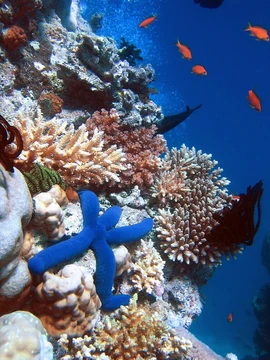
Belize Barrier Reef
Second largest coral reef system, home to diverse marine life.

Stretching along Belize’s coast, the Belize Barrier Reef runs from about 300 meters offshore in the north to 40 kilometers out in the south. It forms a 300-kilometer segment of the larger Mesoamerican Barrier Reef System, which spans 900 kilometers from Cancún through the Riviera Maya to Honduras. This makes it the world’s second-largest coral reef system, behind only Australia’s Great Barrier Reef. The reef is Belize’s top draw for tourists, especially scuba divers and snorkelers, pulling in nearly half of the country’s 260,000 annual visitors. It also underpins the local fishing industry. In 1842, Charles Darwin called it “the most remarkable reef in the West Indies.”
Beyond the main barrier, Belize has three distinct Caribbean atolls: Turneffe Atoll, Glover’s Reef, and Lighthouse Reef. Lighthouse Reef, the easternmost diving spot in Belize, is famous for the Great Blue Hole, which Jacques Cousteau brought to global attention in 1970. Turneffe Atoll sits directly east of Belize City and is the closest atoll to that city. These reefs offer a wide range of scuba diving environments, including walls, pinnacles, and reef flats spread across a vast area of sea.
The reef hosts an impressive variety of life: 70 species of hard coral, 36 species of soft coral, 500 species of fish, and hundreds of invertebrate species. Because 90 percent of the reef remains unexplored, scientists estimate that only 10 percent of its total species have been identified.
Much of the reef falls under the Belize Barrier Reef Reserve System, a protected area covering 960 square kilometers. It includes seven marine reserves, 450 cayes, and three atolls. Among the reserves are Glover’s Reef Marine Reserve, the Great Blue Hole, South Water Caye Marine Reserve, Half Moon Caye Natural Monument, and Hol Chan Marine Reserve. Notable cayes include Ambergris Caye, Caye Caulker, Caye Chapel, Carrie Bow Caye, St. George’s Caye, English Caye, Rendezvous Caye, Gladden Caye, Ranguana Caye, Long Caye, Moho Caye, Blackbird Caye, Three Corner Caye, Northern Caye, Tobacco Caye, and Sandbore Caye. In 1996, UNESCO designated the reserve system a World Heritage Site, citing its vulnerability and its critical natural habitats for conserving biodiversity (criteria VII, IX, and X).
Quick Facts
- Location
- Belize
- Nearest City
- Belize City, Belize
Facts from the source article.
Lore & Background
Charles Darwin described the Belize Barrier Reef as 'the most remarkable reef in the West Indies' in 1842. In addition to its barrier reef, it boasts three distinct Caribbean atolls: Turneffe Atoll, Glover's Reef and Lighthouse Reef. Lighthouse Reef is the most easterly diving area in Belize and is home to the Great Blue Hole, made famous by Jacques Cousteau in 1970; Turneffe Atoll lies directly to the east of Belize City and is the nearest of the atolls to that city. These different reefs provide diverse scuba diving opportunities that include walls, pinnacles and reef flats located throughout an enormous area of sea.
The reef is home to 70 hard coral species, 36 soft coral species, 500 species of fish, and hundreds of invertebrate species. With 90% of the reef still needing to be researched, it is estimated that only 10% of all species have been discovered. A large portion of the reef is protected by the Belize Barrier Reef Reserve System, which includes seven marine reserves, 450 cayes, and three atolls, totaling 960 square kilometres. In 1996 the reserve system was designated a World Heritage Site due to its vulnerability and the fact that it contains the most important and significant natural habitats for in-situ conservation of biological diversity.
Belize became the first country in the world to completely ban bottom trawling in December 2010, and in December 2015 banned offshore oil drilling within 1 km of the Barrier Reef. Despite these protective measures, the reef remains under threat from oceanic pollution, uncontrolled tourism, shipping, fishing, hurricanes, and global warming. Scientists claim that over 40% of Belize's coral reef has been damaged since 1998. The first mass bleaching occurred in 1995, with an estimated mortality of 10 percent of coral colonies, and a second mass-bleaching event occurred when Hurricane Mitch struck in 1998, with biologists observing a 48 percent reduction in live coral cover across the Belize reef system.
Reader's Guide
The Belize Barrier Reef is notable as the second largest coral reef system in the world and a key section of the Mesoamerican Barrier Reef System. It is Belize's top tourist destination, drawing nearly half of the country's 260,000 visitors for scuba diving and snorkeling, and it supports the nation's fishing industry. Charles Darwin praised it in 1842. The reef includes three atolls—Turneffe, Glover's, and Lighthouse—the latter hosting the Great Blue Hole, popularized by Jacques Cousteau in 1970. Its biodiversity includes 70 hard coral species, 36 soft coral species, 500 fish species, and hundreds of invertebrates, though 90% of the reef remains unexplored, with only 10% of species discovered. The Belize Barrier Reef Reserve System, a World Heritage Site since 1996, protects 960 square kilometres including seven marine reserves and 450 cayes. Belize banned bottom trawling in 2010 and offshore oil drilling within 1 km of the reef in 2015. However, threats persist: oceanic pollution, uncontrolled tourism, shipping, fishing, hurricanes, and global warming have damaged over 40% of the reef since 1998. Mass bleaching events in 1995 and 1998 caused significant coral mortality, and in-situ temperature measurements from 2004 to 2014 in a lagoon habitat showed a gradual warming trend from about 22.3 °C to 32.4 °C, increasing thermal stress. The reef's relatively sparse human population and enclosed area make it easier to distinguish human from natural causes of bleaching, but continuous bleaching leaves little chance of recovery.
Did You Know?
- The Great Blue Hole, located at Lighthouse Reef, was made famous by Jacques Cousteau in 1970.
- Scientists estimate that only 10% of all species in the reef have been discovered, with 90% still needing research.
Geographic Scale and Global Standing
The Belize Barrier Reef stretches roughly 300 kilometres along the nation's coastline, sitting approximately 300 metres offshore in the northern reaches and extending as far as 40 kilometres out in the south. It forms a vital segment of the far larger Mesoamerican Barrier Reef System, a continuous underwater structure running from Cancún at the tip of the Yucatán Peninsula, down through the Riviera Maya, and all the way to Honduras—spanning some 900 kilometres in total. This makes the entire system the second-largest coral reef network on Earth, trailing only Australia's Great Barrier Reef. As early as 1842, Charles Darwin singled it out, calling it the most remarkable reef in the West Indies. Today the reef anchors Belize's tourism economy, drawing nearly half of the country's 260,000 annual visitors for scuba diving and snorkeling, while simultaneously serving as a lifeline for the local fishing industry.
Living Diversity and the Underwater Landscape
Beneath the surface, the reef harbours an extraordinary catalogue of life: seventy species of hard coral, thirty-six varieties of soft coral, roughly five hundred fish species, and hundreds of invertebrate species. Yet scientists estimate that only about ten percent of all species present have actually been identified, meaning the vast majority of this ecosystem remains uncharted. Beyond the main barrier structure, three Caribbean atolls—Turneffe, Glover's, and Lighthouse—add further complexity to the diving landscape. Lighthouse Reef, the most easterly of the three, is home to the Great Blue Hole, a feature brought to global attention by Jacques Cousteau in 1970. Turneffe Atoll sits directly east of Belize City, making it the closest of the atolls to that urban centre. Together, these formations offer divers an enormous spread of underwater terrain, from sheer walls and rocky pinnacles to broad reef flats, all scattered across a vast expanse of Caribbean sea.
Conservation Framework and Legal Protections
To safeguard this fragile ecosystem, Belize established the Belize Barrier Reef Reserve System, a protected area encompassing seven marine reserves, 450 cayes, and all three atolls, covering a total of 960 square kilometres. Named reserves within this system include Glover's Reef, the Great Blue Hole, South Water Caye, Half Moon Caye, and Hol Chan, among others. In 1996, UNESCO designated the reserve a World Heritage Site, citing its vulnerability and its role as a critical habitat for in-situ conservation of biological diversity under criteria VII, IX, and X. Belize also made history in December 2010 by becoming the first nation to impose a complete ban on bottom trawling, and in December 2015 it prohibited offshore oil drilling within one kilometre of the barrier reef. Despite these landmark legislative steps, the reef continues to face pressure from oceanic pollution, uncontrolled tourism, shipping traffic, and fishing activities, alongside the broader forces of climate change.
Bleaching Events and the Struggle for Recovery
The reef has endured repeated mass-bleaching episodes that have taken a severe toll on its coral communities. The first major event struck in 1995, killing an estimated ten percent of coral colonies, according to the Coastal Zone Management Institute. A far more devastating blow came with Hurricane Mitch in 1998, after which biologists recorded a 48 percent reduction in live coral cover across the entire system. Scientists estimate that over forty percent of Belize's coral reef has been damaged since 1998. In-situ temperature readings taken in the lagoon off Wee Wee Cay between 2004 and 2014 revealed a steady warming trend, with temperatures climbing from roughly 22.3 degrees Celsius to 32.4 degrees Celsius, signalling growing thermal stress. Once bleached, corals become highly susceptible to disease, which often claims more colonies than the initial bleaching event itself. With repeated bleaching cycles, the reef's capacity for natural recovery diminishes sharply, leaving scientists to warn that continued stress could prove irreversible.
More in Coral Reefs 1-24
Spotted an error? Know more?
Reader corrections go straight into our review queue. Suggest an edit · How this site is sourced