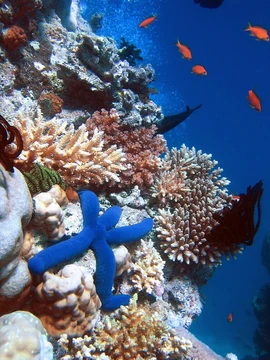
Resilience of coral reefs
Resilience is the capacity to resist and recover from disturbances.

Coral reef resilience describes how well these ecosystems can withstand disturbances—both natural, like storms, and human-caused, such as bleaching events—and then bounce back afterward. In broader terms, resilience is the ability of a biological or social system to keep performing its essential functions or to adjust when faced with environmental pressures and stresses. For reefs specifically, it measures their capacity to cope with shifts in ocean chemistry, sea level, and sea surface temperature. A reef’s overall ability to recover from events like ocean acidification depends on both its resistance (holding firm) and its resilience (rebounding). The natural processes that give reefs this resilience can serve as a model for recovery efforts and offer a management opportunity within marine protected areas (MPAs).
**Mechanisms of resilience**
**Thermal tolerance** Most corals depend on symbiotic algae called zooxanthellae, which provide 60 to 85 percent of their nutrition through photosynthesis. Even a slight rise in sea surface temperature can kill these algae, causing the coral to lose them and turn white—a process known as bleaching. Whether a coral can handle heat stress may come down to the type of symbiont it hosts, which are classified into genetic groups called clades (A through H). Research shows that some corals harbor thermally resistant clades. For instance, corals that mainly host clade D symbionts, or certain heat-tolerant types of clade C symbionts, tend to bleach less severely than others under the same stress. Scientists are still debating whether this thermal resistance comes from a shift or mixing of symbiont types, or from the presence of heat-tolerant versus heat-sensitive strains. Corals that host multiple types of zooxanthellae can withstand a temperature change of 1 to 1.5 °C, but only a few coral species are known to do this. After repeated bleaching events, corals are more likely to contain clade D symbionts.
**Biodiversity and functional diversity** Both the number of species and the variety of ecological roles they play influence how coral reef ecosystems function and how resilient they are. Higher coral species richness tends to boost ecosystem performance—for example, by supporting reef growth and structural development—but this relationship is not linear.
- Nutrition from zooxanthellae
- 60-85%
- Energy from photosynthesis
- 80-90%
- Temperature change tolerance
- 1–1.5 °C
- Symbiont clades
- A-H
- Clade associated with thermal tolerance
- D
Lore & Background
Mechanisms of resilience include thermal tolerance, which is influenced by symbiotic algae called zooxanthellae. Corals obtain about 60-85% of their total nutrition from these symbionts. Slight increases in sea surface temperature can cause zooxanthellae to die, leading to bleaching. Differences in symbionts, determined by genetic groupings (clades A-H), may explain thermal tolerance. Research has shown that corals housing primarily clade D symbionts, and certain types of thermally resistant clade C symbionts, allow corals to avoid bleaching as severely. Scientists remain in debate if thermal resistance is due to mixing or shifting of symbionts, or thermally resistant versus thermally-sensitive types. Species housing multiple types of zooxanthellae can withstand a 1–1.5 °C change in temperature, though few species are known to do so. Corals are more likely to contain clade D symbionts after multiple bleaching events.
Biodiversity and functional diversity both influence ecosystem functioning and resilience. Higher coral species richness has been associated with improved ecosystem performance, though the relationship is non-linear, with benefits increasing rapidly at lower diversity levels and leveling off at higher levels. Functional diversity varies across regions and is not always directly correlated with species richness. A global analysis found that some regions with high species richness exhibit relatively low functional diversity, indicating functional similarity among species. This variation in functional trait diversity suggests reefs differ in the distribution of ecological functions, influencing their responses to environmental change.
Reader's Guide
The significance of coral reef resilience lies in its role in recovery after disturbances such as ocean acidification, storms, and bleaching. Natural resilience processes can serve as a recovery model and offer opportunities for management in marine protected areas. Research on the Mediterranean species Oculina patagonica shows that endolithic algae in coral skeletons may provide additional energy during bleaching, aiding survival and rapid recovery. A study by the Australian Research Council proposed that loss of fast-growing coral could lead to less resilience of remaining coral, and that the Indo-Pacific may be more resilient than the Caribbean based on herbivory and algal bloom rates. Coral bleaching is a major consequence of stress, but corals can restore from bleaching if stress is not chronic. Herbivorous reef fish, like parrotfish, maintain levels of macro algae, contributing to a stronger, more resilient reef. When corals become bleached, organisms often leave, removing the services they supplied. Reefs also provide ecosystem services such as food provision for people dependent on fishing. There is evidence that some coral species are resilient to elevated sea surface temperatures for a short period. Anthropogenic forces such as pollution, sedimentation, and ocean acidification reduce resiliency.
Did You Know?
- Corals housing primarily clade D symbionts can avoid bleaching as severely as others under the same stressor.
- Few species of coral are known to house multiple types of zooxanthellae, which can withstand a 1–1.5 °C temperature change.
Biodiversity in a Tiny Ocean Footprint
Coral reefs are often called the rainforests of the sea, a comparison that captures how these underwater ecosystems pack extraordinary biological richness into a remarkably small footprint. Shallow tropical reefs occupy less than one-tenth of one percent of the global ocean surface—an area roughly equivalent to half of France—yet they shelter at least a quarter of all known marine species. This includes fish, mollusks, worms, crustaceans, echinoderms, sponges, tunicates, and other cnidarians. What makes this diversity especially striking is that coral reefs thrive in waters that are nutrient-poor, meaning the ecosystem's productivity is driven by the symbiotic relationship between corals and their photosynthetic partners rather than by abundant dissolved nutrients. Most reefs flourish in warm, shallow, clear, and sunlit waters where wave action keeps the water agitated. While the vast majority of reef habitats are found in tropical zones, smaller deep-water and cold-water coral communities also exist in other parts of the ocean, showing that the fundamental architecture of reef-building can operate under a wider range of conditions than the classic tropical image suggests.
How Reefs Take Shape: Darwin's Sequence and Beyond
The physical shape of a coral reef is governed by two principal variables: the nature of the substrate beneath it and the history of sea-level change relative to that substrate. Charles Darwin, drawing on observations from the voyage of the Beagle, proposed a three-stage sequence for atoll formation. A fringing reef first develops around a volcanic island as the land and ocean floor slowly subside. Continued sinking transforms the fringing reef into a barrier reef enclosing a lagoon, and if the island eventually drops below sea level, a roughly circular atoll remains, with the coral continuing to grow upward to stay within its narrow depth range. Darwin predicted that bedrock—the remnant of the original volcano—would lie beneath each lagoon, a prediction later confirmed by research. The Great Barrier Reef illustrates a different pathway: formed on a continental shelf roughly 20,000 years ago when sea level was 120 meters lower, it grew as rising waters encroached on coastal hills, eventually producing the world's largest barrier reef stretching 2,000 kilometers. Because Australia is not subsiding, the reef never progressed to the atoll stage.
A Half-Century of Loss and Compounding Stress
Since 1950, shallow tropical coral reefs have lost approximately half of their extent, a decline driven by their inherent sensitivity to changes in water conditions. Several anthropogenic pressures compound one another. Excess nutrients—nitrogen and phosphorus from agricultural runoff and seeps from injection wells or cesspools—disrupt the delicate chemical balance reefs depend on. Rising ocean heat content and increasing acidification stress the calcium carbonate skeletons that hold colonies together. Overfishing practices such as blast fishing, cyanide fishing, and spearfishing on scuba remove the biological communities that maintain reef health. Even sunscreen chemicals and broader harmful land-use practices add further stress. The result is a cascading vulnerability: corals that rely on zooxanthellae for photosynthesis can die when water becomes too warm, too acidic, or too turbid for their symbionts to function. Because most reefs grow only at depths shallower than 150 meters and cannot extend above sea level, their vertical range is fixed, leaving them with little room to adapt as conditions shift.
Economic Stakes of a Living Underwater Infrastructure
Coral reefs deliver a suite of ecosystem services that underpin human economies in ways that are difficult to overstate. They support tourism by providing the vivid underwater landscapes that draw visitors worldwide. They sustain fisheries by offering nursery habitats and feeding grounds for countless marine species. They also serve as natural breakwaters, protecting shorelines from wave energy and storm surge. The monetary value attached to these services has been estimated across a wide range: figures from 1997 and 2003 placed the annual global economic contribution between US$30 billion and US$375 billion, a 2014 estimate pushed the figure to US$9.9 trillion, and a 2020 estimate suggested US$2.7 trillion. The enormous spread among these valuations reflects the difficulty of quantifying indirect benefits such as coastal protection and biodiversity maintenance. What is clear is that the economic stakes are immense relative to the tiny fraction of ocean area reefs occupy, making their preservation a matter of both ecological and financial consequence.
More in Coral Reefs 1-24
Spotted an error? Know more?
Reader corrections go straight into our review queue. Suggest an edit · How this site is sourced