Coral reef protection
Modifying human activities to protect and help recover coral reefs.

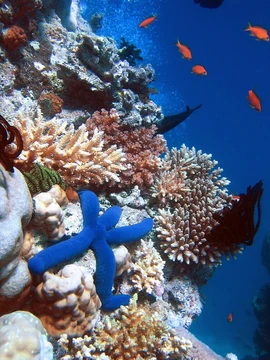
Coral reef protection means changing what people do so that healthy reefs aren't harmed and damaged reefs can bounce back. The main approaches are setting clear goals, managing activities actively, and getting local communities involved to cut down on the stresses that hurt reefs. One common tool is creating Marine Protected Areas (MPAs), which restrict things like fishing. Recreational scuba diving can noticeably damage tropical coral reefs, mostly when divers accidentally hit brittle, branching stony corals. The worst harm usually comes from fins striking the coral, along with hands, knees, and equipment gauges. This damage can be reduced by teaching divers better buoyancy and body position, and by explaining how clumsy behavior hurts the reef. Divers who get a 45-minute talk on coral biology and protected areas, plus a quick in-water demo, tend to cause less damage during their dive. It takes about 10,000 years for coral polyps to build a reef, and anywhere from 100,000 to 30 million years for a fully mature reef to form. Coral reefs are among the most productive and biologically diverse ecosystems on Earth. Differences in wave exposure create various habitat types. Corals need a mutualistic relationship with zooxanthellae algae to build a reef. These single-celled algae get nutrients through photosynthesis, and the coral gives them shelter in exchange for some of those nutrients. Zooxanthellae can die off when environmental conditions change, causing the coral to lose its color—a process called coral bleaching. A rise in water temperature, for example, stresses corals and forces them to expel their zooxanthellae. Without the algae, corals starve because they lose the sugar food source the algae provided. The vibrant colors of corals that rely on these algae come from the different zooxanthellae species living inside them. Corals provide millions of people with ecosystem services like fisheries, medicine, tourism, recreation, coastal protection, and cultural and aesthetic benefits—yet they make up only 0.2% of the world's marine ecosystems. Often called the "rainforests of the sea," coral reefs cover less than 10% of the ocean yet provide a habitat to over 9 million species, approximately one fourth of all marine life, for food, shelter, and even hunting grounds for predators.
- Reef formation time
- approximately 10 thousand years for coral polyps to form a reef, and between 100,000 and 30 million years for a fully mature reef to form
- Coral reef coverage
- 0.2% of the world's marine ecosystems
- Marine species harbored
- over 9 million species, approximately one fourth of all marine life
- People living near reefs
- approximately 500 million people within 100 km of coral reefs
- Global fisheries income
- $5.7 billion of net income provided by coral reefs
- Tourism revenue
- about $9.6 billion through diving tours, recreational fishing trips, hotels, and restaurants
Lore & Background
Recreational scuba diving can have a measurable adverse impact on tropical coral reefs, mostly due to contact damage of brittle and fragile branched stony corals. The most common damages occur when fins strike corals, as well as hands, knees, and equipment gauges. This can be reduced by improving diver buoyancy and trim skills, and by educating divers on the consequences of clumsy behavior. Divers given a 45-minute presentation on coral biology and protected areas combined with a brief in water demonstration have been shown to cause less damages to corals during their dive.
Reader's Guide
Coral reef protection is notable because coral reefs are among the most productive and biologically diverse ecosystems on Earth, yet they constitute a mere 0.2% of the world's marine ecosystems. They provide millions of people with ecosystem services such as fisheries, medicine, tourism, recreation, coastal protection, and aesthetic and cultural benefits. Over a billion people globally depend on fish from coral reefs as a major food source, and local economies receive about $9.6 billion through diving tours and related activities. The warming waters, ocean pH changes, and sea level rise associated with climate change operate on a global basis as stressors, while localized examples include runoff, sedimentation, sewage, and toxic discharges. Acute stressors include unsustainable fishing practices, boat anchors, and accidental groundings. Scuba diving has grown in popularity during the 21st century, and the expanding impact of divers can adversely affect the marine environment. Tropical coral reefs are more easily damaged by poor diving skills than more robust environments. The same pleasant sea conditions that allow development of delicate and highly diverse ecologies also attract the greatest number of tourists, including divers who dive infrequently and never fully develop environmentally friendly skills.
Did You Know?
- It takes approximately 10 thousand years for coral polyps to form a reef.
- Approximately 500 million people live within 100 km of coral reefs and rely on them for coastal protection.
Geographic Spread and Reef Types
India's coral reef systems span a remarkable range of locations along its 7,517-kilometer coastline, of which 6,100 kilometers belong to the mainland. The primary reef habitats cluster in the Andaman and Nicobar Islands, the Gulf of Mannar, the Gulf of Kutch, the Palk Strait, and the Lakshadweep archipelago. A key distinction runs through these sites: every one of them is classified as a fringing reef, with the sole exception of Lakshadweep, where the formations take the form of true atolls. Beyond these major concentrations, smaller coral communities persist in unexpected places. Patchy corals cling to inter-tidal zones along the central west coast, including areas around Ratnagiri and Gaveshani Bank. Hermatypic corals, the reef-building variety, stretch along the shoreline from Kollam in Kerala all the way to Enayam Puthenthurai in Tamil Nadu. Even the Gulf of Khambat on the western coast hosts modest reefs in small inlets, while Angria Bank off Vijaydurg and the smaller Tarkarli reef in Malwan, Maharashtra, add further examples to the national inventory.
The Research and Institutional Ecosystem
Protecting India's coral reefs is not the work of a single agency; it is a collaborative effort spanning government ministries, universities, and specialized research bodies. The Ministry of Earth Sciences sits at the center of this network, supported by the Zoological Survey of India, the Central Marine Fisheries Research Institute, and the National Institute of Oceanography. Academic institutions such as Madurai Kamaraj University and Annamalai University contribute field-level expertise, while the National Centre for Earth Science Studies and the National Institute of Ocean Technology bring additional scientific depth to the mission. One particularly modern dimension of this work comes from the Space Applications Centre in Ahmedabad, which employs remote sensing technology to gather data on reef areas from orbit. This satellite-based approach allows researchers to monitor vast stretches of coastline and island groups that would be impractical to survey by boat alone. Together, these institutions form a layered architecture in which policy, field biology, ocean engineering, and space technology all converge on the shared goal of understanding and safeguarding India's reef ecosystems.
Legal Frameworks and Regulatory Safeguards
The legal architecture surrounding India's coral reefs operates on multiple levels. At the national level, the Ministry of Environment, Forest and Climate Change issues the overarching guidelines and management directives that govern reef protection. When a reef area falls within a designated protected zone, jurisdiction shifts to the relevant State Wildlife Department, creating a two-tier governance structure. The most significant regulatory instrument is the Coastal Regulation Zone notification of 1991, which extends protection to all marine resources along the coast. Under this framework, every type of coral reef is classified under the CRZ1 category, the most restrictive designation. Section 7(2) of the CRZ rules explicitly prohibits the construction of beach resorts or hotels on coral reef areas, drawing a clear line between tourism development and ecological preservation. At the state level, additional restrictions apply: in certain states, the quarrying and collection of massive corals are outright banned, with the narrow exception of activities conducted for scientific research purposes.
Ecological Role and Coastal Defense
Coral reefs in India are among the country's most ancient and biologically dynamic ecosystems, serving roles that extend far beyond their aesthetic appeal. They function as sanctuaries for a vast array of marine species, supporting biodiversity that is especially pronounced in the Andaman and Nicobar Islands, where fringing reefs surround approximately 572 islands, most of which harbor healthy and diverse communities. The Gulf of Mannar, with its chain of 21 islands stretching from Rameswaram in the north to Thoothukudi in the south, forms part of a designated biosphere reserve, underscoring the ecological value recognized by the state. Beyond supporting marine life, these reefs play a critical engineering role: they act as natural barriers that shield the coastline from erosion, a service that becomes increasingly vital as India's 6,100-kilometer mainland coast faces growing pressure from waves and storms. Even the less developed reefs of the Gulf of Kutch, where wide temperature swings and high salinity limit coral growth, contribute to this protective function, though their harbours support comparatively lower biodiversity.
More in Coral Reefs 1-24
Spotted an error? Know more?
Reader corrections go straight into our review queue. Suggest an edit · How this site is sourced