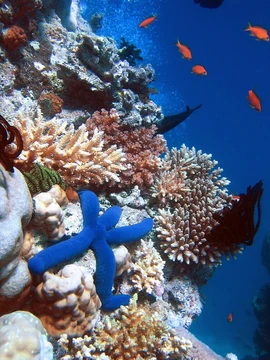
Environmental issues with coral reefs
Human activities and climate change threaten coral reef survival worldwide.

Human activities are driving a global decline in coral reefs. These include mining coral, pollution from organic and inorganic sources, overfishing, blast fishing, and digging canals or access routes to islands and bays. Other threats are disease, destructive fishing methods, and ocean warming. The ocean’s role as a carbon sink, atmospheric changes, ultraviolet radiation, ocean acidification, viral infections, dust storms carrying harmful agents to distant reefs, pollutants, and algal blooms also affect coral reefs. The danger to reefs is not limited to coastal areas; climate change, especially global warming, raises ocean temperatures and causes coral bleaching, which can be fatal.
Scientists predict that between 2020 and 2040, roughly 70 to 90 percent of all coral reefs will vanish, mainly due to warmer ocean waters, higher acidity, and pollution. Some experts think mass die-offs during this period will allow heat-tolerant mutant corals to expand, but at the cost of genetic diversity. A 2008 global study found that 19 percent of the original reef area had already been lost. Currently, less than 20 percent of the world’s reefs are considered healthy, and about 75 percent are at risk from destructive human activities. Southeast Asia is especially affected, with 95 percent of its reefs endangered. By the 2030s, 90 percent of reefs are expected to be threatened by both human actions and climate change; by 2050, all coral reefs are predicted to be in danger.
In the Caribbean and tropical Pacific, direct contact between coral and common seaweeds causes bleaching and death through allelopathic competition. Lipid-soluble extracts from seaweeds that harm coral tissue also trigger rapid bleaching. In these areas, bleaching and mortality occur only where coral touches seaweed or its extracts, after which seaweed expands into the dead coral’s space. However, as of 2009, only 4 percent of reefs worldwide had more than 50 percent algal cover, meaning there is no recent global trend toward algal dominance. Seaweed and other algae thrive in nutrient-rich waters when herbivorous predators—like parrotfish, the urchin *Diadema antillarum*, surgeonfishes, tangs, and unicornfishes—are scarce.
Overfishing, especially selective overfishing, can unbalance coral ecosystems by allowing coral predators to multiply.
- Estimated coral reef loss 2020 to 2040
- 70 to 90%
- Existing coral reef area lost by 2008
- 19%
- World reefs currently in good health
- less than 20%
- World reefs at risk from human activitie
- about 75%
- Reefs endangered in southeast asia
- 95%
- Reefs expected at risk by 2030s
- 90%
- Reefs predicted in danger by 2050
- all coral reefs
Lore & Background
Competition between coral and common seaweeds in the Caribbean Sea and tropical Pacific Ocean causes bleaching and death of coral tissue via allelopathic competition. Lipid-soluble extracts of seaweeds that harmed coral tissues also produced rapid bleaching. As of 2009, only 4% of coral reefs worldwide had more than 50% algal coverage, indicating no recent global trend towards algal dominance. Overfishing, particularly selective overfishing, can unbalance coral ecosystems by encouraging excessive growth of coral predators such as the crown-of-thorns starfish, which feeds on stony coral using an enzyme system that dissolves the wax cetyl palmitate in coral tissues. The giant triton sea snail preys on the starfish but has been overfished for its shell, allowing starfish populations to grow unchecked. Destructive fishing practices include cyanide fishing, where sodium cyanide is dissolved in seawater to narcotize fish; most aquarium fish from the Philippines are captured this way, with an estimated 4,000 or more Filipino fish collectors using over 1,000,000 kilograms of cyanide on Philippine reefs alone. Dynamite fishing kills fish and corals in the blast area, destroying reef structure. Muro-ami, outlawed in the 1980s, involves dropping stones onto reefs to flush out fish. Fishing gear such as gill nets, fish traps, anchors, and bottom dragging gear like beach seines damage corals through abrasion and fracturing. Bottom trawling in deep oceans destroys cold-water and deep-sea corals; fifty-five percent of Alaskan cold-water coral damaged by one pass from a bottom trawl had not recovered a year later.
Reader's Guide
The significance of environmental issues with coral reefs lies in the extensive and varied human activities that drive their decline. The article notes that scientists estimate between 2020 and 2040, about 70 to 90% of all coral reefs will disappear, with primary causes being warming ocean waters, ocean acidity, and pollution. By the 2030s, 90% of reefs are expected to be at risk from both human activities and climate change; by 2050, it is predicted that all coral reefs will be in danger. The legacy of these impacts is already evident: in 2008, a worldwide study estimated that 19% of the existing area of coral reefs had already been lost, and less than 20% of the world's reefs could be regarded as in good health. The threat is particularly strong in Southeast Asia, where 95% of reefs are endangered. The article also notes that some believe mass mortality events will give way to the expansion of thermally tolerant mutant populations, but at the cost of coral genetic diversity. The scale of human impacts has grown exponentially with increased human population and improved storage and transport systems, as markets for fish and other natural resources have become global. Pollution from land-based sources, including runoff carrying sediment, nutrients, pesticides, wastewater, and industrial effluent, introduces pathogens such as Aspergillus sydowii and Serratia marcescens, and copper has been shown to interfere with the life history and development of coral polyps.
More in Coral Reefs 1-24
Spotted an error? Know more?
Reader corrections go straight into our review queue. Suggest an edit · How this site is sourced