Coral Triangle
A global epicentrum of marine biodiversity in the Indo-Pacific.

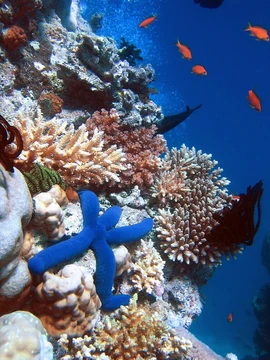
The Coral Triangle is a marine region spanning the tropical waters of Indonesia, Malaysia, Papua New Guinea, the Philippines, Solomon Islands, and Timor-Leste. It sits between the Pacific and Indian Oceans, covering parts of two biogeographic zones: the Indonesian-Philippines Region and the Far Southwestern Pacific Region. Covering 5.7 million square kilometers, it is one of the world’s eight major coral reef zones and is often called the "Amazon of the seas" due to its immense marine biodiversity. Each ecoregion within the Triangle hosts at least 500 species of reef-building corals. Overall, the area contains more than 76% of the world’s shallow-water reef-building coral species, 37% of its reef fish species, 50% of its razor clam species, six of the seven sea turtle species, and the largest mangrove forest on Earth. The highest concentration of coral diversity is in the Bird’s Head Seascape off Indonesian Papua, which has 574 coral species—95% of those found in the Coral Triangle and 72% of the global total.
The region’s marine ecosystem generates an estimated $1.2 trillion per year in gross domestic product, according to a 2014 Asian Development Bank report, and provides food for over 120 million people. Fisheries exports bring in about $3 billion annually in foreign exchange, while coastal tourism adds another $3 billion, per the Coral Triangle Knowledge Network. The World Wide Fund for Nature has made the Coral Triangle a top conservation priority, launching its Coral Triangle Program in 2007 to address ecological threats. Notable biodiversity hotspots include the Verde Island Passage in the Philippines. UNESCO World Heritage Sites in the region are the Tubbataha Reef Natural Park in the Philippines and the Raja Ampat UNESCO Global Geopark in Indonesia.
Although the Coral Triangle covers just 1.6% of the planet’s ocean area, it holds 76% of all known coral species. It is home to 52% of Indo-Pacific reef fishes and 37% of the world’s reef fishes, making it the most diverse coral reef fish habitat globally. Over 3,000 species of bony fish are spread across more than 90% of the Triangle, including large species like the whale shark, coelacanth, and chimaeras. Beyond corals and fish, the region hosts roughly 950 mollusk species, 458 crustacean species, and six of the seven marine turtle species.
- Area
- 5.7 million square kilometres
- Reef building coral species per ecoregio
- at least 500
- Percentage of world shallow water reef b
- more than 76%
- Percentage of world reef fish species
- 37%
- Annual gross domestic product of marine
- roughly $1.2 trillion per year
- People provided food
- over 120 million
- Annual foreign exchange from fisheries e
- $3 billion
Lore & Background
The Coral Triangle is located between the Pacific and Indian oceans and encompasses portions of two biogeographic regions: the Indonesian-Philippines Region and the Far Southwestern Pacific Region. It contains more than 76% of the world's shallow-water reef-building coral species, 37% of its reef fish species, 50% of its razor clam species, six out of seven of the world's sea turtle species, and the world's largest mangrove forest. The epicenter of coral diversity is found in the Bird's Head Seascape of Indonesian Papua, which hosts 574 species. The Verde Island Passage in the Philippines is one of the centers of biodiversity. Three theories explain the high species diversity: the centre of origin model, the centre of overlap model, and the centre of accumulation model. The region faces threats from anthropogenic activities, habitat change, over-exploitation, climate change, and ocean acidification, which can be magnified by nutrient-driven bioerosion from land-based pollution.
Reader's Guide
The Coral Triangle is significant as one of eight major coral reef zones in the world and a global hotspot of marine biodiversity. Its biological resources include 76% of the world's shallow-water reef-building coral species, 37% of its reef fish species, and the world's largest mangrove forest. The Asian Development Bank reported in 2014 that the gross domestic product of the marine ecosystem is roughly $1.2 trillion per year, providing food to over 120 million people. The region annually brings in about $3 billion in foreign exchange from fisheries exports and another $3 billion from coastal tourism. The World Wide Fund for Nature considers it a top priority for marine conservation, addressing threats through its Coral Triangle Program launched in 2007. UNESCO World Heritage Sites in the region include Tubbataha Reef Natural Park in the Philippines and Raja Ampat UNESCO Global Geopark in Indonesia. The biodiversity is under threat from poor marine management, coastal development, overfishing, destructive fishing, lack of political will, poverty, high market demand, and local disregard for rare and threatened species.
Did You Know?
- The Coral Triangle covers only 1.6% of the planet's oceanic area but contains 76% of all known coral species.
- The Bird's Head Seascape of Indonesian Papua hosts 574 coral species, 95% of the Coral Triangle's total.
- A 2008 joint Indonesian–U.S. survey discovered around 40 newly identified deep-sea coral species at depths of 3800 meters.
- The region contains the world's largest mangrove forest.
More in Coral Reefs 1-24
Spotted an error? Know more?
Reader corrections go straight into our review queue. Suggest an edit · How this site is sourced