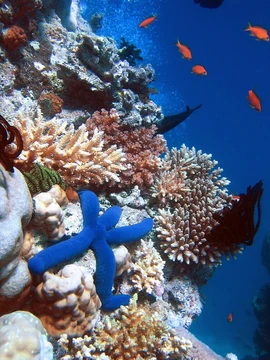
Coral reefs of Tuvalu
Tuvalu's reefs comprise atolls and reef islands of volcanic origin.

The coral reefs of Tuvalu consist of three reef islands and six atolls, containing approximately 710 km² of reef platforms. The islands are volcanic in origin, spread between 5° to 10° south and 176° to 180° west of the International Date Line. Atolls have an annular reef rim surrounding a lagoon, while reef islands are smaller tabular platforms without a salt-water lagoon, though they may have a closed rim of dry land with remnants of a lagoon that has no direct connection to the open sea.
Quick Facts
- Location
- Pacific Ocean
- Total Islands
- 9
- Major Islands
- Funafuti, Nanumanga, Nanumea, Niulakita, Niutao, Nui, Nukufetau, Nukulaelae and Vaitupu
- Country
- Tuvalu
Facts from the source article.
Lore & Background
The atolls and reef islands of Tuvalu formed from oceanic volcanoes, with coral reefs growing around the shore. Over millions of years, the volcano became extinct, eroded, and subsided beneath the ocean, leaving only the reef and small coral islets, with a lagoon replacing the former volcano. For the atoll to persist, coral growth must match relative changes in sea level. Boreholes on Fongafale islet, at Darwin's Drill, resulted from drilling by the Royal Society of London in 1896, 1897, and 1898 to investigate coral reef formation, following Charles Darwin's work. The survey of Funafuti atoll published in 1970 described it as an almost circular submarine mountain 12,000 feet high, originally volcanic, rising vertically from 840 feet below water level to the surface as a reef enclosing a lagoon 13.5 by 10.0 miles.
Reader's Guide
The reefs of Tuvalu are notable for their role in understanding atoll formation, as evidenced by the Darwin's Drill boreholes on Fongafale islet. Surveys have assessed live coral cover (LCC) levels: in 2004, Funafuti had 19.5% LCC across all reef habitats; in 2010, mean hard coral cover was 15% on Funafuti, 11% on Nanumea, and 6% on Nukulaelae. The average LCC across these three islands was 20-30%, compared to 30-70% in Kiribati. Standard criteria define LCC below 24.5% as low, indicating poor reef health. Surveys in 2020 near settlements on Funafuti, Nanumea, and Nanumaga showed lower LCC at boat channels compared to reference sites, with Nanumea having the highest and richest coral community. Crown-of-thorns starfish and corallivorous snails are present but without destructive outbreaks. Giant clams have declined due to human population, pollution, habitat destruction, and harvesting. Rising sea levels at 3.9 mm per year shift sand, causing accretion to island shorelines.
Did You Know?
- The boreholes on Fongafale islet, called Darwin's Drill, were drilled in 1896, 1897, and 1898 by the Royal Society of London.
- Over four decades, the total land area of all 101 Tuvaluan islands or islets increased by 73.5 ha (2.9%).
- No sewage treatment systems exist in Tuvalu; sewage enters the ocean and lagoon directly or through seepage.
More in Coral Reefs 1-24
Spotted an error? Know more?
Reader corrections go straight into our review queue. Suggest an edit · How this site is sourced