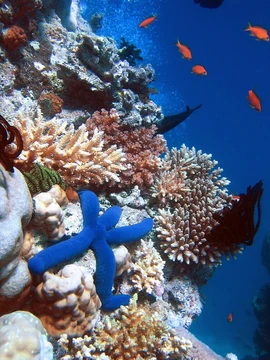
Coral reefs of the Virgin Islands
Coral reefs spanning 297.9 km² among three U.S. Virgin Islands.

The coral reefs of the Virgin Islands are marine ecosystems located between the islands of St. Croix, St. Thomas, and St. John. These reefs cover an area of 297.9 km², including other marine habitats. They are notable for their diverse species and for forming three distinct structures: fringing reefs, barrier reefs, and atoll reefs.
- Area
- 297.9 km²
- Location
- Between St. Croix, St. Thomas, and St. John
- Coral species
- Over 40 species of scleractinian corals and three species of Millepora
- Fish species surveyed
- 215 fishes from St. John and 202 from St. Croix (survey 2001-2006)
- Sea turtle species
- Four species
- Reef structures
- Fringing reefs, barrier reefs, atoll reefs
Lore & Background
The coral reefs of the Virgin Islands grow when coral larvae swim freely and attach to hard surfaces around the islands, developing an external skeleton that protects them and provides a base for other larvae. These corals form three structures: fringing reefs close to shore, barrier reefs separated by deep water, and atoll reefs circling a lagoon. The reefs are distributed patchily around St. Thomas and St. John, while a developed barrier reef system surrounds St. Croix along its eastern and southern shores.
The reefs host over 40 species of scleractinian corals and three species of Millepora, with live scleractinian corals found mainly around Buck Island, St. Croix, and St. John. A survey from 2001-2006 recorded 215 fish species from St. John and 202 from St. Croix. Four species of sea turtles are also found in the Virgin Islands. The reefs are impacted by freshwater from the Amazon and Orinoco River, delivered via anticyclonic rings rich in nutrients.
The marine environment has been degraded by increasing coral diseases, including black-band disease, stony coral tissue loss disease, white-band disease, and white plague disease. Elevated sea temperatures have caused bleaching and mortality, especially among branching acroporid corals. Other factors include natural disasters (hurricanes, earthquakes, tsunamis), tourism pressures (scuba diving, snorkeling, untreated sewage, boat anchors), coastal development (dredging, sediment runoff), pollution, overfishing, destructive fishing methods (dynamite, cyanide), and dust from Africa.
Reader's Guide
The coral reefs of the Virgin Islands are significant as a marine ecosystem covering 297.9 km² and supporting a high diversity of species, including over 40 scleractinian corals and hundreds of fish species. They are notable for their three structural forms—fringing, barrier, and atoll reefs—and for their distribution across St. Croix, St. Thomas, and St. John. The reefs face multiple threats that have degraded their condition: diseases such as stony coral tissue loss disease and white-band disease, bleaching from elevated sea temperatures, natural disasters like hurricanes, and human activities including tourism, coastal development, pollution, and overfishing. The legacy of these reefs is one of ecological richness under pressure from both natural and anthropogenic factors, with their continued existence challenged by cumulative stressors. The article notes that the reefs are also affected by dust from Africa and nutrient-rich freshwater from the Amazon and Orinoco River, adding complexity to their environmental context.
More in Coral Reefs 1-24
Spotted an error? Know more?
Reader corrections go straight into our review queue. Suggest an edit · How this site is sourced