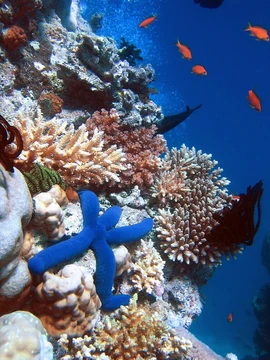
Coral reefs of Solomon Islands
Solomon Islands coral reefs are among the most diverse in the world.

The Coral reefs of Solomon Islands are located in Oceania, east of Papua New Guinea and northwest of Vanuatu, lying between latitudes 5° and 13°S and longitudes 155° and 169°E. The islands are part of the Coral Triangle, the region of the western Pacific with the world's greatest diversity of corals and coral reef species, and a 2004 baseline survey identified the Solomons as having the second highest diversity of corals in the world, second only to the Raja Ampat Islands in eastern Indonesia.
Quick Facts
- Location
- Pacific Ocean
- Archipelago
- Solomon Islands archipelago
- Total Islands
- 6 main islands and more than 986 smaller islands
- Major Islands
- Choiseul, the New Georgia Islands, Santa Isabel, Malaita, Makira (San Cristobal), Guadalcanal.
- Country
- Solomon Islands
Facts from the source article.
Lore & Background
The coral reefs of Solomon Islands are developed by the carbonate-based skeletons of a variety of animals and algae, built up over time to the surface in oceans. They are found in shallow, warm salt water where sunlight filters through clear water, allowing microscopic organisms to live and reproduce. The reefs are composed of tiny, fragile animals known as coral polyps. The recognizable reef systems include fringing reef, patch reef, barrier reef, atoll reefs and lagoon environment. The reefs are predominantly fringing reefs, though Ontong Java Atoll and Sikaiana are examples of coral atolls. Sikaiana, a small atoll northeast of Malaita, is almost 14 km in length with a lagoon totally enclosed by the coral reef, formed from an oceanic volcano that subsided beneath the ocean surface. Rennell Island is the second largest raised coral atoll in the world, with a completely closed rim of dry land and a lagoon with no direct connection to the open sea.
Reader's Guide
The coral reefs of Solomon Islands are significantly important because of their biodiversity, and are at risk from the detrimental effects of human action and inaction, such as overfishing and heightened levels of nutrients in the water due to pollution from human waste, which feeds the growth of macroalgae species. More than 90% of inshore coastal areas, reefs and islets are owned and managed under the customary marine tenure system, under which family units, clans, or tribes have rights to access and use marine resources. This kinship group ownership system is recognised under the Solomon Islands Constitution. Management methods include limited entry, closed seasons, closed areas, size limits, species prohibitions and restrictions on the use of fishing equipment. The success or failure of conservation efforts on coral reefs largely depends on the attitudes of the communities owning them. There are 113 Locally Managed Marine Areas (LMMA) containing an estimated 155 no-take zones, with the largest LMMA having a contiguous 13 km no-take zone on Tetepare Island. A total of 12 offshore sites and 53 inshore sites have been identified as Key Biodiversity Areas, including Marovo Lagoon and the Arnavon Community Marine Conservation Area.
Did You Know?
- The Solomon Islands has the 22nd largest Exclusive Economic Zone of 1,589,477 km² in the Pacific Ocean.
- The largest LMMA with a contiguous 13 km no-take zone is on Tetepare Island.
More in Coral Reefs 1-24
Spotted an error? Know more?
Reader corrections go straight into our review queue. Suggest an edit · How this site is sourced