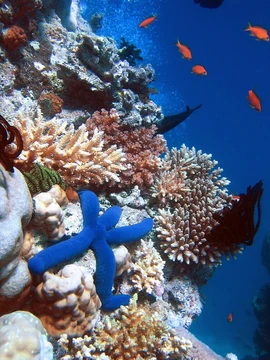
Coral reefs of Kiribati
Kiribati's coral reefs span 32 atolls and one raised island.

The Coral reefs of Kiribati consist of 32 atolls and one raised coral island, Banaba (Ocean Island), dispersed over 3.5 million km² of the Pacific Ocean. The islands straddle the equator and the 180th meridian, extending into both the eastern and western hemispheres and the northern and southern hemispheres. The reef systems include 3 submerged reefs, 15 fringing reefs, and 18 atolls. The Phoenix Islands Protected Area (PIPA), declared in 2006, was at that time the world's largest designated marine protected area and was designated a UNESCO World Heritage Site in 2010.
Quick Facts
- Location
- Pacific Ocean
- Archipelago
- Gilbert Islands, Line Islands and Phoenix Islands
- Total Islands
- 32 atolls and 1 Raised coral atoll
- Major Islands
- Banaba
- Highest Mount
- Unnamed location on Banaba
- Elevation M
- 81
- Country
- Kiribati
Facts from the source article.
Lore & Background
The coral atolls and reef islands of Kiribati formed from oceanic volcanoes, with coral reefs growing around the shore. Over millions of years, the volcano became extinct, eroded, and subsided beneath the ocean, leaving only the reef and small coral islets with a lagoon in place of the former volcano. For an atoll to persist, the coral reef must be maintained at the sea surface, with coral growth matching any relative change in sea level. Banaba is an elevated limestone cap surrounded by a fringing reef, while low islands such as Makin, Tamana, Arorae, Enderbury, Flint, and Vostok Island lack lagoons but have fringing reefs.
The Gilbert Islands are exposed to pollution and over-utilisation of reef resources by residents, similar to threats to the Coral reefs of Tuvalu. In contrast, most atolls of the Phoenix Islands and Line Islands are uninhabited. The isolation of the Phoenix Islands means they are among the most pristine coral reefs on Earth. The Phoenix Islands Protected Area includes three atolls with lagoons and perimeter coral reefs (Orona, Nikumaroro, and Canton Island), five low islands with fringing reefs (Manra, Rawaki, McKean, Birnie, and Enderbury), and two submerged reefs (Winslow and Carondelet).
Reader's Guide
The Coral reefs of Kiribati are notable for their diversity and conservation significance. The reefs host approximately 200 species of corals and about 1,000 species of shellfish, including black-lipped pearl oysters and Anadara cockles. In the Gilbert Islands, blue coral is abundant on reefs such as Tarawa, though absent from the Phoenix and Line Islands. The Phoenix Islands Protected Area, covering 408,250 km², conserves one of the world's largest intact oceanic coral archipelago ecosystems, with 14 known underwater seamounts and about 800 known species of fauna, including 200 coral species and 500 fish species. The PIPA Management Plan 2015–2020 imposed a total ban on commercial fishing within its boundaries and in all lagoons of the eight PIPA islands. The area has been identified as an important feeding and spawning site for tuna, and scientific research expeditions have found deep-water coral and biodiversity supporting oceanic pelagic species. Twenty-two Key Biodiversity Areas have been identified in Kiribati, covering approximately 74% of the total land, lagoon, and reef habitat. As of 2013, 12 of these KBAs had been partially or completely established as conservation areas. Four marine reserves for grouper conservation are located in the Gilbert Islands on the atolls of Butaritari, Tabiteuea, Nonouti, and Onotoa.
Did You Know?
- The Phoenix Islands Protected Area was the world's largest designated marine protected area when declared in 2006.
- The reefs of the Phoenix Islands were found in 2000 surveys to be in excellent health with no evidence of coral diseases.
- Blue coral (Heliopora coerulea) is abundant on the reefs of the Gilbert Islands but absent from the Phoenix and Line Islands.
- The PIPA Management Plan 2015–2020 banned all commercial fishing within the protected area boundaries and lagoons.
More in Coral Reefs 1-24
Spotted an error? Know more?
Reader corrections go straight into our review queue. Suggest an edit · How this site is sourced