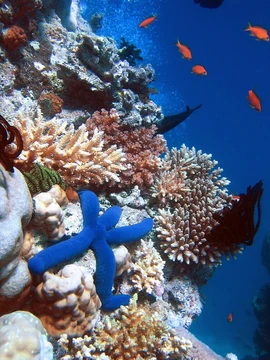
Coral reefs of Jamaica
Jamaica's coral reefs face severe decline from environmental and human pressures.

The coral reefs of Jamaica are marine ecosystems located along the island's coastline within the Caribbean Sea. They are notable for hosting 60 different species of coral and for their economic importance, accounting for 27% of Jamaica's GDP through tourism. However, the reefs have experienced severe decline due to both environmental and human factors, threatening the country's environmental sustainability and economy.
- Reef area
- 763 km² (295 mi²) as of 2014
- Coastline length
- 894 km (556 mi)
- Coral species count
- 60
- Reef loss 1980 2000
- 85%
- Gdp contribution
- 27%
- Reef area sq miles
- 479
- Fish species count
- 135
Lore & Background
Jamaica's coral reefs once covered a much larger area along its 894 km of coastline, but about 85% of the reefs were lost between 1980 and 2000. The reefs are distributed primarily on the northern coast from Morant Point to Negril, while on the southern coast they are more restricted, occurring mostly near Old Harbour and Port Royal. Various species of hard coral from multiple families are found in these reefs.
The decline of Jamaica's coral reefs began to be moderated in 1972, yet cover has declined more than 50% since then. Causes include overfishing, pollution, hurricanes, and disease. In 2005, up to 95% of corals bleached in some locations, with only 50% recovering later. Major hurricane events such as Hurricane Allen in 1980, Hurricane Gilbert in 1988, and Hurricane Ivan in 2004 have caused significant damage, and in 2005 a record 26 storms affected 68% of Jamaica's coral reefs, with 38% of those corals dying.
Invasive lionfish (Pterois volitans and Pterois miles), first sighted in the Caribbean in the 1980s off Florida, pose a serious threat. With no known predators in Jamaican waters, they feed on herbivorous fish that control algae growth. A single lionfish can cause a 79% reduction in recruitment of native reef fish and wipe out 80% of young reef fish in five weeks. Overfishing has also been severe: in 1970 on the north coast, trap fishermen set 1800 traps—at least double sustainable levels—and fish density dwindled to 9.8 fish per 100 m² between 2001 and 2006.
Reader's Guide
The significance of Jamaica's coral reefs lies in their dual role as an economic engine and an ecological keystone. The reefs account for 27% of Jamaica's GDP, primarily through tourism, making their degradation a direct threat to the national economy. Human activities such as overfishing, pollution from untreated sewage, and damage from snorkeling and diving have compounded natural stressors like hurricanes and disease. Sewage pollution, 85% of which enters the Caribbean untreated, causes eutrophication and introduces toxins that double the probability of coral disease and triple the probability of bleaching. Ocean acidification, driven by rising CO₂ levels, weakens coral skeletons by breaking down calcium carbonate, making reefs more fragile and susceptible to storm damage. The legacy of these combined pressures is a reef system that has lost 85% of its cover between 1980 and 2000, with recovery hampered by invasive lionfish and algal overgrowth. Actions have been put in place to counteract these losses, offering a symbol of hope for the revival of Jamaica's environment, though the challenges remain substantial.
Did You Know?
- Jamaica's coral reefs host 60 different species of coral.
- 85% of sewage entering the Caribbean is untreated, contributing to coral bleaching and disease.
- In 2005, up to 95% of Jamaica's corals bleached, but only 50% recovered.
More in Coral Reefs 1-24
Spotted an error? Know more?
Reader corrections go straight into our review queue. Suggest an edit · How this site is sourced