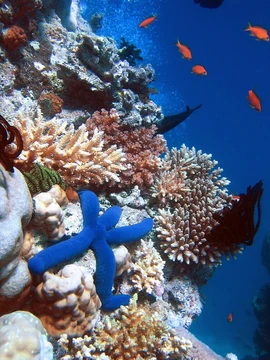
Coral reefs in India
Ancient dynamic ecosystems protecting India's coastline and marine life.

Coral reefs in India rank among the country’s oldest and most active ecosystems. They shelter a wide variety of marine life and help shield the shoreline from erosion. India’s total coastline, including its islands, stretches about 7,517 kilometers; the mainland portion accounts for 6,100 kilometers.
Most Indian coral reefs are found in the Andaman and Nicobar Islands, the Gulf of Mannar, the Gulf of Kutch, the Palk Strait, and the Lakshadweep islands. With the exception of the Lakshadweep atolls, all of these are fringing reefs. Patchy corals also occur along the intertidal zones of the central west coast, such as at Ratnagiri and Gaveshani Bank. Hermatypic corals appear along the shoreline from Kollam in Kerala to Enayam Puthenthurai in Tamil Nadu.
**Research and Institutions** Key bodies involved in managing, monitoring, and studying coral reefs include the Ministry of Earth Sciences, the Zoological Survey of India, the Central Marine Fisheries Research Institute, Madurai Kamaraj University, Annamalai University, the National Centre for Earth Science Studies, the National Institute of Ocean Technology, and the National Institute of Oceanography. The Space Applications Centre in Ahmedabad uses remote sensing to gather data on reef areas.
**Laws and Regulations** The Ministry of Environment, Forest and Climate Change oversees protection guidelines for coral reefs. If a reef lies within a protected area, the state wildlife department has jurisdiction. The Coastal Regulation Zone (CRZ) notification of 1991 safeguards all marine resources, placing all coral reefs under the CRZ‑1 category. Section 7(2) of this notification bans the construction of beach resorts or hotels on coral reefs. In certain states, quarrying and collecting massive corals is prohibited except for scientific purposes.
**List of Coral Reefs** - **Andaman and Nicobar Islands:** Located in the Bay of Bengal, these are exclusively fringing reefs spread across about 572 islands, most of which support healthy biodiversity. - **Eastern Coast:** A coral reef exists near the sea between Chandrabhaga coast and Ramachandi in the Konark area of Odisha. - **Gulf of Mannar:** Fringing reefs form a chain of 21 islands from Rameswaram in the north to Thoothukudi (Tuticorin) in the south. This area is part of the Gulf of Mannar Biosphere Reserve.
- Coastline total km
- 7517
- Mainland coast km
- 6100
- Reef types present
- Fringing reefs and atolls
- Major reef locations
- Andaman and Nicobar Islands, Gulf of Mannar, Gulf of Kutch, Palk Strait, Lakshadweep
- Lakshadweep islands
- 36
- Gulf of mannar islands
- 21
- Andaman nicobar islands count
- 572
Lore & Background
Coral reefs in India are mainly restricted to the Andaman and Nicobar Islands, Gulf of Mannar, Gulf of Kutch, Palk Strait and the Lakshadweep islands. All of these reefs are fringing reefs, except Lakshadweep which are atolls. Patchy corals are present along inter-tidal areas of the central west coast, such as Ratnagiri and Gaveshani Bank. Hermatypic corals are also present along the seashore from Kollam in Kerala to Enayam Puthenthurai in Tamil Nadu. The Andaman and Nicobar Islands consist of exclusively fringing reefs around about 572 islands, most with healthy biodiversity. The Gulf of Mannar features fringing reefs with a chain of 21 islands from Rameswaram to Thoothukudi, forming part of the Gulf of Mannar biosphere reserve. The Gulf of Kutch exclusively consists of fringing reefs, relatively less developed due to large temperature range and high salinity, and the entire gulf is known as a Marine National Park. Lakshadweep consists exclusively of coral atolls with 36 islands, ranging from less than 1 km to about 9 km in length and not exceeding 2 km in width.
Reader's Guide
The significance of coral reefs in India lies in their ecological role as sanctuaries for marine species and their function in protecting the coastline from erosion. Major institutions involved in management, monitoring and research include the Ministry of Earth Sciences, Zoological Survey of India, Central Marine Fisheries Research Institute, Madurai Kamaraj University, Annamalai University, National Centre for Earth Science Studies, National Institute of Ocean Technology, and National Institute of Oceanography. The Space Applications Centre in Ahmedabad collects data on coral reef areas using remote sensing. The Ministry of Environment, Forest and Climate Change manages and provides guidelines for protection. If a coral reef region is under a protected area, it falls under the jurisdiction of the State Wildlife department. The Coastal Regulation Zone (CRZ) notification of 1991 protects all marine resources, with all types of coral reefs protected under the CRZ1 category. Section 7(2) of that notification prohibits construction of beach resorts or hotels on coral reefs. In certain states, quarrying and collecting of massive corals are banned except for scientific purposes. Specific reefs include those near Chandrabhaga coast and Ramachandi in Odisha, Angria Bank off Vijaydurg in Maharashtra, Tarkarli in Malwan, Maharashtra, and Netrani Island in Karnataka.
Did You Know?
- India has about 7517 km of coastline including islands, with a mainland coast of 6100 km.
- All coral reefs in India are fringing reefs except Lakshadweep, which are atolls.
- The Gulf of Kutch is entirely a Marine National Park with relatively less developed reefs due to high temperature and salinity.
- The Coastal Regulation Zone notification of 1991 prohibits construction of beach resorts or hotels on coral reefs.
More in Coral Reefs 1-24
Spotted an error? Know more?
Reader corrections go straight into our review queue. Suggest an edit · How this site is sourced