Coral reef restoration
Restoring damaged coral reefs through fragmentation, nurseries, and transplantation.

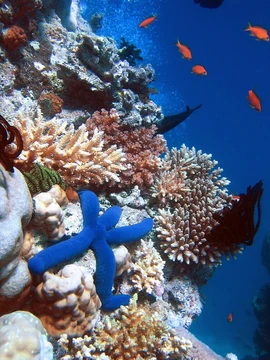
Coral reef restoration uses both natural processes and human intervention to fix damaged reefs. Damage comes from natural events and human activities, and restoration aims to reverse that harm. The main technique involves breaking off pieces of mature coral, attaching them to lines or frames, caring for them while they heal and grow, and then moving them to their permanent spot on the reef once they are big enough. These efforts can happen in the ocean or on land, and they may use either sexual or asexual reproduction. A downside is the potential for introducing invasive species, which could upset the local ecosystem’s balance. By 2021, with help from the US NOAA, more than 40,000 coral reefs had been restored across the Caribbean.
Coral reefs are home to over a quarter of all marine life. They act as a buffer between land and sea, reducing storm damage and coastal erosion. They provide jobs, recreation, and food for coastal communities, and reef tourism is a major economic driver worldwide. Reefs also absorb a lot of carbon, playing a key role in carbon storage. The total value of services from coral reef ecosystems is estimated at $375 billion per year. In the United States alone, reefs generate about $3.6 billion in economic output, and globally they contribute an estimated $9.9 trillion annually.
The most common tropical reef-building corals are stony corals (Scleractinia), which create hard skeletons of calcium carbonate that give reefs their structure. Coral polyps live in a mutualistic relationship with single-celled algae called zooxanthellae. These algae live inside the coral tissue and provide energy through photosynthesis, while the coral offers them shelter and nutrients. About 655 million people—roughly 9% of the global population—live near coral reefs.
Corals can reproduce asexually when a polyp buds to create another identical polyp. Sexually, corals reproduce through broadcast spawning, either in tanks or in the sea. Fertilized gamete bundles in the water column form larvae.
Coral restoration is one way to help reefs survive. The most common method is fragmentation, often used to build artificial reefs like coral trees, line nurseries, and fixed structures.
Half of the world’s coral has disappeared since 1970, and all reefs are at risk of extinction by 2050.
- Restored reefs caribbean
- over 40,000
- Year of caribbean restoration
- 2021
- Global economic output from reefs
- $9.9 trillion annually
- Us reef economic output
- $3.6 billion
- Annual reef ecosystem services value
- $375 billion
- Global population near reefs
- 655 million (9% of global population)
- Coral disappeared since 1970
- half
Lore & Background
Coral reef restoration is one approach to ensure the continued existence of reefs. Fragmentation is the most common strategy, used to establish artificial reefs such as coral trees, line nurseries, and fixed structures. The process of cultivating coral polyps is known as coral gardening, with ocean-based or land-based nurseries being the two primary methods. Fragmentation involves dividing a wild coral colony into smaller pieces, which are grown asexually into additional colonies genetically identical to the host. Up to 75% of the host colony may be removed without negative effect on its growth rate.
Reader's Guide
Coral reef restoration is significant because over 25% of marine life lives in coral reef ecosystems, and reefs provide crucial buffers between land and ocean, reducing storm damage and coastal erosion. They offer employment, recreational opportunities, and food for coastal communities, with reef tourism being a major economic driver. Reefs are also a major carbon sink. However, half the world's coral have disappeared since 1970, and all reefs are threatened with extinction by 2050. Restoration efforts, such as those by US NOAA that restored over 40,000 coral reefs in the Caribbean as of 2021, aim to counteract threats including rising ocean temperatures, ocean acidification, chemical pollution, and sediment loading. The legacy of restoration lies in its potential to mitigate damage from both natural and anthropogenic causes, though concerns about invasive species and the vulnerability of fragmented corals to disease and storms remain.
Did You Know?
- Coral reef restoration involves both natural and anthropogenic processes.
- Fragmentation allows for about an 8x increase in reproduction compared to the donor coral.
- A 2008 study reported that fixed structure nurseries had a 43% survival rate, while line nurseries had a 100% survival rate.
- Over 40,000 coral reefs have been restored throughout the Caribbean region as of 2021 with the help of US NOAA.
More in Coral Reefs 1-24
Spotted an error? Know more?
Reader corrections go straight into our review queue. Suggest an edit · How this site is sourced