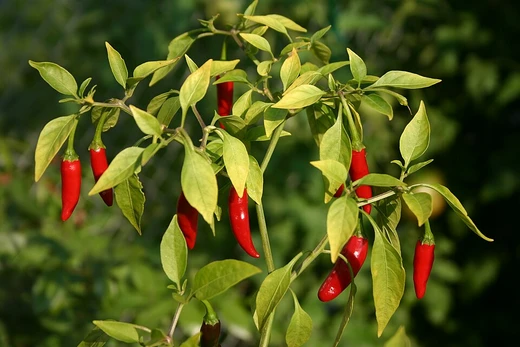
Padrón peppers
The peppers are small, about 2 inches long, with an elongated shape, and are typically picked and eaten while still green.[1] Their taste is generally mild, but some individual peppers can be quite hot, leading to the Galician saying "Os pementos de Padrón, uns pican e outros non".[1]
Quick Facts
- Scientific name
- Capsicum annuum
- Typical length
- about 2 in / 5.08 cm
- Unripe color
- green
- Ripe color
- red
- Protected designation
- pemento de Herbón (since 2010)
Facts from the source article.
Key facts and history
Since 2010, the name "pemento de Herbón" has been legally protected as a protected designation of origin under European Union law.[2] Pepper plants that experience drought stress tend to yield hotter fruits, and the peppers increase in spiciness as they ripen.[1] When fully ripe, the peppers turn red.[1] In the town of Padrón and its surrounding area, cooks remove the stems before frying the peppers.[3]
In other locations, the stems are usually kept on the peppers and are used as a handle while eating.[3]
What the cited sources add
Another 2019 article notes that the ideal cultivation area for Padrón peppers remains the municipalities of Padrón, Dodro, Rois, Pontecesures, and Valga.[4] That article also mentions that a larger pepper variety from Arnoia, measuring 7 to 11 centimeters, is fried whole with the stem included.[4] A liquor made from Padrón peppers exists, prepared without the stems.[4]
References
- Wikipedia, "Padrón pepper" (CC BY-SA 4.0), which cites: Davis, "The Camino Portugues: From Lisbon and Porto to Santiago – Central, Coastal and Spiritual caminos", Cicerone Press Limited, 2018; Baró, "Vegan Recipes from Spain", Grub Street Cookery, 2018, p. 52; Estrada, "Pungency level in fruits of the Padrón pepper with different water supply", Scientia Horticulturae, 1999-10-11, p. 385–396; Rombauer, "Joy of Cooking", Simon and Schuster, 2019, p. 260; Estrada, "Evolution of capsaicinoids in Capsicum annuum L. var. annuum cv. Padrón fruit at different growth stages after flowering", Capsicum & en.wikipedia.org
- Wikipedia, "Padrón pepper" (CC BY-SA 4.0), which cites: ; "Gourmetour: Food, Wine & Travel Quarterly Magazine", INFE, 2000, p. 89; "D.O.P. Pemento de Herbón", Ministry of Agriculture, Fisheries and Food; Palma, "Antioxidant Profile of Pepper (Capsicum annuum L.) Fruits Containing Diverse Levels of Capsaicinoids", Antioxidants, September 2020, p. 878; Winston, "The Spanish Table: Traditional Recipes and Wine Pairings from Spain and Portugal", Gibbs Smith, 2009, p. 36; Balla, "Bar Tartine: Techniques & Recipes", Chronicle Books, 2014, p. 230 (original not read by us) en.wikipedia.org
- Wikipedia, "Padrón pepper" (CC BY-SA 4.0), which cites: "En Padrón no hay debate: los pimientos se fríen sin tallo", La Voz de Galicia, 2019-07-14; Torrado, "Los pimientos, ¿con o sin rabo?", La Voz de Galicia, August 24, 2019; "En Padrón no hay debate: los pimientos se fríen sin tallo", La Voz de Galicia, 2019-07-14; Torrado, "Los pimientos, ¿con o sin rabo?", La Voz de Galicia, August 24, 2019 (we also read that source) en.wikipedia.org
- Torrado, "Los pimientos, ¿con o sin rabo?", La Voz de Galicia, August 24, 2019. lavozdegalicia.es
Each numbered sentence above was checked against the source it cites before publication. Sentences citing Wikipedia adapt text from the English Wikipedia article Padrón pepper (contributors), used under CC BY-SA 4.0; this entry is available under the same licence. Other sources were used for facts only.
More in Chili Pepper Varieties
Spotted an error? Know more?
Reader corrections go straight into our review queue. Suggest an edit · How this site is sourced