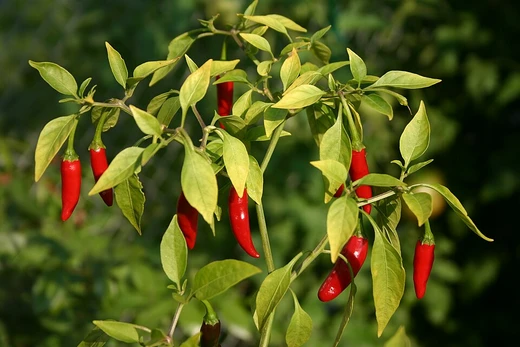
Espelette pepper
It received AOC classification on 1 June 2000 and PDO status on 22 August 2002.[1] The Capsicum annuum variety known as Espelette pepper is grown in the French commune of Espelette, Pyrénées-Atlantiques, which is historically part of the Basque region.[1] With a mild heat level that peaks at 4,000 on the Scoville scale, this pepper offers a sweet, fruity, and berry-like taste.[2][3]
Quick Facts
- Species
- Capsicum annuum
- Origin
- France
Facts from the source article.
Key facts and history
The pepper is now a cornerstone of Basque cuisine, gradually replacing black pepper and serving as a key ingredient in piperade.[3] In 2014, 160 producers planted 183 hectares and produced 203 tons of powdered pepper and 1,300 tons of raw pepper.[4] Non-AOC Espelette peppers are also grown and marketed in California, United States.[5] Initially employed for medicinal purposes, it later gained favor as a seasoning and for preserving meat.[3]
Only the Gorria type of Capsicum annuum is permitted for AOC/AOP Espelette pepper production.[6] Since 1968, the Confrérie du Piment d'Espelette has organized a yearly pepper festival on the final weekend of October, drawing roughly 20,000 visitors.[6]
What the cited sources add
The World Spice merchant describes the pepper's flavor profile as fresh and fruity with a hint of heat, essential to Basque and regional French cooking.[7] That source notes the pepper is often called the "Champagne of peppers" because it can only be labeled as Piment d'Espelette if it comes from its designated region.[7] The same source states the pepper began its journey in the New World and was brought to Europe from the Americas.[7] A 2016 article by Kerros advises keeping Espelette refrigerated and out of direct light, and using it to add character to any dish.[8]
The same article notes that Wilbur Scoville, an American pharmacologist, created a method in 1912 to measure the capsaicin content in chili peppers.[8]
References
- Wikipedia, "Espelette pepper" (CC BY-SA 4.0), which cites: Larousse, p. 92. (original not read by us) en.wikipedia.org
- Wikipedia, "Espelette pepper" (CC BY-SA 4.0), which cites: "Piment d'Espelette", World Spice, 2023-11-22; Kerros, "FRANCE : The harvest of Espelette pepper", terreexotique.com, 2016-09-20 (we also read that source) en.wikipedia.org
- Wikipedia, "Espelette pepper" (CC BY-SA 4.0), which cites: Larousse, p. 804. (original not read by us) en.wikipedia.org
- Wikipedia, "Espelette pepper" (CC BY-SA 4.0), which cites: "Despite Floods and a Tough Season Espelette Harvest Yields 1300 Tonnes of Peppers", November 2, 2014; "La filière", Piment d'Espelette (original not read by us) en.wikipedia.org
- Wikipedia, "Espelette pepper" (CC BY-SA 4.0), which cites: Karp, "Local Espelette powder comes to Los Angeles farmers' markets", LA Times, November 17, 2014 (original not read by us) en.wikipedia.org
- Wikipedia, "Espelette pepper" (CC BY-SA 4.0), which cites: Larousse, p. 804.; Smith, "A-Z of unusual ingredients: Espelette pepper", Telegraph, Aug 21, 2013; "Agenda", Piment D'Espelette (original not read by us) en.wikipedia.org
- "Piment d'Espelette", World Spice, 2023-11-22. worldspice.com
- Kerros, "FRANCE : The harvest of Espelette pepper", terreexotique.com, 2016-09-20. terreexotique.com
Each numbered sentence above was checked against the source it cites before publication. Sentences citing Wikipedia adapt text from the English Wikipedia article Espelette pepper (contributors), used under CC BY-SA 4.0; this entry is available under the same licence. Other sources were used for facts only.
More in Chili Pepper Varieties
Spotted an error? Know more?
Reader corrections go straight into our review queue. Suggest an edit · How this site is sourced