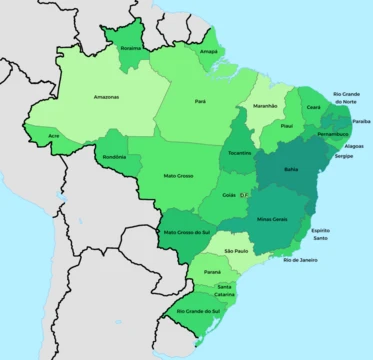
Mato Grosso
Brazilian state with vast ecosystems and agricultural prominence.

via Wikipedia: Mato Grosso · see source
Mato Grosso, whose name means "Thick Bush," is a Brazilian state in the Central-West region. It ranks as the country's third-largest state by area, covering 903,357 square kilometers—roughly 82.2 percent the size of neighboring Bolivia to the southwest. Despite its size, it holds just 1.66 percent of Brazil's population and contributes about 1.9 percent of the national GDP. Its borders, moving clockwise from the west, touch Rondônia, Amazonas, Pará, Tocantins, Goiás, and Mato Grosso do Sul. The state is divided into 142 municipalities.
The landscape is mostly flat, shifting between broad chapadas (plateaus) and plains. Mato Grosso encompasses three major ecosystems: the Cerrado savanna, the Pantanal wetland, and the Amazon rainforest. The Chapada dos Guimarães National Park, with its caves, grottoes, trails, and waterfalls, is a key tourist draw. In the far northwest, a sliver of Amazon forest appears. The Xingu Indigenous Park and the Araguaia River lie within the state. To the south, the Pantanal—the world's largest wetland—hosts nearly a thousand animal species and numerous aquatic birds.
**Geography**
Mato Grosso's terrain features cliffs, canyons, and waterfalls. The Chapada dos Guimarães National Park showcases sandstone mountains eroded into varied vistas. The Pantanal, one of the globe's largest wetland and prairie ecosystems, is also here. The Paraguay River basin holds around 230 fish species, making it a magnet for anglers and researchers. Some fish are prized in sport fishing; others, including ornamental species, interest aquarists; still others are rare enough to warrant detailed study. Fishing in the Pantanal is economically important, and fish are a local staple. The Pantanal resembles Florida's Everglades but is far larger.
**History**
The Bororo people have long inhabited the Mato Grosso region. As late as 1880, soldiers patrolled the outskirts of Cuiabá, the state's capital and largest city, to guard settlers against Bororo raids. By the end of the 19th century, disease and conflict with explorers, slave traders, prospectors, settlers, and other indigenous groups had severely reduced the Bororo population, though 5,000 to 10,000 still occupied central and eastern Mato Grosso and western Goiás. In 1903, the Treaty of Petrópolis ceded the state's southwestern part to Bolivia in exchange for the then-Bolivian territory of Acre. This historically remote area drew early-20th-century expeditions seeking lost civilizations, notably British Captain Percy Fawcett's search for the Lost City of Z. Some Hollow Earth proponents speculated the region held entrances to the planet's interior. In 1977, Mato Grosso was split, creating the neighboring state of Mato Grosso do Sul from its former territory.
**Demographics**
Population growth in Mato Grosso surged during the 20th century, driven by timber, ranching, and agriculture. The state still has one of Brazil's lowest population densities. As of 2018, the Brazilian Institute of Geography and Statistics (IBGE) reported 3,441,998 residents, with a density of 3.8 inhabitants per square kilometer. Urbanization stood at 76.6 percent in 2006, and population growth was 2.4 percent between 1991 and 2000. There were 836,000 houses in 2006. Ethnically, the state has a high proportion of caboclos (people of mixed European and indigenous ancestry), typical of interior Brazil. The last PNAD census recorded 2,048,782 Brown (Mixed) people (56 percent), 1,181,590 White people (32.3 percent), 360,698 Black people (9.9 percent), 56,687 Amerindian people (1.5 percent), and 10,813 Asian people (0.3 percent). The 2022 census data on ethnic groups were also available.
**Largest Cities**
(No specific cities or populations were listed in the source beyond Cuiabá and Rondonópolis in the education section.)
**Education**
Portuguese is the official language and the main language of instruction. English and Spanish are part of the high school curriculum. Over 58 universities operate in Mato Grosso. Cuiabá hosts the Federal University of Mato Grosso (UFMT), Mato Grosso State University (Unemat), and Universidade de Cuiabá (Unic). Rondonópolis is home to the Federal University of Rondonópolis (UFR), which was part of UFMT until 2018.
**Economy**
Agriculture is the largest share of the state's GDP at 40.8 percent, followed by services at 40.2 percent, and industry at 19 percent (2004 figures). Major exports include soybeans (83 percent), wood (5.6 percent), meats (4.8 percent), and cotton (3.3 percent) as of 2002. In 2014, Mato Grosso contributed 1.8 percent of Brazil's economy. By 2020, it led national grain production with a 28.0 percent share. It was Brazil's top soybean producer (26.9 percent, or 33.0 million tons), the largest maize producer, and the biggest cotton producer (about 65 percent of national output, or 1.8 of 2.8 million tons). It ranked sixth in sugarcane, with 16 million tons in the 2019/20 harvest, and third in beans (10.5 percent of Brazilian production). In 2019, it led in sunflowers with 60,000 tons. For cassava, Brazil produced 17.6 million tons in 2018; Mato Grosso contributed 287,000 tons. In 2009, the state's cattle herd reached 30 million head.
- Major ecosystems
- Cerrado, Pantanal, Amazon rainforest
Verified Timeline
Lore & Background
Mato Grosso contains three main ecosystems: the Cerrado, the Pantanal and the Amazon rainforest. The Chapada dos Guimarães National Park, with its caves, grottoes, tracks, and waterfalls, is one of its tourist attractions. The extreme northwest of the state has a small part of the Amazonian forest. The Xingu Indigenous Park and the Araguaia River are in Mato Grosso. Farther south, the Pantanal, the world's largest wetland, is the habitat for nearly one thousand species of animals and many aquatic birds. The Bororo Indians live in the Mato Grosso area. As late as 1880, soldiers patrolled lands on the outskirts of Cuiabá, Mato Grosso's capital and largest city, to protect settlers from Bororo raids. By the end of the 19th century, although severely reduced by disease and by warfare with explorers, slave traders, prospectors, settlers, and other indigenous groups, as many as five to 10 thousand Bororo continued to occupy central and eastern Mato Grosso, as well as western Goiás. The southwestern part of this state was ceded by Brazil to Bolivia in exchange for the then-Bolivian territory of Acre, according to the Treaty of Petrópolis in 1903. This historically remote area attracted expeditions of exploration in the early 20th century that sought to find lost civilizations. A notable example was British Captain Percy Fawcett's expedition to find the Lost City of Z which he believed existed in the jungles of Brazil. Certain proponents of the Hollow Earth hypothesis speculated that the region had sites of access to the interior of the earth and its settlements. In 1977, the state was split into two halves, and the neighboring state of Mato Grosso do Sul was created from the other part of its territory.
Reader's Guide
Mato Grosso is significant as a major agricultural and economic hub within Brazil. Agriculture is the largest component of the state's GDP at 40.8%, followed by the service sector at 40.2%. The industrial sector represents 19% of the GDP (2004). Mato Grosso's major exports include soybeans (83%), wood (5.6%), meats (4.8%), and cotton (3.3%) (2002). In 2020, Mato Grosso was the leader in national grain production, with 28.0%. It's the largest producer of soy in Brazil, with 26.9% of the total produced in 2020 (33.0 million tons); the largest producer of maize in the country; the largest producer of cotton in Brazil, with around 65% of national production (1.8 out of the 2.8 million tons harvested in the country); the sixth largest producer of sugarcane in the country, 16 million tons harvested in the 2019/20 harvest; and the third largest producer of beans, with 10.5% of Brazilian production. In 2009, the cattle herd from Mato Grosso reached the mark of 30 million cattle, the largest cattle herd in the country, representing almost 14% of national production alone. Mato Grosso had production of gold (8.3 tons at a value of R$1 billion) and tin (536 tons at a value of R$16 million). The state also has a small production of sapphire and jasper. Marechal Rondon International Airport, located 10 km from the city center of Cuiabá, in the suburb of Várzea Grande, started receiving international flights in 1996. It now serves more than half a million passengers a year. The 1,600 mm Northern Brazil Railway connects Mato Grosso with the state of São Paulo and sea ports. The state flag has similar colors to the flag of Brazil, with blue symbolizing the sky, green vegetation, and white standing for peace. The star is yellow to symbolize the gold which attracted the first settlers.
Did You Know?
- Mato Grosso is roughly 82.2% of the size of its southwest neighbor, the nation of Bolivia.
- The Pantanal, the world's largest wetland, is the habitat for nearly one thousand species of animals and many aquatic birds.
- In 1977, the state was split into two halves, creating the neighboring state of Mato Grosso do Sul.
- Mato Grosso is the largest producer of cotton in Brazil, with around 65% of national production.
- The largest sandstone cavern in Brazil, Aroe Jari, extends nearly 1,550 m and is located in Chapada dos Guimarães.
A Landscape of Three Worlds
Mato Grosso sprawls across 903,357 square kilometers in Brazil's Central-West region, making it the third-largest state and roughly 82.2% the size of neighboring Bolivia. Despite its enormous footprint, the terrain is deceptively flat, shifting between vast chapadas and plain areas. Within this expanse, three distinct ecosystems coexist: the Cerrado, the Pantanal and the Amazon rainforest. The Pantanal, the world's largest wetland, is the habitat for nearly one thousand species of animals and many aquatic birds. The Paraguay basin is rich in the number and diversity of fish (around 230 species), a fascinating place for fishermen and scholars. The fishing industry in the Pantanal plays an important role in the region's economy and, for local people, fish is a staple food. The Pantanal has a habitat similar to the Everglades in Florida in the United States, although the Pantanal is much larger. To the north, the Chapada dos Guimarães National Park showcases sandstone mountains eroded into a remarkably varied vistas, with caves, grottoes, tracks, and waterfalls. The extreme northwest of the state has a small part of the Amazonian forest. The Xingu Indigenous Park and the Araguaia River are in Mato Grosso.
Indigenous Roots and a Frontier Past
The Bororo people have inhabited the Mato Grosso area for generations, yet their history is marked by relentless pressure from outside forces. Even as late as 1880, soldiers stationed on the outskirts of Cuiabá, Mato Grosso's capital and largest city, patrolled to protect settlers from Bororo raids. By the end of the 19th century, disease, armed conflict with explorers, slave traders, prospectors, settlers, and other indigenous groups had devastated the Bororo, though an estimated five to ten thousand still occupied central and eastern Mato Grosso, as well as western Goiás. The state's borders themselves were reshaped by diplomacy: under the 1903 Treaty of Petrópolis, the southwestern part of this state was ceded by Brazil to Bolivia in exchange for the then-Bolivian territory of Acre. The area's remoteness and mystery drew early-twentieth-century expeditions searching for lost civilizations, most famously British Captain Percy Fawcett's quest for the Lost City of Z which he believed existed in the jungles of Brazil. Some Hollow Earth theorists even speculated the region had sites of access to the interior of the earth and its settlements. In 1977, the state was finally split into two halves, and the neighboring state of Mato Grosso do Sul was created from the other part of its territory.
Agricultural Powerhouse
Agriculture dominates Mato Grosso's economy, accounting for 40.8% of the state's GDP, with services close behind at 40.2% and industry contributing the remaining 19% (2004). The state's export profile is overwhelmingly agricultural: soybeans alone represent 83% of major exports, followed by wood at 5.6%, meats at 4.8%, and cotton at 3.3% (2002). By 2020, Mato Grosso had become the undisputed leader in Brazilian grain output, supplying 28.0% of the national total. It produced 33.0 million tons of soybeans that year, capturing 26.9% of the country's harvest, and also led in maize and cotton, with cotton alone representing around 65% of national production (1.8 out of the 2.8 million tons harvested in the country). The state ranked sixth in sugarcane with 16 million tons harvested in the 2019/20 harvest, third in beans with 10.5% of Brazilian production, and led in sunflowers with 60,000 tons in 2019. Livestock is equally significant: the cattle herd hit 30 million head in 2009, the largest in Brazil at almost 14% of national production, and the state held the fifth-largest pork herd with around 2.5 million animals by 2018. Mineral extraction, including gold (8.3 tons at a value of R$1 billion) and tin (536 tons at a value of R$16 million), rounds out an economy that contributes about 1.9% of Brazil's total GDP.
People and Education in a Vast Interior
Mato Grosso is home to just 1.66% of Brazil's population, with roughly 3,441,998 residents as of 2018, spread across 142 municipalities, yielding one of the country's lowest population densities at 3.8 inhabitants/km2. The state experienced rapid growth throughout the 20th century, driven by timber, ranching and agricultural development. Urbanization reached 76.6% (2006), and the population grew at 2.4% (1991–2000). Ethnically, the state reflects the broader interior Brazilian pattern of mixed heritage: the last PNAD census recorded 2,048,782 Brown (Mixed) people (56%); 1,181,590 White people (32.3%); 360,698 Black people (9.9%); 56,687 Amerindian people (1.5%); and 10,813 Asian people (0.3%). Portuguese is the official national language and the primary language taught in schools. English and Spanish are also taught as part of the official high school curriculum. The state hosts more than 58 universities. Cuiabá, the capital, is home to the Federal University of Mato Grosso (UFMT), the Mato Grosso State University (Unemat), and the Universidade de Cuiabá (Unic). Rondonópolis also has the Federal University of Rondonópolis (UFR), formerly a part of UFMT until 2018.
More in Brazilian States 1-24
Related in Brazilian States
Links follow this subject's own source article.
Spotted an error? Know more?
This is a living reference — every entry is fact-audited, and reader corrections feed straight into our audit queue. Suggest an edit · See this site's audit record