Pará
Northern Brazilian state traversed by the lower Amazon River.

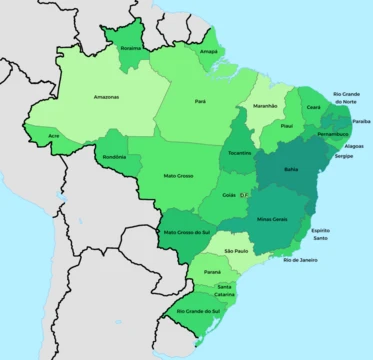
Pará sits in northern Brazil, cut through by the lower stretch of the Amazon River. It shares borders with the Brazilian states of Amapá, Maranhão, Tocantins, Mato Grosso, Amazonas, and Roraima. To the northwest lie Guyana and Suriname, while the Atlantic Ocean borders it to the northeast. Its capital and largest city, Belém, sits on the bay of Marajó, close to where the Amazon River meets the sea. Though the state holds 4.1% of Brazil’s population, it contributes only 2.2% of the national GDP.
With more than 8.6 million residents, Pará is the most crowded state in Brazil’s North Region and the ninth-most populous nationwide. In area, it ranks second only to Amazonas, which lies upriver. The state’s best-known symbols are the Amazon River and the Amazon rainforest. Its economy draws on rubber from rubber tree groves, cassava, açaí, pineapple, cocoa, black pepper, coconut, banana, and tropical hardwoods like mahogany, as well as minerals such as iron ore and bauxite. Soy, a newer cash crop, is grown around Santarém.
Each October, tens of thousands of tourists flock to Belém for the Círio de Nazaré, the year’s most important religious event. The capital also showcases Marajó-style ceramics, inspired by the vanished Marajoara culture that once flourished on the large island in the Amazon River.
The name “Pará” comes from the Tupi word *pará*, meaning “sea,” though it sometimes refers to large rivers. The state took its name from the Pará River, a tributary of the Amazon.
In 1500, Spanish navigator Vicente Yáñez Pinzón became the first European to sail the mouth of the Amazon River. Later, on August 26, 1542, Spaniard Francisco de Orellana reached the Amazon’s mouth after traveling by river from Quito, Ecuador. On October 28, 1637, Portuguese explorer Pedro Teixeira set out from Belém for Quito; during that expedition, he placed a marker at the meeting of the Napo and Aguarico rivers—on what is now the border between Ecuador and Peru—claiming the area for Portugal (and later Brazil). This helped secure most of the Amazon basin, including all of present-day Pará.
Before Europeans arrived, archaeologists group Brazil’s ancient inhabitants by lifestyle and tools: coastal hunter-gatherers and farmers. Europeans later called these groups “Indians.” Evidence shows humans lived in Brazil and the Santarém region as early as 3000 BC. Around 3,500 years ago, the Marajó people lived in farmers’ huts or houses. They made ceramics, used dyes and natural medicines, practiced slash-and-burn agriculture, and grew cassava. Their culture peaked between 500 and 1300 AD, and their legacy survives in Marajoara pottery, known for its size and decoration.
Under the 1494 Treaty of Tordesillas, the Amazon valley belonged to Spain. To secure the region for Portugal, Portuguese expeditionaries built the Fort of the Nativity (Forte do Presépio) in 1616, in what became Santa Maria de Belém do Grão-Pará. This fort was the first of its kind in the Amazon and remained the most important in the territory until 1660. Even so, early Dutch and English incursions for spices forced the Portuguese to strengthen their hold.
In the 1600s, the region—then part of the captaincy of Maranhão—thrived on crops and livestock. In 1616, the captaincy of Grão-Pará was created, under the Portuguese colonial state of Maranhão. That same year, the state of Grão-Pará and Maranhão moved its capital to Belém. In 1755, the captaincy of Rio Negro was added, forming the State of Grão-Pará and Rio Negro. By 1751, as Portugal expanded westward, the colonial state of Grão-Pará included both the captaincy of Grão-Pará and that of São José do Rio Negro (now the state of Amazonas).
In 1823, Pará chose to join independent Brazil, having reported directly to Lisbon during the colonial period. But political conflicts continued. The most significant was the Cabanagem revolt (1835), which declared the province of Pará independent. Along with the Ragamuffin War, it was the only uprising during the regency period to seize power—and the only one led by common people.
The Cabanagem was a popular and social revolt during the Brazilian Empire, influenced by the French Revolution. It erupted from extreme poverty, hunger, and disease that plagued the Amazon in the early 1800s, in the former province of Grão-Pará (which then included today’s states of Pará, Amazonas, Amapá, Roraima, and Rondônia). The revolt lasted from 1835 to January 1840. It stemmed from Brazil’s 1822 independence, which did not immediately affect the province because Prince Regent Pedro I had relegated the region to political irrelevance. After independence, strong Portuguese influence remained, and the central government in Brazil gave the province little political weight.
Indians, blacks, and mestizos—mostly poor—all called *cabanos* (from their mud huts, or *cabanas*), banded together against the regent government. They rebelled to push for greater regional importance and to address poverty. At the rebellion’s core was a mobilization against the Brazilian Empire’s reactionary forces.
- capital
- Belém
- population
- over 8.6 million
- area
- 1.2 million square kilometres
- national_rank_population
- ninth-most populous state in Brazil
- national_rank_area
- second-largest state in Brazil
- gdp_share
- 2.2% of Brazilian GDP
- population_share
- 4.1% of Brazilian population
Quick Facts
- Settlement Type
- State
- Flag Size
- 125px
- Motto
- la · Sub lege progrediamur / "Let us progress under the law"
- Anthem
- Hino do Pará · pt · vertical-align=sup
- Subdivision Type
- Country
- Subdivision Name
- Brazil
- Subdivision Type2
- Region
- Subdivision Name2
- North
- Seat Type
- Capital and largest city
- Seat
- Belém
- Government Type
- Unitary state
- Leader Title
- Governor
Facts from the source article.
Lore & Background
Pará is a state in northern Brazil, traversed by the lower Amazon River. It borders the states of Amapá, Maranhão, Tocantins, Mato Grosso, Amazonas, and Roraima, as well as the nations of Guyana and Suriname to the northwest, and the Atlantic Ocean to the northeast. Its capital and largest city is Belém, situated on the bay of Marajó near the Amazon River’s estuary. Pará is the most populous state in Brazil’s North Region, with over 8.6 million residents, and is the country’s second-largest state by area, surpassed only by Amazonas. The state is home to 4.1% of Brazil’s population and contributes 2.2% of its GDP. Its defining icons are the Amazon River and the Amazon rainforest. The state produces rubber from rubber trees, cassava, açaí, pineapple, cocoa, black pepper, coconut, banana, tropical hardwoods like mahogany, and minerals including iron ore and bauxite; soy is a newer crop cultivated near Santarém. Belém hosts the Círio de Nazaré procession each October, a major religious event drawing tens of thousands of tourists. The city is also known for Marajó-style ceramics, inspired by the ancient Marajoara culture that flourished on the large island in the Amazon River. The state’s name derives from the Tupi word pará, meaning “sea” or large river, referencing the Pará River, a tributary of the Amazon.
Reader's Guide
Pará is significant as a major Brazilian state containing the lower Amazon River and vast rainforest, contributing to global biodiversity and climate regulation. Its economy has historically relied on rubber, cassava, açaí, cocoa, and minerals like iron ore and bauxite, with recent soy cultivation. The state's cultural heritage includes the Marajoara pottery tradition and the annual Círio de Nazaré procession in Belém, which draws tens of thousands of tourists. Politically, the Cabanagem revolt highlighted tensions between regional autonomy and central authority during Brazil's imperial period. Pará's large area and population make it a key demographic and economic player in northern Brazil, though it produces only 2.2% of national GDP despite housing 4.1% of the population.
Did You Know?
- Pará is the second-largest state in Brazil by area, after Amazonas.
- Belém's Círio de Nazaré is the year's most important religious celebration, held every October.
More in Brazilian States 1-24
Spotted an error? Know more?
This is a living reference — every entry is fact-audited, and reader corrections feed straight into our audit queue. Suggest an edit · See this site's audit record