Rio Grande do Sul
Southernmost Brazilian state with gaucho culture and high life expectancy.

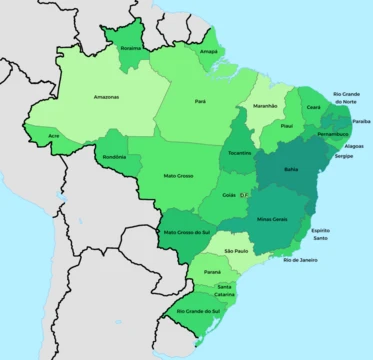
Rio Grande do Sul, the southernmost state of Brazil, is bordered by Santa Catarina to the north and northeast, the Atlantic Ocean to the east, Uruguay to the south and southwest, and the Argentine provinces of Corrientes and Misiones to the west and northwest. Its capital and largest city is Porto Alegre. The state is divided into 497 municipalities and holds 5.4 percent of the national population, contributing 6.6 percent of Brazil’s GDP. It records the highest life expectancy in the country and a crime rate that is relatively low by Brazilian standards. Before European contact, the region was primarily inhabited by the Guarani and Kaingang peoples, with smaller populations of Charrúa and Minuane. The first Europeans were Jesuit missionaries, followed by settlers from the Azores. The 19th century brought conflicts such as the Ragamuffin War and the Paraguayan War, and later large waves of German and Italian immigration shaped the state’s culture. Rio Grande do Sul shares a gaucho heritage with Argentina and Uruguay. Geographically, the northern part lies on the southern slopes of a plateau extending from São Paulo, broken by low mountain ranges. A range of low mountains crosses the state into Uruguay. To the west lies a vast grassy plain used for livestock—sheep in the north and cattle in the south. To the east is a low coastal zone containing two large estuarine lagoons, Lagoa dos Patos and Lagoa Mirim, separated from the ocean by sandy peninsulas. The coast is a continuous sand beach broken only by the Rio Grande outlet. The state has two river systems: one draining east to the lagoons and another flowing west to the Uruguay River as part of the Río de la Plata basin. Major eastern rivers include the Jacuí, Sinos, Caí, Gravataí, and Camaquã, which empty into Lagoa dos Patos, while the Jaguarão flows into Lagoa Mirim. The Guaíba River, though technically a lake, connects these rivers to the lagoon. The Jacuí is among the most important rivers, rising in the northern Coxilha Grande and flowing to the Guaíba estuary, with tributaries including the Vacacaí and Taquari. The Jaguarão forms part of the border with Uruguay and is navigable for 42 kilometers. Lagoa dos Patos, named after an Indigenous tribe, runs parallel to the coast for about 240 kilometers, varying in width from 35 to 58 kilometers, but is shallow and filled with sandbanks. Lagoa Mirim, on the
- Capital
- Porto Alegre
- Population share
- 5.4% of Brazilian population
- GDP share
- 6.6% of Brazilian GDP
- Life expectancy
- Highest in Brazil
- Climate
- Predominantly humid subtropical (Cfa), subtropical highland (Cfb) in highest areas
Lore & Background
Before the arrival of Portuguese and Spanish settlers, the region now known as Rio Grande do Sul was primarily inhabited by the Guarani and Kaingang peoples, with smaller populations of the Charrúa and Minuane. The first Europeans to arrive were Jesuit missionaries, followed by settlers from the Azores. The 19th century saw the state become a stage for major conflicts, including the Ragamuffin War and the Paraguayan War. Large waves of German and Italian immigration also profoundly shaped the state’s culture and demographics. Geographically, the northern part of the state lies on the southern slopes of a high plateau that extends southward from São Paulo, broken by low mountain ranges that appear as escarpments. A range of low mountains crosses the state southward into Uruguay. To the west of this range lies a vast grassy plain ideal for stock-raising, with the northern, elevated part suitable for sheep and the southern part for cattle. To the east is a low coastal zone containing two large estuarine lagoons, Lagoa dos Patos and Lagoa Mirim, separated from the Atlantic Ocean by sandy, partially barren peninsulas. The coast itself is a single great sand beach, broken only by the outlet of these lakes, called the Rio Grande. The state has two distinct river systems: one draining eastward to the lagoons, and the other flowing westward to the Uruguay River as part of the Río de la Plata basin. Key rivers of the eastern group include the Jacuí, Sinos, Caí, Gravataí, and Camaquã, which flow into Lagoa dos Patos, and the Jaguarão, which flows into Lagoa Mirim. The Guaíba River, though technically a lake, is broad and deep, providing extensive fluvial navigation. The Jacuí is among the most important rivers, rising in the northern Coxilha Grande ranges and flowing to the Guaíba estuary. The Uruguay River itself is formed by the confluence of the Canoas and Pelotas rivers. The largest lakes are Lagoa dos Patos, which lies parallel to the coast and is filled with sand banks, and Lagoa Mirim, which straddles the Uruguayan border and connects to Lagoa dos Patos via the São Gonçalo Channel. Both lakes are remnants of an ancient coastal depression. Fully one-third of the state belongs to the Río de la Plata drainage basin, with major westward-flowing streams including the Ijuí, Ibicuí, and Quaraí rivers.
Reader's Guide
Rio Grande do Sul holds significance as a border state with distinct cultural and historical ties to Argentina and Uruguay, reflected in its shared gaucho traditions. Its geography includes the Lagoa dos Patos and Lagoa Mirim, two large estuarine lagoons, and the Guaíba River, which provides extensive fluvial navigation. The state's economy contributes 6.6% of Brazil's GDP while housing 5.4% of the population. Its climate is predominantly humid subtropical, with occasional droughts and rare snowfalls in mountainous areas. The state is also notable for the Caturrita Formation, rich in Triassic fossils, including the cynodont Riograndia named after the state. The legacy of European migration, particularly German and Italian, remains evident in the state's demographics and culture.
Did You Know?
- The state has the highest life expectancy in Brazil and a relatively low crime rate compared to the national average.
- The Caturrita Formation in Rio Grande do Sul contains Triassic fossils, including the cynodont Riograndia named after the state.
More in Brazilian States 1-24
Spotted an error? Know more?
This is a living reference — every entry is fact-audited, and reader corrections feed straight into our audit queue. Suggest an edit · See this site's audit record