Piauí
Brazilian state with the shortest coastline and inland capital.

Piauí, a state in Brazil’s Northeast Region, has the country’s shortest coastline at just 66 kilometers. Its capital, Teresina, is the only state capital in the northeast that sits inland, not on the coast. Unlike most of the region, Piauí was settled from the interior outward, expanding toward the ocean over time. The state holds 1.6% of Brazil’s population and contributes 0.7% of its GDP.
In the southeast, the UNESCO World Heritage site Serra da Capivara National Park features over 400 archaeological sites and the world’s largest concentration of rock paintings, set among canyons and caatinga vegetation. Other notable archaeological areas include Sete Cidades National Park, both rich in remains from prehistoric Paleo-Indian and sedentary Indigenous cultures.
Early settlers included Francisco Dias d’Ávila from Bahia, who brought the first cattle herds, and Domingos Afonso Mafrense from Portugal, who founded what is now Oeiras. During the 17th century, impoverished nobles, Jesuit priests, and enslaved Black and Indigenous people settled there, along with large-scale cattle farming. Landowners from Bahia and Maranhão later arrived seeking new pastures. By the early 1900s, stock raising was the main industry, dating to Mafrense’s first settlement in 1674, which established cattle ranges. Goat raising was a secondary activity, as goats tolerated neglect and scarce food. Agricultural products included cotton, sugar, and tobacco; forest products included rubber, carnauba wax, and dyewoods. Exports were hides, skins, rubber, wax, tobacco, and cotton.
Teresina, planned in 1852 by an architect inspired by a chessboard, was Brazil’s first planned city. Located where the Parnaíba and Poti Rivers meet, it became known as the Green City for its many mango trees lining the streets.
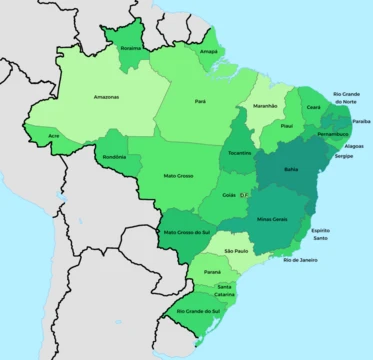
Piauí borders Maranhão to the west, Ceará and Pernambuco to the east, Tocantins to the west, and Bahia to the south, with a short Atlantic coast to the north. The Parnaíba River marks the entire boundary with Maranhão, and the state lies mostly within the Parnaíba basin. The coastal area and lower Parnaíba are low, swampy, and historically malarial. Southward, the land rises to a plateau with open campos, watered by tributaries like the Poti, Longa, Canindé, and Piauí rivers. The Piauí River is navigable for boats with one-meter draft up to Nova Iorque, above the Gurguéia’s mouth. River valleys are separated by flat-topped plateaus called chapadas, including Serra Uruçui, Serra da Capivara National Park, and Chapada das Mangabeiras, which forms the southwestern boundary.
Along the Atlantic coast, sandy soils support Northeastern Brazil restingas—low evergreen forests adapted to poor nutrients. The lower Parnaíba basin hosts Maranhão Babaçu forests, dominated by babaçu palms. Eastern Piauí is covered by dry Caatinga shrublands, while the southwestern portion, in the upper Parnaíba and Gurguéia basins, features Cerrado savannas. Enclaves of Atlantic dry forests in the Gurguéia basin transition between Cerrado and Caatinga. Serra da Capivara National Park lies in the Caatinga of south-central Piauí, protecting caves with ancient paintings.
The climate is hot and humid in the lowlands and along the lower Parnaíba, but dry in the uplands with high daytime temperatures and cool nights.
According to the 2022 census, Piauí had 3,271,199 people, with a density of 13 inhabitants per square kilometer. Urbanization was 60.7% in 2006, population growth 1.1% from 1991 to 2000, and there were 791,000 houses in 2006. The 2022 census reported 64.8% Brown (Multiracial), 22.6% White, 12.2% Black, 0.2% Amerindian, and 0.1% Asian residents.
The population is mostly Christian; Piauí has the highest proportion of Catholics and the lowest proportion of Protestants in Brazil. Religious diversity is strong, with over 800 adherents of Afro-Brazilian religions in Teresina alone—about one per thousand inhabitants. The state also has followers of polytheistic spiritualities, including Piaganismo, considered Brazil’s first neo-pagan religion.
- Capital
- Teresina
- Area
- Not specified in article
- Coastline length
- 66 km
- GDP share of Brazil
- 0.7%
- Largest religious group
- Catholic (highest proportion in Brazil)
- UNESCO World Heritage Site
- National Park of Serra da Capivara
Lore & Background
Piauí was first settled inland, with early settlers including Francisco Dias d'Ávila from Bahia, who brought the first herds of cattle, and Domingos Afonso Mafrense from Portugal, who founded what is today Oeiras. In the 17th century, impoverished noblemen, Jesuit priests, and black and Amerindian slaves settled there. Large estate owners seeking pastures arrived from Bahia and Maranhão. Secondary industry included goat raising. Agricultural products were cotton, sugar, and tobacco; forest products included rubber, carnauba wax, and dyewoods. Exports included hides, skins, rubber, wax, tobacco, and cotton.
Reader's Guide
Piauí is significant as a state with a unique colonization history—expanding inland to coast rather than the reverse. Piauí is one of the poorest states of Brazil, with the service sector contributing 60.1% of GDP, industry 27.3%, and agriculture 12.6%. Exports include essential oils, soybeans, woven cotton, cashews, crustaceans, and leather. The state has South America's only opal mines at Pedro Segundo and significant deposits of nickel and iron ore. Transfers from the federal government are estimated to represent around a third of state GDP. The state has offered substantial tax benefits to agro-industrial companies, and projects by Bunge, Cargill, Algar, and Suzano have been criticised by environmental activists.
Did You Know?
- Piauí has the shortest coastline of any coastal Brazilian state, at 66 km.
- Piauí is the state with the highest proportion of Catholics and the lowest proportion of Protestants in Brazil.
More in Brazilian States 1-24
Spotted an error? Know more?
This is a living reference — every entry is fact-audited, and reader corrections feed straight into our audit queue. Suggest an edit · See this site's audit record