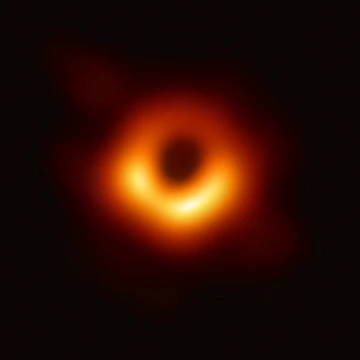
Black star (semiclassical gravity)
Theoretical alternative to black holes without an event horizon.

A black star is a theoretical gravitational object composed of matter, proposed as an alternative to the black hole concept within general relativity. It was developed using semiclassical gravity theory and does not require an event horizon, potentially representing a transitional phase between a collapsing star and a singularity.
- Field
- Theoretical physics, semiclassical gravity
- Known for
- Alternative to black holes without an event horizon
- Type
- Theoretical gravitational object
- Basis
- Semiclassical gravity theory
Lore & Background
The predicted interior of a black star is composed of a strange state of spacetime, with each length in depth heading inward appearing the same as a black star of equivalent mass and radius with the overlayment stripped off. Temperatures increase with depth towards the center. It features Hawking radiation as well as thermal Planckian radiation that closely resembles the expected Hawking radiation of an equivalent black hole.
Reader's Guide
The black star concept is significant as a theoretical alternative to black holes within semiclassical gravity, challenging the necessity of event horizons and singularities in gravitational collapse. It offers a potential resolution to the information paradox and other issues associated with classical black holes by avoiding a singularity through quantum vacuum effects. Its significance lies in providing a testable model that could mimic black hole observations while differing in interior structure and ultimate fate. The idea connects to broader theoretical frameworks, including the Einstein–Maxwell–Dirac and Einstein–Yang–Mills–Dirac systems, linking it to quantum electrodynamics and the standard model. While still hypothetical, the black star represents an important avenue for exploring the interface between general relativity and quantum mechanics, with implications for understanding the end states of stellar collapse and the nature of spacetime at extreme densities.
Did You Know?
- A black star does not require an event horizon.
- It is created when matter compresses at a rate significantly less than the free fall velocity of a hypothetical particle falling to the center of its star.
- Quantum processes create vacuum polarization, producing a form of degeneracy pressure that prevents spacetime from occupying the same space at the same time.
- A black star will appear almost exactly like a black hole because almost all light produced is drawn back to the star.
More in Black holes 1-24
Spotted an error? Know more?
Reader corrections go straight into our review queue. Suggest an edit · How this site is sourced