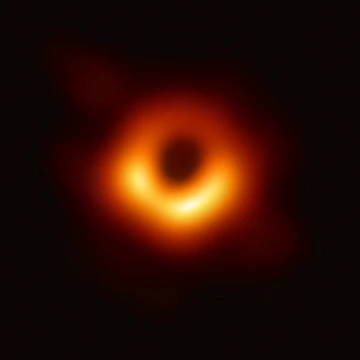
Outline of black holes
A region of spacetime where gravity prevents anything from escaping.

A black hole is a mathematically defined region of spacetime exhibiting such a strong gravitational pull that no particle or electromagnetic radiation can escape from inside it. The theory of general relativity predicts that a sufficiently compact mass can deform spacetime to form a black hole, with the boundary of this region called the event horizon. Black holes act like ideal black bodies, reflecting no light, and are predicted to emit Hawking radiation due to quantum effects near the event horizon.
- Type
- Astronomical object, black body, collapsed star
- Key property
- Event horizon – boundary from which no escape is possible
- Predicted emission
- Hawking radiation, with spectrum of a black body at temperature inversely proportional to mass
- Size range
- From micro black holes to supermassive black holes (hundreds of thousands to billions of solar masses)
- First commonly accepted example
- Cygnus X-1, discovered in 1964, accepted in early 1970s
- First direct image
- Supermassive black hole in Messier 87, observed in 2017, published April 10, 2019
Lore & Background
David Finkelstein identified the Schwarzschild surface as an event horizon. Roy Kerr found the exact solution for a rotating black hole in 1963. Stephen Hawking and Roger Penrose showed in the late 1960s that global singularities can occur and black holes are not mathematical artifacts. Cygnus X-1, discovered in 1964, became the first astrophysical object commonly accepted as a black hole after further observations in the early 1970s. James Bardeen and Jacob Bekenstein formulated black hole thermodynamics in the early 1970s, and Hawking predicted Hawking radiation in 1974. The LIGO Scientific Collaboration announced the first detection of a black hole merger via gravitational waves on February 11, 2016. The Event Horizon Telescope observed the supermassive black hole in Messier 87 in 2017, leading to the first direct image published on April 10, 2019.
Reader's Guide
Black holes are significant as extreme predictions of general relativity, testing the limits of physics. They are classified by properties such as rotation, charge, and size, from micro black holes (possibly primordial) to supermassive black holes at galaxy centers. Their properties include accretion disks that radiate X-rays, event horizons, photon spheres, ergospheres, and phenomena like spaghettification and gravitational lensing. Black hole thermodynamics connects gravity with quantum mechanics, and Hawking radiation suggests black holes can evaporate. Observations of Cygnus X-1, gravitational waves from mergers, and direct imaging of the Messier 87 black hole have confirmed their existence and advanced astrophysics. The M–sigma relation links supermassive black hole mass to galaxy bulge properties, indicating a role in galaxy evolution. Open questions remain about singularities, quantum effects, and the nature of virtual black holes.
Did You Know?
- The event horizon has no locally detectable features, though crossing it has enormous effect on the object's fate.
- Hawking radiation temperature is on the order of billionths of a kelvin for stellar-mass black holes, making it essentially impossible to observe.
- The first direct image of a black hole was of the supermassive black hole in Messier 87, published on April 10, 2019.
- A black hole can be classified as an astronomical object, a black body, and a collapsed star.
The Core Mechanism
The black hole bomb describes a dramatic physical effect in which a bosonic field striking a spinning black hole gets amplified through a process called superradiant scattering. The key to the "bomb" lies in what happens next: if that amplified field is bounced back toward the hole, the amplification repeats, and the cycle compounds until the field undergoes runaway growth — an explosion that can rival the energy output of a supernova. Nature offers one plausible route for the necessary reflection. If the bosonic field carries mass, the heavier modes become gravitationally trapped in the vicinity of the black hole rather than escaping to infinity. This confinement creates an endless loop of self-amplification, a condition physicists call a superradiant instability. Because the amplified field can emerge from mere background noise, the system is inherently unstable. The term can also describe a specific engineered setup, such as a Penrose sphere, in which no passive pathway exists for energy to leak out, guaranteeing the runaway cascade.
Historical Development
The intellectual lineage of the black hole bomb stretches back to 1971, when Roger Penrose proposed that a rotating black hole could shed angular momentum and energy onto a particle scattered by its spacetime — an idea now known as the Penrose process. The following year, Yakov Zel'dovich extended the reasoning to waves carrying angular momentum, demonstrating that any rotating absorber could amplify scattered waves. He illustrated the principle with electromagnetic waves bouncing off a spinning metal cylinder and observed that wrapping the setup in a resonant reflector would convert mere amplification into sustained generation. That same year, William H. Press and Saul Teukolsky applied the concept to the astrophysical setting of a rotating black hole and coined the memorable phrase "black hole bomb" to describe the resulting runaway scenario. Together, these three contributions within a single two-year window laid the theoretical groundwork for what would become a rich field of superradiance research.
Instability in Broader Systems
The black hole bomb is not confined to astrophysics. Zel'dovich's general rotational superradiance framework applies to any system where superradiant modes are confined near a rotating absorber and the energy loss from the system falls below the amplification gain. Under those conditions, the system tips into instability: background noise seeds an exponential climb in the amplitude of the resonant modes. The cascade continues until one of two endpoints is reached — either the confining structure can no longer hold the mode energy and the system effectively explodes, or the rotating body has bled off enough energy that it no longer satisfies the superradiance threshold for the trapped resonances. Electromagnetic and acoustic systems both exhibit analogous instabilities. In 2025, researchers reported observing this instability in a laboratory electromagnetic experiment, marking a significant step from purely theoretical prediction to empirical confirmation. The Penrose sphere, a geometry with no passive escape route for energy, remains a canonical example of a setup engineered to force the runaway cycle.
Implications for Fundamental Physics
Beyond its dramatic explosive potential, the black hole bomb carries deep implications for our understanding of fundamental physics. If such a runaway effect were ever observed to occur spontaneously in nature, it could signal new physics extending beyond the Standard Model. A 2017 paper by William E. East and Frans Pretorius, examining the superradiant instability and backreaction of massive vector fields around Kerr black holes, highlighted that the phenomenon would demonstrate black holes possess "hair" — additional structure beyond the mass, charge, and spin traditionally allowed by the no-hair theorem. This connection elevates the black hole bomb from a curiosity of general relativity to a potential probe of quantum field behavior in strong gravitational environments. The broader research community has pursued related questions, including work by Pani, Cardoso, Gualtieri, Berti, and Ishibashi in 2012, who explored how bounds on photon mass interact with black-hole-bomb scenarios, further linking the effect to constraints on fundamental particle properties.
Frequently Asked Questions
What exactly is a black hole?
A black hole is a region of spacetime where gravity is so extreme that nothing—not even light—can escape once it crosses the boundary. General relativity predicts that compressing enough mass into a small enough volume will warp spacetime into this inescapable zone.
What is an event horizon?
The event horizon is the one-way boundary encircling a black hole, marking the point of no return for any particle or radiation. Once something passes through it, escaping would require exceeding the speed of light, which is physically impossible.
What was the first black hole scientists actually accepted?
Cygnus X-1, identified in 1964, became the first widely recognized black hole candidate in the early 1970s. Before that confirmation, black holes existed purely as mathematical predictions from Einstein's field equations.
When did we first actually "see" a black hole?
The Event Horizon Telescope collaboration published the first direct image of a black hole's shadow on April 10, 2019, depicting the supermassive black hole at the center of galaxy Messier 87. The raw observations were collected in 2017, but processing the data took nearly two years.
Do black holes emit anything at all?
Stephen Hawking demonstrated that quantum effects near the event horizon cause black holes to radiate energy, now known as Hawking radiation. The emitted spectrum matches that of a perfect black body, with smaller holes radiating at higher temperatures than their supermassive counterparts.
More in Black holes 1-24
Spotted an error? Know more?
Reader corrections go straight into our review queue. Suggest an edit · How this site is sourced