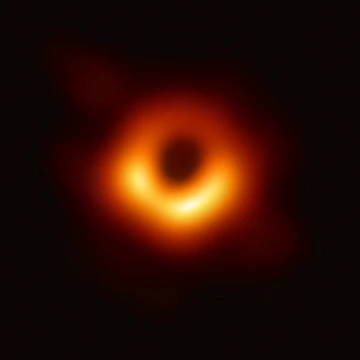
Extremal black hole
Hypothetical black hole with minimum mass and zero temperature.

An extremal black hole is a hypothetical black hole with the minimum possible mass compatible with its charge and angular momentum. It has zero temperature and emits no Hawking radiation. Although none have been observed in nature, extremal black holes serve as valuable theoretical constructs in black hole research.
- Field
- Theoretical physics
- Known for
- Zero Hawking temperature, supersymmetry in certain theories, use in string theory entropy calculations
Lore & Background
Extremal black holes are defined as black holes with the minimum possible mass that can coexist with their given charge and angular momentum. They are theorized to have zero Hawking temperature and therefore emit no Hawking radiation. In supersymmetric theories, extremal black holes are often supersymmetric themselves, a consequence of the BPS bound, and their entropy can be calculated using string theory.
A proposal known as the 'third law of black hole thermodynamics' states that no physical process can form a black hole with vanishing surface gravity, which would prevent the formation of an extremal black hole. A proof of this was published in 1986 by Werner Israel, but more recent work claims the proof contains an error, leaving the possibility of extremal black holes open. The third law of thermodynamics for black holes has always been controversial.
Near-extremal black holes, with mass slightly above the extremal value, have a simple horizon structure and are studied using perturbation theory around the extremal case. They have a very small Hawking temperature and emit a small amount of Hawking radiation. Their entropy can often be calculated in string theory, at least to first order in non-extremality.
Reader's Guide
Extremal black holes are significant primarily as theoretical tools. They provide a simplified setting for studying black hole thermodynamics, quantum gravity, and string theory. Their zero-temperature property allows researchers to explore the limits of black hole physics, such as the BPS bound and supersymmetry. The controversy surrounding the third law of black hole thermodynamics—whether extremal black holes can form—highlights ongoing debates in the field. Near-extremal black holes extend this utility by enabling perturbative calculations. While not observed, these constructs have advanced understanding of black hole entropy and the information paradox, and they remain a key concept in theoretical physics.
Did You Know?
- Extremal black holes have zero Hawking temperature and emit no Hawking radiation.
- In supersymmetric theories, extremal black holes are often supersymmetric due to the BPS bound.
- A 1986 proof by Werner Israel claimed no physical process can form an extremal black hole, but later work suggests an error in that proof.
- Near-extremal black holes have a very small Hawking temperature and are studied using perturbation theory.
The Architecture of No Return: Event Horizon and Singularity
A black hole represents the ultimate gravitational extreme in the cosmos: a region so densely packed that the escape velocity at its boundary surpasses the speed of light itself, sealing off any form of matter or radiation from ever reaching the outside universe. Albert Einstein's general theory of relativity provides the mathematical language for this phenomenon, recasting gravity not as a force but as the warping of spacetime by mass and energy. Within this framework, any object compressed below a critical threshold will inevitably collapse into a black hole, and the surface marking the point of no return is termed the event horizon. One of the most striking predictions of the theory is that an observer crossing this boundary would notice nothing unusual in their immediate surroundings; the trap is absolute, yet locally undetectable at the moment of passage. Deeper still, general relativity demands the existence of a central singularity, a point at the core where spacetime curvature becomes mathematically infinite, signaling the breakdown of the theory itself.
From Philosophical Curiosity to Physical Reality
The notion that an object's gravity could be strong enough to imprison its own light stretches back to the late 1700s, when English clergyman-astronomer John Michell and French mathematician Pierre-Simon Laplace each independently imagined stars so vast that their surface escape velocity would exceed light speed. Michell's 1784 letter even calculated that a Sun-density star with five hundred times the solar radius would be invisible, and he correctly suggested such bodies might still be detected through their gravitational pull on neighboring stars. For over a century, however, the idea remained a thought experiment. The turning point came in 1916, when Karl Schwarzschild derived the first exact solution to Einstein's newly published field equations, producing what we now call the Schwarzschild radius. Yet even then, the physics community was deeply skeptical; Arthur Eddington dismissed the concept in 1926, and Einstein himself attempted in 1939 to prove black holes could not form. It was not until the late 1950s and 1960s that theorists recognized these objects as a generic, unavoidable consequence of general relativity, and by 1974 the X-ray source Cygnus X-1 was widely accepted as the first confirmed stellar black hole.
Birth, Growth, and the Seating of Galaxies
The most common pathway to black hole formation is the violent death of a massive star. When such a star exhausts its nuclear fuel, its core can no longer support itself against gravity, and the resulting collapse during a supernova event compresses the remnant past the point of no return. Once born, a black hole is far from static; it continues to accrete surrounding gas, dust, and even entire stars, steadily increasing its mass. At the supermassive scale—millions of solar masses—growth can also proceed through the direct gravitational collapse of enormous gas clouds or through the merger of two smaller black holes. Modern astrophysics has reached a broad consensus that a supermassive black hole resides at the heart of most galaxies, acting as a gravitational anchor for the surrounding stellar population. These central giants are not merely relics of the early universe but remain active engines, their influence shaping the dynamics and evolution of their host galaxies over cosmic timescales.
Seeing the Invisible: Detection and the Quantum Whisper
Because a black hole emits no light of its own, astronomers must rely on its gravitational and electromagnetic fingerprints to confirm its presence. Matter spiraling inward forms a glowing accretion disk, heated to extreme temperatures by friction, and in the most energetic cases this produces a quasar, rivaling entire galaxies in brightness. When two black holes collide, the resulting distortion of spacetime radiates gravitational waves that can be detected by sensitive interferometers on Earth. Alternatively, the orbital wobble of companion stars reveals the mass and position of an unseen partner, a technique that has identified numerous stellar-mass black holes in binary systems and confirmed that the radio source Sagittarius A* at the Milky Way's center harbors a supermassive black hole of roughly 4.3 million solar masses. On the quantum side, field theory in curved spacetime predicts that horizons emit a faint thermal glow known as Hawking radiation, whose rate scales inversely with mass. In practice, even the smallest observed stellar black holes gain mass from the cosmic microwave background faster than they lose it through this quantum evaporation, making the effect negligible for all currently known objects.
Frequently Asked Questions
What is an extremal black hole?
An extremal black hole is a theoretical black hole sitting at the absolute minimum mass allowed for a given combination of electric charge and angular momentum. It represents the lightest configuration in which the event horizon still exists rather than the object becoming a naked singularity.
Why does an extremal black hole have zero temperature?
At the extremal limit the geometry of the horizon shifts such that the Hawking temperature drops to exactly zero. As a result the hole emits no thermal radiation whatsoever, unlike every other black hole solution of general relativity.
Have any extremal black holes ever been observed in nature?
No astronomer has ever detected one, and the charge-to-mass ratios required are so extreme that they are widely regarded as physically unrealistic for astrophysical objects. They remain purely mathematical constructs used to probe the boundaries of general relativity and quantum gravity.
How do extremal black holes connect to string theory?
In certain supersymmetric frameworks, extremal black holes can be modelled as bound states of strings and branes, allowing physicists to count their underlying microstates. That microstate count reproduces the Bekenstein-Hawking entropy formula, giving one of the few concrete bridges between quantum mechanics and black hole thermodynamics.
What is the key difference between an extremal and a non-extremal black hole?
A non-extremal black hole carries a positive Hawking temperature and steadily radiates energy, while an extremal one sits at the theoretical mass floor and radiates nothing. The extremal case also preserves a fraction of supersymmetry in certain models, making it a special limiting solution of the Einstein-Maxwell equations.
More in Black holes 1-24
Spotted an error? Know more?
Reader corrections go straight into our review queue. Suggest an edit · How this site is sourced