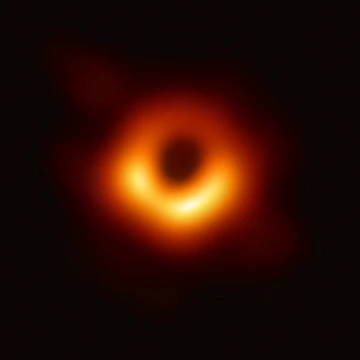
Intermediate-mass black hole
Black holes between stellar and supermassive in mass.

An intermediate-mass black hole (IMBH) is a class of black hole with mass in the range of 100 to 100,000 solar masses, significantly higher than stellar black holes but lower than supermassive black holes. Several candidate objects have been discovered in the Milky Way and nearby galaxies based on indirect observations of gas cloud velocities and accretion disk spectra, though evidence varies in strength.
- Mass range
- 100 to 100,000 solar masses
- First gravitational wave merger
- GW190521 (21 May 2019, published 2 September 2020)
- Largest candidate sample
- 305 candidates from Sloan Digital Sky Survey
- Notable candidate
- HLX-1 in galaxy ESO 243–49
- Detection methods
- Gravitational waves, reverberation mapping, X-ray sources, stellar velocities
Lore & Background
Observational evidence for IMBHs includes the gravitational wave signal GW190521, resulting from the merger of two black holes of 85 and 65 solar masses, forming a 142-solar-mass black hole. Another signal, GW231123, was observed on 23 November 2023 and announced in July 2025. Before these, the strongest evidence came from low-luminosity active galactic nuclei, such as NGC 4395, which appears to contain a black hole of about 360,000 solar masses—though this exceeds the typical IMBH range, some studies consider it a candidate. The largest sample of IMBH candidates includes 305 selected from one million optical spectra, with X-ray emission detected from 10 of them.
Reader's Guide
Intermediate-mass black holes occupy a crucial gap in the black hole mass spectrum, bridging stellar-mass and supermassive black holes. Their existence is key to understanding how supermassive black holes grow, possibly through mergers of smaller black holes or runaway collisions in dense star clusters. However, many claimed detections remain disputed: for instance, globular cluster candidates like M31 G1 can be fit without a massive central object, and the quasiperiodic oscillation from M82 X-1 is based on only about four cycles. The M–sigma relation predicts IMBHs in low-luminosity galaxies, with the smallest prediction being the nucleus of RGG 118 at about 50,000 solar masses. Their origin remains uncertain, with proposed scenarios including merging of stellar-mass black holes, runaway collisions in dense clusters, or primordial formation in the Big Bang.
Did You Know?
- The largest sample of intermediate-mass black hole candidates includes 305 selected from one million optical spectra from the Sloan Digital Sky Survey.
- The candidate HLX-1 in galaxy ESO 243–49 is an intermediate-mass black hole with a smaller cluster of stars around it.
- A study from July 2024 suggested that seven fast-moving stars in Omega Centauri could be bound to an IMBH of at least 8,200 solar masses, though this remains a candidate rather than a confirmed detection.
Seeds of the Intermediate Regime
The link between primordial black holes and intermediate-mass black holes rests on a deceptively simple idea: objects born in the earliest instants of the cosmos could serve as the foundational seeds from which larger black holes later grow. Because primordial black holes were created before the first stars ever ignited, they are not confined to the narrow mass window that stellar evolution typically produces. Their initial masses, depending on the cosmological model invoked, can span an extraordinary range—from Planck-scale relics of roughly 10 to the minus 8th power kilograms up to objects exceeding thousands of solar masses. This wide span means a fraction of the primordial population could naturally fall into the intermediate-mass bracket, providing ready-made starting points for IMBH growth. Unlike stellar-mass black holes, which demand the violent compression of a dying star, these early-universe objects formed purely through gravitational collapse of extremely dense pockets of subatomic matter during the inflationary and radiation-dominated epochs. Their existence, though still hypothetical, offers a pathway to explain how intermediate-mass black holes might have been present long before galactic centers had time to assemble them through conventional accretion channels.
A Formation Pathway Without Stars
The standard route to black hole creation in the present universe demands the death of a massive star, a supernova event that compresses the stellar core beyond the point of no return. Primordial black holes bypass this requirement entirely. In the inflationary era and the early radiation-dominated phase of the cosmos, regions of subatomic matter could become so extraordinarily dense that gravity overwhelmed all other forces, triggering collapse into a black hole without any stellar progenitor. This mechanism places their birth typically less than one second after the Big Bang, well before the nucleosynthesis that produced the baryonic matter we observe today. For intermediate-mass black holes specifically, this starless formation channel is significant because it removes the need to explain how a black hole of several hundred to thousands of solar masses could assemble itself in the sparse environments of early galaxies. The objects would simply have been born at that mass, or close to it, in the turbulent first instants of cosmic history, and then persisted—provided their mass exceeded roughly 10 to the 12th power kilograms, below which Hawking radiation would have evaporated them long before the present epoch.
Mass Distributions and the Dark Matter Question
A long-standing hypothesis holds that primordial black holes could constitute a major, perhaps even dominant, fraction of the universe's dark matter. This idea gained fresh momentum when gravitational-wave detections by LIGO and Virgo revealed that merging black holes do not all share a single mass; instead, their distribution is broad and, as JWST observations of early massive galaxies suggest, broadly platykurtic. Recent analyses converge on a picture in which the primordial population peaks around one solar mass but extends over a wide range, a profile that naturally includes objects in the intermediate-mass bracket. These candidates possess several attractive properties for a dark matter role: they are nearly collisionless, stable if sufficiently massive, and move at non-relativistic speeds. Critics, however, point to tight abundance limits derived from microlensing surveys, cosmic microwave background anisotropies, and the sizes of faint dwarf galaxies. Newer work has revived the possibility by proposing that primordial black holes formed in clusters during the quark-hadron epoch—around one or thirty solar masses—and later dispersed, which could reconcile their presence with existing observational constraints while still allowing a non-negligible contribution to the dark matter budget.
Observational Milestones and the IMBH Connection
The detection of gravitational waves by Advanced LIGO and Virgo in 2015, from the merger of two roughly 30-solar-mass black holes, sent shockwaves through the primordial black hole community. Within a month, three independent research groups argued that the detected objects could have a primordial origin rather than a stellar one. Two of those groups found the inferred merging rates compatible with a scenario in which all dark matter consists of primordial black holes, provided a non-trivial fraction are clustered within faint dwarf galaxies or globular clusters, as standard structure-formation theory predicts. A third group concluded the opposite, limiting the primordial contribution to under one percent of total dark matter. The unexpectedly large masses of the LIGO sources reignited interest in the one-to-one-hundred-solar-mass range, squarely in the territory where intermediate-mass black holes reside. Subsequent observations—JWST's discovery of unexpectedly large high-redshift galaxies, NANOGrav's 2021 low-frequency gravitational-wave signal, and proposals linking primordial objects to the mysterious Little Red Dots—have continued to tighten the web of evidence, keeping the question of whether a primordial seed population underlies the intermediate-mass class very much alive.
Frequently Asked Questions
What is an intermediate-mass black hole?
An IMBH is a black hole whose mass falls between the stellar-mass and supermassive categories, spanning roughly 100 to 100,000 solar masses. It occupies the long-sought middle rung of the black-hole mass ladder.
How do scientists hunt for intermediate-mass black holes?
Detection relies on a toolkit that includes gravitational-wave signals, X-ray accretion-disk emission, reverberation mapping of surrounding gas, and precise measurements of stellar orbital velocities. The Sloan Digital Sky Survey has yielded a pool of 305 candidate objects, the largest sample assembled to date.
What was the first gravitational-wave event tied to an intermediate-mass black hole?
GW190521, recorded on 21 May 2019 and published in September 2020, was the first confirmed merger involving objects in the intermediate-mass range. It gave the community its strongest direct proof that IMBHs not only exist but can collide and merge.
What is HLX-1 and why do fans keep bringing it up?
HLX-1 is a persistently bright X-ray source in the galaxy ESO 243–49, often cited as one of the most compelling IMBH candidates known. Its unusually steady high-energy output points to a black hole well above stellar mass yet below the supermassive threshold.
Why do intermediate-mass black holes matter to the bigger picture?
IMBHs are widely viewed as the critical growth bridge between stellar-mass remnants and the supermassive giants that sit at the hearts of galaxies. Confirming their existence helps astronomers close the gap in the black-hole evolution story.
More in Black holes 1-24
Spotted an error? Know more?
Reader corrections go straight into our review queue. Suggest an edit · How this site is sourced