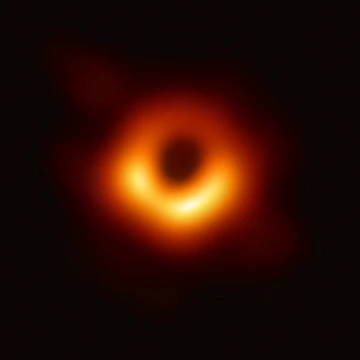
Astrophysical jet
Bipolar streams of ionised matter expelled at high velocity.

Astrophysical jets are streams of ionized gas ejected at high speed from an astronomical object, appearing as two narrow beams shooting in opposite directions along the object's rotation axis. When the ejected material moves near the speed of light, the jet is called a relativistic jet, because it exhibits effects explained by special relativity. These jets are linked to various high-energy sources, including black holes, neutron stars, and pulsars, though their exact origins remain unclear.
Scientists think jets form from dynamic processes in accretion disks. As the disk spins, it creates a rotating, tangled magnetic field that funnels disk material into the jets and propels it away from the central object. A general relativity effect called frame-dragging may also influence jet behavior. The largest and most powerful jets come from supermassive black holes at the centers of active galaxies, such as quasars and radio galaxies, or within galaxy clusters, and can stretch over millions of parsecs. Other sources include cataclysmic variable stars, X-ray binaries, and gamma-ray bursts. Smaller jets, about a parsec in size, appear in star-forming regions around T Tauri stars and Herbig–Haro objects, which are partly shaped by jet interactions with the interstellar medium. Bipolar outflows are also associated with protostars, evolved post-AGB stars, planetary nebulae, and bipolar nebulae.
Relativistic jets are beams of ionized matter accelerated to nearly the speed of light. Most are linked to central black holes in active galaxies, radio galaxies, or quasars, as well as to galactic stellar black holes, neutron stars, and pulsars. Their lengths range from thousands to millions of parsecs. At such speeds, special relativity causes noticeable effects, like relativistic beaming, which alters the jet's apparent brightness. The most powerful jets come from massive central black holes, but their structure and behavior resemble those from smaller galactic neutron stars and black holes. These smaller systems, often called microquasars, show a wide range of velocities—for instance, the SS 433 jet averages 0.26c. Relativistic jet formation may also explain gamma-ray bursts, which produce the most relativistic jets known, being ultrarelativistic.
The composition of jets is still uncertain.
- Key feature
- Bipolar streams of ionised matter aligned with rotation axis
- Energy source theories
- Blandford–Znajek process (extracts rotational energy from a spinning black hole via magnetic fields anchored in the accretion disk or ergosphere), Penrose mechanism, accretion disk dynamics
Lore & Background
Astrophysical jets are believed to arise from dynamic interactions within accretion disks. One explanation is that as an accretion disk spins, it generates a rotating, tangled magnetic field which concentrates material from the disk into the jets and then drives it away from the central object. Jets may also be influenced by a general relativity effect known as frame-dragging. Most of the largest and most active jets are created by supermassive black holes in the centre of active galaxies. In the Milky Way, the largest known jet comes from SS 433, not from IGR J11014-6103, though the latter's jet does move at 0.8c.
Reader's Guide
Astrophysical jets are significant because they represent a fundamental mechanism for energy and matter transport across cosmic scales, from star-forming regions to the centres of galaxies. Relativistic jets, in particular, demonstrate special relativistic effects such as beaming, and their study helps probe the environments around black holes and neutron stars. The mechanisms behind jet composition remain uncertain, with some studies favouring an electrically neutral mixture of nuclei, electrons, and positrons, while others are consistent with positron–electron plasma. The Blandford–Znajek process and Penrose mechanism offer theoretical frameworks for extracting energy from rotating black holes to power jets. Observations of jets from neutron stars, such as pulsar IGR J11014-6103, challenge simple rotation or accretion power models, indicating that jet formation may involve multiple, not yet fully understood processes. Understanding astrophysical jets thus advances knowledge of accretion physics, general relativity, and the evolution of galaxies and stellar systems.
Did You Know?
- Relativistic jets are beams of ionised matter accelerated close to the speed of light.
- The SS 433 jet has a mean velocity of 0.26c.
- Pulsar IGR J11014-6103 has the largest jet observed in the Milky Way, with velocity estimated at 0.8c.
- The Blandford–Znajek process explains extraction of energy from magnetic fields around an accretion disk, twisted by the spin of the black hole.
Formation and the Mystery of Energy Extraction
Astrophysical jets remain one of the most enigmatic phenomena in high-energy astronomy. While their existence is well documented, the precise mechanisms that launch them are still debated. The leading picture involves a spinning accretion disk surrounding a compact object—whether a black hole, neutron star, or pulsar. As the disk rotates, it twists and tangles the magnetic field threading through it. This tangled field then funnels disk material into two narrow, collimated streams that shoot out in opposite directions along the object's rotational axis. General relativity adds another layer: the frame-dragging effect of a spinning mass can further shape and energise the outflow. Two landmark theories formalise how a black hole's spin transfers energy into the jet. The Blandford–Znajek process describes magnetic field lines being wound tighter by the hole's rotation until they fling relativistic material outward. The Penrose mechanism, later extended by Reva Kay Williams to account for relativistic particle momentum, extracts energy directly through gravitomagnetic interactions. In practice, the true picture likely blends contributions from the accretion disk, X-ray emission, and the central engine's spin.
Relativistic Beams and the Speed-of-Light Frontier
When jet material accelerates to a significant fraction of light speed, the outflow enters the relativistic regime and begins to display the striking predictions of special relativity. The most dramatic signature is relativistic beaming: the apparent brightness of the beam shifts depending on the observer's angle relative to the flow, making one side of a pair of jets look far brighter than the other. The most powerful examples come from supermassive black holes at the hearts of quasars and radio galaxies, where beam lengths stretch across hundreds of thousands or even millions of parsecs. Yet the same structural patterns appear in far smaller systems called microquasars, powered by stellar-mass black holes or neutron stars. The pulsar system SS 433, for instance, ejects material at a mean speed of roughly 0.26 times the speed of light. At the extreme end, gamma-ray bursts produce the most ultrarelativistic jets known. The exact composition of these beams is still contested: some models favour an electrically neutral blend of nuclei, electrons, and positrons, while others point to a pure positron–electron plasma. If heavier nuclei are swept up in such a plasma, they would inherit the same near-light velocity and carry extraordinary energy.
A Spectrum of Scales: From Stellar Nurseries to Galaxy Clusters
Jets are not the exclusive province of supermassive black holes; they appear across an astonishing range of sizes and source types. At the grandest scale, the most active and longest jets are launched by supermassive black holes sitting in the cores of quasars, radio galaxies, and galaxy clusters, with lengths that can surpass millions of parsecs. The elliptical galaxy CGCG 049-033, located roughly 600 million light-years from Earth, hosts what is currently the longest galactic jet ever identified. Moving down in scale, cataclysmic variable stars, X-ray binary systems, and the cataclysmic events known as gamma-ray bursts all produce or are shaped by jet activity. At the smallest end, parsec-scale outflows are detected in star-forming regions. T Tauri stars and Herbig–Haro objects, for example, are partially sculpted by the collision of young stellar jets with the surrounding interstellar medium. Bipolar outflows are also linked to protostars still gathering mass, to evolved post-AGB stars, and to the formation of planetary nebulae and bipolar nebulae. This continuity from a few parsecs to millions demonstrates that the underlying physics of collimated, high-velocity outflow operates across many orders of magnitude.
The Neutron Star Jet Enigma
Among the most puzzling jet sources are spinning neutron stars, which should, in principle, follow the same accretion-and-rotation logic as black holes. The pulsar IGR J11014-6103 provides a striking counter-example. It hosts the largest jet yet observed within the Milky Way, with material streaming at an estimated 80 percent of the speed of light. X-ray emission from the system has been detected, yet no radio signature and no accretion disk have been found. Early assumptions held that the pulsar was spinning rapidly, supplying the rotational energy needed to drive the jet. Subsequent measurements, however, revealed a spin rate of only 15.9 hertz—far too slow to account for such a powerful outflow. The absence of both an accretion disk and a fast spin means the jet appears to be powered by neither of the two mechanisms that explain most other relativistic jets. Complicating the picture further, the beam is neatly aligned with the pulsar's rotation axis yet runs perpendicular to the star's actual direction of travel through space. This combination of clues leaves astrophysicists without a complete explanation for where the energy and collimation originate.
Frequently Asked Questions
What is an astrophysical jet?
An astrophysical jet is a pair of narrow, high-speed beams of charged particles that shoot out in opposite directions from a compact object, aligned along its spin axis. They are most commonly associated with black holes, neutron stars, and pulsars.
How does an astrophysical jet form?
The leading idea is that the swirling accretion disk around a black hole twists magnetic field lines, and those fields then channel and launch the ionized plasma outward along the rotation axis. The exact mechanism is still debated among astrophysicists.
What powers an astrophysical jet?
One prominent theory, the Blandford–Znajek process, proposes that magnetic fields anchored in the disk or ergosphere siphon rotational energy directly from the spinning black hole. Other contributors include the Penrose mechanism and general accretion-disk dynamics.
What makes a jet 'relativistic'?
When the ejected plasma travels at a significant fraction of the speed of light, the jet is labeled relativistic because its behavior—such as apparent superluminal motion and Doppler boosting—requires special relativity to explain.
Why are astrophysical jets important to black hole research?
They serve as a natural laboratory for studying how extreme gravity, magnetism, and plasma physics interact under conditions we cannot reproduce on Earth. Observing them also helps astronomers identify and characterize otherwise invisible black holes.
More in Black holes 1-24
Spotted an error? Know more?
Reader corrections go straight into our review queue. Suggest an edit · How this site is sourced