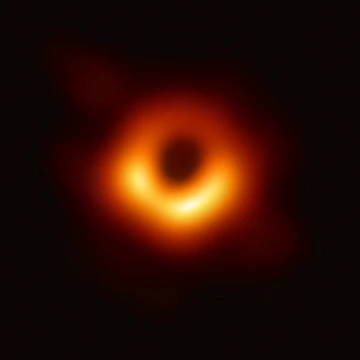
Binary black hole
Two black holes in close orbit, confirmed by gravitational waves.

A binary black hole is a system where two black holes orbit one another. These systems come in two main types: stellar-mass binaries, which form from the remains of massive binary stars or through gravitational capture, and supermassive binaries, which are thought to result from galaxy mergers. Stellar-mass binary black holes were directly detected for the first time in September 2015 via gravitational waves. Supermassive binary candidates have been identified through indirect signs, but none have been directly confirmed yet.
For decades, black holes were hard to prove because they emit no light. But Einstein’s theory predicted that merging black holes would release immense energy as gravitational waves, with distinct patterns calculable from general relativity. This made binary black holes a key target for gravitational-wave observatories. As the black holes spiral together, they radiate gravitational waves, causing their orbit to decay and their orbital period to shorten. This inspiral phase lasts until they finally merge. In the final milliseconds, the black holes accelerate to extreme speeds, and the gravitational wave signal peaks. After merging, the resulting single black hole settles into a stable shape—a stage called ringdown—where any distortions are radiated away as more gravitational waves.
The first confirmed stellar-mass binary black hole merger, GW150914, was detected by LIGO in September 2015 and announced in February 2016. It involved two black holes of about 30 solar masses each, located roughly 1.3 billion light-years away. In its last 20 milliseconds of spiraling and merging, it released energy equivalent to three solar masses, peaking at a power of 3.6×10⁴⁹ watts—more than the combined light of every star in the observable universe.
Stellar-mass binary black holes are now known to exist, thanks to GW150914. Supermassive black hole binaries are expected to form when galaxies merge. Candidate systems include galaxies with double cores, like NGC 6240, and single-core galaxies with double emission lines, such as SDSS J104807.74+005543.5 and EGSD2 J142033.66 525917.5. Some galactic nuclei show periodic emissions, suggesting a large object orbits a central black hole—for example, OJ287, a likely supermassive binary with a 12-year orbital period.
- Type
- Astronomical object
- Classification
- Stellar-mass or supermassive
- First confirmed
- September 2015 (GW150914)
- Key observatory
- Laser Interferometer Gravitational-Wave Observatory (LIGO)
- Known for
- Strongest known sources of gravitational waves; confirmation of gravitational waves and black hole mergers
Lore & Background
For many years, proving the existence of black holes was challenging because they allow no visible light or other electromagnetic radiation to escape. However, it was known from Einstein that if a pair of black holes were to merge, an immense amount of energy would be given off as gravitational wave radiation, with distinctive waveforms that could be calculated using general relativity. During the late 20th and early 21st century, binary black holes became of great interest scientifically as a potential source of gravitational waves. Binary black hole mergers would be one of the strongest known sources of gravitational waves in the universe, and thus offered a good chance of directly detecting such waves. As the orbiting black holes give off these waves, the orbit decays, and the orbital period decreases. This lengthy inspiral stage persists until the black holes finally merge when they are close enough. In the final fraction of a second the black holes can reach extremely high velocity, and the gravitational wave amplitude reaches its peak. Once merged, the single hole settles down to a stable form, a stage called ringdown, where aspherical distortions in its shape are dissipated as additional gravitational wave radiation.
Reader's Guide
The existence of stellar-mass binary black holes (and gravitational waves themselves) was finally confirmed when LIGO detected GW150914, a distinctive gravitational wave signature of two merging stellar-mass black holes of around 30 solar masses each, occurring about 1.3 billion light-years away. In its final 20 ms of spiraling inward and merging, GW150914 released around 3 solar masses as gravitational energy, peaking at a rate of 3.6×10⁴⁹ W—more than the combined power of all light radiated by all the stars in the observable universe put together. Supermassive binary black holes are believed to form during galaxy mergers, with candidates such as NGC 6240, SDSS J104807.74+005543.5, and OJ287. The final parsec problem describes the difficulty of bringing supermassive black holes close enough for gravitational waves to cause merger, with proposed solutions including dynamical friction, circumbinary accretion, and interactions with a third supermassive black hole. The lifecycle of a binary black hole includes inspiral, merger, and ringdown stages, each characterized by distinct gravitational wave emissions. The first observation of stellar-mass binary black holes merging, GW150914, was performed by the LIGO detector, with the signal consistent with predictions of numerical relativity simulations.
Did You Know?
- During its final 20 ms of merging, GW150914 released around 3 solar masses as gravitational energy, peaking at 3.6×10⁴⁹ W.
- Supermassive binary black hole candidates include NGC 6240, SDSS J104807.74+005543.5, and OJ287.
- The final parsec problem arises because dynamical friction ejects matter from the orbital path, making it difficult for supermassive black holes to merge within the age of the universe.
Theoretical Foundations in General Relativity
Albert Einstein's 1915 general theory of relativity redefined gravitation not as a force but as the curvature of spacetime caused by matter. Within months of the field equations being published, astrophysicist Karl Schwarzschild applied them to a spherically symmetric, non-spinning star and uncovered a solution in which, at a particular radius, mathematical terms diverged to infinity. That radius later became known as the Schwarzschild radius, and the boundary it defines—the event horizon—marks the point of no return, beyond which not even light can escape. General relativity further predicts that every black hole harbours a central singularity where spacetime curvature becomes infinite. Strikingly, crossing that horizon would produce no locally detectable change for an infalling observer. The theory's acceptance was not immediate: in 1926 Arthur Eddington dismissed compressed stars as a flaw in the still-young framework, and in 1939 Einstein himself attempted to demonstrate their impossibility by arguing that pressure or centrifugal forces would always halt collapse. He overlooked the possibility that implosion could push a system past the critical threshold. It was not until the 1960s that the physics community broadly recognized black holes as a generic, unavoidable prediction of general relativity rather than a mathematical oddity.
From 18th-Century Speculation to Accepted Astrophysics
The notion that an object's gravity could be strong enough to trap its own light predates modern astrophysics by more than a century. In 1784, English clergyman and astronomer John Michell published a brief letter calculating that a star sharing the Sun's density but stretched to five hundred times its radius would have a surface escape velocity exceeding the speed of light, rendering it invisible. He correctly suggested such bodies might still be detected through their gravitational pull on nearby visible objects. Two decades later, Pierre-Simon Laplace offered a similar qualitative argument in his treatise on the Solar System, and when Franz Xaver von Zach pressed him for a mathematical treatment, Laplace supplied one for publication. The first rigorous solution of Einstein's equations appeared in 1916, and only by the late 1950s did physicists begin interpreting it as a genuine region from which nothing could emerge. The turning point came in the 1960s, when theoretical work established that such objects were not exotic edge cases but a generic consequence of general relativity. The first black hole to win wide scientific acceptance was the X-ray source Cygnus X-1, identified through a series of studies spanning 1971 to 1974.
Formation, Growth, and the Supermassive Question
Stellar-mass black holes are born in the violent death throes of massive stars. When such a star exhausts its nuclear fuel and collapses at the end of its life cycle, the resulting supernova can leave behind a remnant so compact that its gravity overwhelms all outward pressure, creating a black hole. Once formed, these objects are far from static: they continue to grow by absorbing mass from their surroundings. At the other extreme, supermassive black holes containing millions of solar masses may originate through several pathways—devouring stars over cosmic timescales, merging with other black holes, or forming directly from the gravitational collapse of enormous gas clouds. There is broad consensus among astronomers that a supermassive black hole resides at the centre of most galaxies. In our own Milky Way, the radio source known as Sagittarius A* has been established as hosting a supermassive black hole of approximately 4.3 million solar masses, a finding derived from tracking the orbits of stars circling the galactic core. This object exemplifies how black holes, from stellar to supermassive, serve as gravitational anchors shaping the structure of their host systems.
Detecting the Invisible: Observation and Quantum Effects
Because a black hole emits no light of its own, astronomers must rely on indirect signatures to confirm its presence. Matter spiralling inward forms an accretion disk of plasma heated to extreme temperatures by friction, radiating across the electromagnetic spectrum. In the most energetic cases, this process powers a quasar, one of the brightest objects known. When two black holes merge, the distortion of spacetime they generate propagates outward as gravitational waves, offering a completely independent detection channel. Stars orbiting an invisible companion reveal both the black hole's mass and its position through careful tracking of their motions; this technique has identified numerous stellar-mass black hole candidates in binary systems. On the quantum side, field theory in curved spacetime predicts that event horizons emit a faint thermal glow known as Hawking radiation, with the emission rate inversely proportional to the black hole's mass. In principle this causes gradual mass loss, but for the smallest observed class—stellar black holes—the rate is so minuscule that they actually gain mass from the cosmic microwave background faster than they radiate it away.
Frequently Asked Questions
What is a binary black hole?
A binary black hole is a pair of black holes locked in mutual orbit around a common center of mass. Unlike a single isolated black hole, the two objects continuously tug on each other, slowly spiraling inward until they eventually merge into one.
How were binary black holes first confirmed?
In September 2015, LIGO recorded the gravitational-wave signal from the merger of two stellar-mass black holes, an event catalogued as GW150914. This marked the first direct detection of a binary black hole system and the first-ever observation of gravitational waves.
What are the two main classes of binary black holes?
Stellar-mass binaries consist of two black holes left behind by the collapse of massive companion stars or captured gravitationally, while supermassive binaries are predicted to arise when two galaxies collide and their central black holes settle into orbit. Direct confirmation exists for the stellar-mass class, but supermassive candidates remain unconfirmed.
Why are binary black holes significant for physics?
They are the most powerful known emitters of gravitational waves in the universe, providing a natural laboratory to test general relativity under extreme conditions. Their detection also confirmed Einstein's century-old prediction that accelerating massive objects ripple the fabric of spacetime.
How do binary black holes form?
Stellar-mass pairs typically originate as two massive stars in a binary system that each collapse into black holes, or they can form when a passing black hole is gravitationally captured by another. Supermassive pairs are expected to emerge after two galaxies merge, dragging their central black holes into a shared orbit.
More in Black holes 1-24
Spotted an error? Know more?
Reader corrections go straight into our review queue. Suggest an edit · How this site is sourced