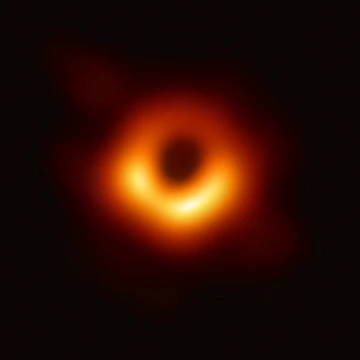
AdS black hole
Black hole solution with negative cosmological constant, asymptotic to anti-de Sitter space.

An anti-de Sitter (AdS) black hole is a theoretical object predicted by general relativity and its extensions. It describes an isolated, massive body existing within a universe that has a negative cosmological constant. Unlike a standard black hole, which flattens out into Minkowski spacetime far away, this type of black hole instead approaches the geometry of anti-de Sitter space at great distances. It can be thought of as a generalization of the Kerr black hole solution.
In four dimensions (three spatial dimensions plus time), the shape of spacetime around such a black hole is described by a specific metric. This metric depends on a radial coordinate, time, and two angular coordinates, and it includes a constant related to the black hole's mass and a constant representing the curvature of the AdS space. For higher dimensions, the metric follows a similar pattern, with the mass term adjusted to account for the extra dimensions.
According to the AdS/CFT correspondence, if gravity were a quantum theory, an AdS black hole would correspond to a thermal state on the boundary of the space. In a practical application like AdS/QCD, this thermal state represents the deconfined phase of quark-gluon plasma. For an observer falling into an AdS black hole, the spacetime near the central singularity is predicted to undergo chaotic, oscillatory behavior of the BKL type.
- Field
- Theoretical physics
- Known for
- Black hole solution with negative cosmological constant, asymptotic anti-de Sitter space, and role in AdS/CFT correspondence
- Type
- Theoretical object
- Dimensions
- 3+1 and d+1 dimensions
Lore & Background
In 3+1 dimensions, the metric of an AdS black hole is given by ds² = −(k²r² + 1 − C/r) dt² + 1/(k²r² + 1 − C/r) dr² + r² dΩ², where t is time, r is radial coordinate, Ω are polar coordinates, C is a constant, and k is the AdS curvature. In general, for d+1 dimensions, the metric becomes ds² = −(k²r² + 1 − C/r^(d−2)) dt² + 1/(k²r² + 1 − C/r^(d−2)) dr² + r² dΩ².
According to the AdS/CFT correspondence, if gravity were quantized, an AdS black hole would be dual to a thermal state on the conformal boundary. In contexts such as AdS/QCD, this corresponds to the deconfinement phase of the quark–gluon plasma. Late-infall observers into AdS black holes may experience chaotic oscillations of spacetime of BKL type near their central singularities.
Reader's Guide
AdS black holes are significant in theoretical physics as solutions to general relativity with a negative cosmological constant, providing a framework for studying black holes in asymptotically anti-de Sitter spacetimes. Their importance is amplified by the AdS/CFT correspondence, which suggests that if gravity were quantized, an AdS black hole would be dual to a thermal state on the conformal boundary. This duality has applications in AdS/QCD, where it models the deconfinement phase of the quark–gluon plasma. The metric formulations in 3+1 and d+1 dimensions allow for generalizations of the Kerr vacuum solution. Additionally, the chaotic BKL-type oscillations near the central singularity offer insights into the nature of spacetime near black hole singularities. These features make AdS black holes a key tool for exploring quantum gravity, holography, and high-energy physics.
Did You Know?
- An AdS black hole asymptotically approaches anti-de Sitter space at spatial infinity.
- The metric in 3+1 dimensions includes a constant C and the AdS curvature k.
- Late-infall observers may experience chaotic BKL-type oscillations near the central singularity.
Formation and Physical Character
Primordial black holes represent a fundamentally different origin story compared to the stellar-mass black holes produced by supernova explosions. In the inflationary epoch and the early radiation-dominated phase of the cosmos, regions of subatomic matter became so densely concentrated that gravity triggered collapse without any stellar fuel cycle or core implosion. Because this mechanism predates the ignition of the first stars, the resulting objects are not confined to the narrow mass window typical of stellar remnants. Theoretical models allow initial masses spanning an extraordinary range, from Planck-scale relics of roughly ten to the minus eighth kilogram up to objects exceeding thousands of solar masses. However, any primordial black hole born below approximately ten to the twelfth kilogram would have already evaporated entirely through Hawking radiation long before the present epoch. At the low-mass end, surviving specimens could possess the mass of a small asteroid while measuring only the diameter of a hydrogen atom, hurtling through space at tremendous velocities. Most would traverse a star in a matter of moments with negligible disturbance, yet slower-moving individuals might be gravitationally captured. Stephen Hawking even speculated that our own Sun could be harbouring such a compact intruder.
Theoretical Roots and Cosmological Role
The concept of black holes born in the infant universe was first articulated in 1966 by Yakov Zeldovich and Igor Novikov, who envisioned gravitational collapse occurring in the earliest moments after the Big Bang. Stephen Hawking followed with the first rigorous, in-depth treatment in 1971, laying groundwork that the field still builds upon. Although the hypothesis remains unconfirmed, its cosmological implications are substantial. Because these objects would form before the nucleosynthesis that produced the baryonic matter we observe, they naturally sidestep the constraints that apply to stellar remnants. They fit neatly into the category of massive compact halo objects, exhibiting properties that make them attractive dark matter candidates: they interact with other matter only through gravity, persist indefinitely once massive enough, drift at speeds well below the speed of light, and typically appear within the first second of cosmic history. Beyond dark matter, primordial black holes are also regarded as promising seeds for the supermassive black holes anchoring the cores of large galaxies, as well as for the intermediate-mass black holes that occupy a puzzling middle ground in the black hole mass spectrum.
The Dark Matter Controversy and Gravitational Wave Evidence
Primordial black holes have long occupied a contested position in the dark matter debate. Early analyses assumed that most would share a single, monochromatic mass, but the detection of gravitational waves by LIGO and Virgo shattered that assumption, revealing a broader mass distribution. JWST observations of unexpectedly large early galaxies further suggested a broadly platykurtic spread, and recent syntheses point to a mode near one solar mass. In March 2016, one month after the landmark detection of two merging thirty-solar-mass black holes, three independent research groups proposed a primordial origin. Two argued that the inferred merger rates were fully compatible with dark matter consisting entirely of primordial black holes, provided a non-negligible fraction resided in clustered structures such as dwarf galaxies or globular clusters. The third group concluded the opposite, limiting the primordial contribution to under one percent of total dark matter. Critics continue to cite tight constraints from microlensing surveys, cosmic microwave background anisotropies, dwarf galaxy sizes, and X-ray and radio source correlations, while newer models invoke clusters that disperse over time, with formation concentrated in the quark-gluon plasma epoch at roughly one or thirty solar masses.
Recent Frontiers and Speculative Horizons
The past decade has seen a remarkable surge of speculative applications for primordial black holes. In September 2022, researchers invoked them to account for the so-called Little Red Dots, surprisingly massive galaxies detected at high redshift by the James Webb Space Telescope. A 2019 proposal by James Unwin and Jakub Scholtz suggested a primordial black hole of five to fifteen Earth masses, roughly the diameter of a tennis ball, lurking in the extended Kuiper Belt as an alternative explanation for the orbital anomalies once attributed to a hypothetical ninth planet. That same year, a separate study opened the door to asteroid-mass primordial black holes constituting all of dark matter. In September 2021, the NANOGrav collaboration reported a low-frequency signal potentially attributable to gravitational waves from such objects. Then, on 26 November 2023, researchers presented what they described as the first evidence of an overmassive black hole galaxy, a structure whose existence would require an unusually heavy black hole seed—precisely the kind of object primordial black hole theory predicts. Each of these threads keeps the hypothesis alive and under active investigation.
Frequently Asked Questions
What is an AdS black hole?
An AdS black hole is a theoretical solution in general relativity describing a massive, isolated body embedded in a universe with a negative cosmological constant. Rather than fading into flat Minkowski space at large distances, the surrounding geometry instead settles into the characteristic negative curvature of anti-de Sitter space.
How does an AdS black hole differ from a standard Schwarzschild or Kerr black hole?
The key distinction lies in the far-field behavior: while ordinary black holes approach flat spacetime infinitely far away, an AdS black hole's geometry transitions into the negatively curved structure of anti-de Sitter space. In that sense it acts as a generalization of the Kerr solution, with the negative cosmological constant reshaping the asymptotic region.
What role does the AdS black hole play in the AdS/CFT correspondence?
The AdS black hole provides the gravitational-side description that is conjecturally equivalent to a thermal state of a conformal field theory living on the boundary of the AdS space. This duality makes it a central tool for probing quantum gravity, holography, and the thermodynamics of strongly coupled systems.
In how many dimensions can an AdS black hole be defined?
The most commonly studied version lives in four spacetime dimensions (three spatial plus time), but the solution generalizes naturally to d+1 dimensions. In higher dimensions the metric acquires additional angular components, yet the defining feature—negative cosmological constant with AdS asymptotics—remains the same.
Is the AdS black hole something we have actually observed?
No; it remains a purely theoretical construct arising from the equations of general relativity and its extensions under the assumption of a negative cosmological constant. Because our observable universe appears to possess a small positive cosmological constant, no direct astrophysical counterpart is expected.
More in Black holes 1-24
Spotted an error? Know more?
Reader corrections go straight into our review queue. Suggest an edit · How this site is sourced