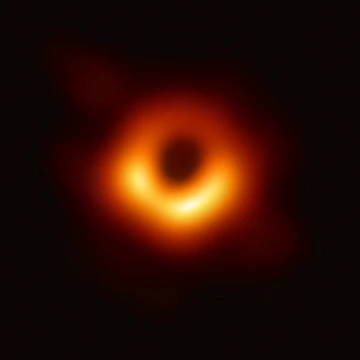
Micro black hole
Hypothetical tiny black holes where quantum effects dominate.

Micro black holes, sometimes called mini or quantum mechanical black holes, are a hypothetical class of black holes much smaller than our Sun (less than one solar mass). Their defining feature is that quantum mechanical effects are crucial to their behavior. In 1971, Stephen Hawking first proposed the existence of primordial black holes—a specific type of sub-stellar-mass black hole that could have formed in the early universe.
These objects could have formed in the extremely dense conditions of the early universe, shortly after the Big Bang, or possibly during later phase transitions. If they exist, they might be detected by the particles they are predicted to emit through Hawking radiation.
Some theories that include extra spatial dimensions suggest micro black holes could be created at energy levels as low as a few teraelectronvolts (TeV)—energies reachable by particle accelerators like the Large Hadron Collider (LHC). This has sparked public concerns about catastrophic scenarios, but such quantum black holes would evaporate almost instantly, either completely or leaving behind only a very weakly interacting remnant. Moreover, cosmic rays striking Earth already carry energies in the hundreds of TeV without causing any harm.
Regarding the minimum possible mass, Hawking initially speculated that a black hole would not form below about 10⁻⁸ kilograms (roughly the Planck mass, which is approximately 2.18 × 10⁻⁸ kg). To create a black hole, enough mass or energy must be concentrated so that the escape velocity from that region exceeds the speed of light.
If extra dimensions exist, gravity becomes stronger at short distances than in our usual three-dimensional space. In certain models—like large extra dimensions, specific Randall–Sundrum setups, or certain string theory configurations—this effect could lower the Planck scale to the TeV range. In that case, black hole production might become observable at the LHC and would also be a common natural event caused by cosmic rays. However, this assumes general relativity remains valid at such tiny scales. If it does not, other unknown effects could set a larger minimum size.
One alternative theory, Einstein–Cartan gravity, includes torsion—a twist in spacetime that interacts with the intrinsic spin of elementary particles.
- Type
- Hypothetical astronomical object
- First proposed
- 1971 by Stephen Hawking (primordial black holes)
- Minimum mass range
- ~2.18 × 10⁻⁸ kg (Planck mass) to 10¹⁶ kg (with torsion)
- Possible formation
- Early universe (primordial black holes) or particle accelerators
- Key effect
- Hawking radiation
- Observable signature
- Gamma-ray bursts from evaporation
Lore & Background
The idea of micro black holes originated with Stephen Hawking in 1971, who proposed that primordial black holes—a specific type of sub-stellar-mass black hole—could have formed in the early universe. Such objects might have formed in the early universe, known as primordial black holes, or possibly through phase transitions. Hawking later argued in 1975 that black holes evaporate via Hawking radiation, with smaller black holes evaporating faster, eventually producing a burst of particles. Some theories involving extra dimensions suggest micro black holes could be created at energies as low as the teraelectronvolt range, potentially within reach of the Large Hadron Collider.
Reader's Guide
Micro black holes represent a frontier where general relativity and quantum mechanics intersect. Their significance lies in testing fundamental physics: if produced in accelerators, they could confirm extra dimensions; if observed via Hawking radiation, they would validate quantum gravity effects. Primordial micro black holes could explain dark matter if they leave stable Planck-mass remnants. However, the concept remains hypothetical, with theoretical disputes over their minimum mass and stability. The possibility of micro black holes from cosmic rays or the LHC has raised public concerns, but the article notes that such quantum black holes would instantly evaporate, and cosmic rays at higher energies cause no damage. Their legacy is as a theoretical probe of the early universe and high-energy physics, though their existence is not confirmed.
Did You Know?
- Stephen Hawking introduced the concept of black holes smaller than stellar mass in 1971.
- Some theories with extra dimensions predict micro black holes could form at energies as low as the teraelectronvolt range.
- A primordial black hole with an initial mass of about 10¹² kg would be completing its evaporation today.
- The Einstein–Cartan theory suggests torsion may limit the minimum black hole mass to about 10¹⁶ kg.
Origins and Theoretical Foundations
The idea that black holes could exist far below stellar mass was first proposed by Stephen Hawking in 1971, opening a window into a regime where quantum mechanics and gravity intertwine. These hypothetical objects—sometimes called mini black holes or quantum mechanical black holes—would weigh less than one solar mass, placing them in a territory where classical general relativity alone cannot fully describe their behavior. One compelling origin story traces them back to the extreme conditions of the early universe. In the dense, turbulent aftermath of the Big Bang, or during subsequent phase transitions, pockets of matter may have collapsed into these tiny gravitational traps, giving rise to what researchers now term primordial black holes. Unlike their stellar-mass cousins, which form from dying stars, primordial black holes would be relics of cosmic infancy. Their potential detectability rests on a subtle signature: the stream of elementary particles they are predicted to emit through Hawking radiation, offering astronomers a possible observational handle on otherwise invisible objects.
Hawking Radiation and the Evaporation Paradox
In 1975, Stephen Hawking demonstrated that quantum effects near an event horizon cause black holes to slowly shed mass by emitting elementary particles—photons, electrons, quarks, and gluons—into surrounding space. The mechanism, often pictured as virtual particle pairs forming near the horizon with one partner falling in while the other escapes, results in a net loss of mass for the black hole. Crucially, the evaporation rate accelerates as the object shrinks: the smaller the black hole, the hotter it becomes, and the more rapidly it radiates. This positive feedback loop culminates in a violent, sudden burst as the hole approaches the Planck mass. At that threshold, the Hawking temperature reaches roughly 5.6 × 10³⁰ kelvin, and the entropy drops to just 4π nats—essentially the minimum physically meaningful value. At this point, the emitted particle's energy is comparable to the hole's own mass, thermodynamic descriptions collapse, and Hawking's own calculations cease to apply. Despite occasional fringe papers denying evaporation, the broader physics community, as Leonard Susskind has noted, treats the phenomenon as firmly established.
Extra Dimensions and the LHC Question
Certain extensions of known physics—large extra dimensions, specific Randall–Sundrum configurations, and string-theory constructions such as GKP solutions—predict that gravity's strength grows much more steeply at short distances when additional spatial dimensions are present. In such frameworks, the Planck scale could be dragged down to the teraelectronvolt range, energies within reach of the Large Hadron Collider. If correct, the LHC might produce tiny quantum black holes as a routine byproduct of high-energy collisions, and cosmic rays striking Earth's atmosphere at hundreds of TeV would do the same as a common natural occurrence. These predictions sparked widespread public alarm about catastrophic end-of-the-world scenarios. However, the theoretical picture is reassuring: any quantum black hole so produced would evaporate almost instantaneously, either vanishing completely or leaving behind only a very weakly interacting remnant. Moreover, the fact that cosmic rays have bombarded Earth for billions of years at comparable or greater energies without any observable damage provides strong empirical reassurance that no such danger exists.
Minimum Mass Limits and Theoretical Boundaries
Stephen Hawking initially speculated that no black hole could form below roughly 10⁻⁸ kilograms, approximately the Planck mass, because concentrating mass or energy enough to make escape velocity exceed light speed sets a fundamental lower bound. However, the Einstein–Cartan theory of gravity, which incorporates spacetime torsion required by the conservation of total angular momentum in curved spacetime, modifies the Dirac equation and causes fermions to possess a finite spatial extent. This spatial extension of elementary particles would push the minimum viable black hole mass up to around 10¹⁶ kilograms. The energy required to create such an object exceeds LHC capabilities by thirty-nine orders of magnitude, making accelerator production impossible under this framework. Yet a paradox emerges: if the LHC were somehow to produce a mini black hole, it would simultaneously disprove general relativity at small distances and invalidate the fermion-extension argument, since that argument assumes a minimum mass to sustain a hole rather than to initiate one. The two constraints thus point in opposite directions, leaving the true minimum mass an open question at the frontier of quantum gravity.
Frequently Asked Questions
What is a micro black hole?
A micro black hole is a hypothetical black hole with a mass well below one solar mass, small enough that quantum-mechanical effects govern its behavior rather than classical gravity alone. They are also referred to as mini or quantum-mechanical black holes and remain purely theoretical at this point.
Who first proposed the concept and when?
Stephen Hawking introduced the idea in 1971, specifically in the context of primordial black holes that might have existed since the early universe. His work laid the groundwork for the broader micro-black-hole framework that includes Hawking radiation and eventual evaporation.
How could a micro black hole actually form?
The leading hypothesis is that they condensed from the extreme density fluctuations present shortly after the Big Bang, or during later cosmic phase transitions. A secondary, more speculative possibility involves creating them artificially inside high-energy particle accelerators, though no such event has ever been confirmed.
What is the key physical effect associated with them?
Hawking radiation is the defining process: because the object is so small, it steadily loses mass by emitting particles, and the smaller it gets the faster it radiates. This means a micro black hole would eventually evaporate completely rather than persist forever like a stellar-mass one.
How would we know one existed if we found it?
The predicted observable signature is a brief, intense burst of gamma rays as the final stage of evaporation releases the remaining mass in a fraction of a second. Astronomers have searched for such flashes, but none has been conclusively identified as coming from a micro black hole.
More in Black holes 1-24
Spotted an error? Know more?
Reader corrections go straight into our review queue. Suggest an edit · How this site is sourced