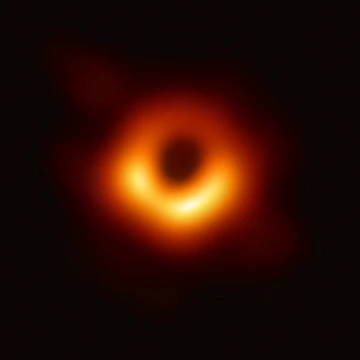
AdS black brane
Einstein equation solution with planar event horizon and negative cosmological constant.

An anti de Sitter (AdS) black brane is a solution of the Einstein equations in the presence of a negative cosmological constant that possesses a planar event horizon, distinguishing it from an AdS black hole with a spherical event horizon. This solution is significant in theoretical physics for modeling spacetimes that asymptote to anti de Sitter spacetime at spatial infinity.
- Field
- General relativity / Theoretical physics
- Known for
- Planar event horizon solution to Einstein equations with negative cosmological constant
- Type
- Spacetime solution
Lore & Background
The AdS black brane is derived from the Einstein equation R_μν - 1/2 R g_μν + Λ g_μν = 0, where Λ is a negative cosmological constant. Working in d spacetime dimensions with coordinates (t, r, x₁, ..., x_{d-2}), the line element for a stationary, time reversal invariant, space inversion invariant, rotationally invariant, and translationally invariant spacetime is given by ds² = L² (dr²/(r² h(r)) + r²(-dt² f(r) + d→x²)). The cosmological constant is replaced with a length scale L via Λ = -1/(2L²) (d-1)(d-2).
The solution yields f(r) = a(1 - b/r^{d-1}) and h(r) = 1 - b/r^{d-1}, with a and b integration constants. The constant a is associated with a residual symmetry from rescaling time; requiring the line element to approach ds² = L² (dr²/r² + r²(-dt² + d→x²)) as r → ∞ forces a = 1. The point r = 0 is a curvature singularity, and r^{d-1} = b is a coordinate singularity when b > 0, as shown by switching to coordinates (v, r, x₁, ..., x_{d-2}) with v = t + r*(r) and dr*/dr = 1/(r² h(r)).
Reader's Guide
The AdS black brane is a key solution in the study of anti de Sitter spacetimes, particularly in the context of the AdS/CFT correspondence, where it serves as a gravitational dual to a finite-temperature field theory. Its planar horizon mimics a thermal bath in the boundary theory, making it essential for understanding holographic thermodynamics and transport phenomena. The solution's dependence on the cosmological constant Λ and the integration constant b, which sets the horizon location, allows for the exploration of black brane thermodynamics, including temperature and entropy. The coordinate singularity at r^{d-1} = b is removable via a coordinate transformation, revealing the event horizon. The curvature singularity at r = 0 is a genuine singularity. The AdS black brane's translationally invariant horizon contrasts with spherical black holes, making it suitable for modeling systems with planar symmetry, such as those in condensed matter holography. Its legacy lies in providing a simple, exact solution that bridges gravity and quantum field theory, enabling calculations of transport coefficients and phase transitions in strongly coupled systems.
Did You Know?
- The AdS black brane has a planar event horizon, unlike the spherical horizon of an AdS black hole.
- The solution includes integration constants a and b, with a set to 1 to match asymptotic AdS spacetime.
- The line element is stationary, time reversal invariant, space inversion invariant, rotationally invariant, and translationally invariant in the x_i directions.
Geometric Generalization Beyond the Point
In the framework of general relativity, a black brane represents a solution to the Einstein field equations that extends the familiar black hole concept into higher spatial dimensions. Where a black hole is localized at a point, a black p-brane stretches across p additional spatial directions while maintaining translational symmetry along those axes. This means the object is not confined to a single location but rather occupies an extended geometric shape, essentially a membrane-like structure embedded in the surrounding spacetime. The parameter p quantifies how many extra spatial dimensions the brane spans beyond the temporal direction, making it a genuinely higher-dimensional gravitational source. In this sense, the black brane is not merely a larger black hole; it is a qualitatively different geometric entity whose horizon and interior structure are shaped by its extended topology rather than spherical symmetry. The translation invariance along the brane's worldsheet coordinates distinguishes it sharply from the spherically symmetric case, giving rise to a fundamentally different gravitational field whose falloff with distance from the brane surface is governed by the dimensionality of the transverse space.
String-Theoretic Identity and the Horizon
Within string theory, the black brane acquires a more concrete physical interpretation as a collection of D1-branes enveloped by an event horizon. This picture connects the abstract gravitational solution to the fundamental objects of string theory, where branes are the basic extended entities. The presence of a horizon around the D1-brane group is what elevates the configuration from a mere stack of branes to a genuine black object capable of trapping information. A key conceptual point that many physicists emphasize is the distinction between a black brane and a black hole: while both possess horizons, the singularity at the heart of a black brane is not a zero-dimensional point. Instead, it is a higher-dimensional object, reflecting the extended nature of the brane that sources the geometry. This contrasts with the point-like singularity of a classical black hole. The identification of points as zero-branes in the broader brane taxonomy makes this distinction natural: a black hole corresponds to a zero-brane singularity hidden behind a horizon, whereas a black p-brane harbors a p-dimensional singular core, with profound implications for the thermodynamics and quantum description of these objects.
BPS Structure and Electromagnetic Character
The BPS black brane occupies a special place in the taxonomy of extended gravitational solutions, sharing its defining characteristics with the BPS black hole. Both types of objects carry electric charges, which in the context of supersymmetric theories correspond to conserved charges associated with gauge fields threading the geometry. What distinguishes certain BPS black branes from their black-hole counterparts is the additional possibility of carrying magnetic charges as well. This dual electromagnetic character, simultaneously electric and magnetic, enriches the solution space and connects the brane to a broader web of gauge-theoretic structures. The BPS condition itself implies that these objects are extremal: their mass is saturated by their charges, and they preserve a fraction of the underlying supersymmetry. This extremality has important consequences for their stability and for the way they interact with probe particles. In the broader landscape of string theory, BPS black branes serve as controlled, exactly solvable examples where one can study the interplay between extended geometry, gauge fields, and supersymmetry without the complications of full quantum gravity, making them natural laboratories for exploring duality symmetries.
Metric Architecture and Curvature Structure
The metric of a black p-brane in an n-dimensional spacetime encodes the full geometric structure of the solution in a compact expression. It decomposes naturally into three parts: a term along the brane's worldsheet governed by the (p+1)-dimensional Minkowski metric with signature (−,+,+,...), a radial term that diverges at the horizon radius r_s, and an angular term describing a (n−p−2)-sphere surrounding the brane. The worldsheet coordinates label positions along the extended brane, while the four-velocity vector allows for boosted configurations of the entire object. The radial coordinate measures distance from the brane's surface, and the sphere metric captures the transverse geometry. The exponent n−p−3 appearing in the power-law falloff of the gravitational potential reflects how the dimensionality of the transverse space controls the strength of the field. The curvature structure, as captured by the Ricci tensor, further reveals how the geometry bends in the radial and angular directions, with terms involving Christoffel symbols and metric components encoding the tidal forces experienced by test particles approaching the brane surface.
Frequently Asked Questions
What is an AdS black brane?
An AdS black brane is a solution to Einstein's field equations in a spacetime with a negative cosmological constant, characterized by a flat, planar event horizon. It describes a black object whose geometry extends uniformly in all spatial directions rather than wrapping into a sphere.
How does an AdS black brane differ from a standard AdS black hole?
The defining difference is the horizon topology: the brane's event horizon is planar (flat Euclidean space), whereas the standard AdS black hole has a spherical horizon. Both live in the same negatively curved background, but the brane's geometry is translationally invariant along the horizon.
What role does the AdS black brane play in theoretical physics?
It acts as a mathematical model for spacetimes that asymptote to anti-de Sitter geometry at spatial infinity. Researchers rely on it as a building block in holographic correspondence frameworks, where a lower-dimensional quantum theory is mapped onto a higher-dimensional gravitational description.
What are the defining mathematical ingredients of an AdS black brane?
The solution is constructed by solving Einstein's equations with a negative cosmological constant inserted, yielding a metric whose horizon is a flat plane. This contrasts with the spherical-horizon solution, where the horizon topology is that of a sphere.
Why do physicists care about the AdS black brane?
Its planar geometry simplifies the study of black-hole thermodynamics and quantum field theory in curved spacetime by removing the complications of spherical symmetry. It is also a natural setting for holographic models of condensed-matter systems and strongly coupled quantum theories.
More in Black holes 1-24
Spotted an error? Know more?
Reader corrections go straight into our review queue. Suggest an edit · How this site is sourced