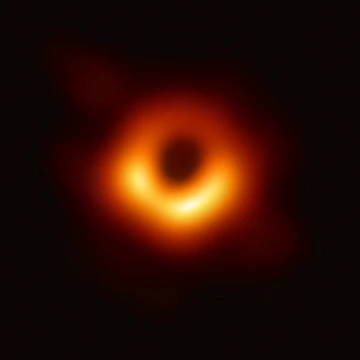
Bekenstein bound
Upper limit on entropy in a finite region of space.

The Bekenstein bound is an upper limit on the thermodynamic entropy or Shannon entropy that can be contained within a given finite region of space with finite energy. It implies that the information of a physical system must be finite if the region of space and the energy are finite. The bound was originally proposed by Jacob Bekenstein in 1972.
- Field
- Physics
- Known for
- Bekenstein bound, black hole thermodynamics
- Named after
- Jacob Bekenstein
Lore & Background
The universal form of the bound was originally found by Jacob Bekenstein in 1972 as the inequality S ≤ 2πkRE/ħc, where S is entropy, k is Boltzmann constant, R is the radius of a sphere enclosing the system, E is total mass-energy, ħ is reduced Planck constant, and c is speed of light. The bound does not contain the gravitational constant G, so it ought to apply to quantum field theory in curved spacetime. The Bekenstein–Hawking boundary entropy of four-dimensional black holes exactly saturates the bound.
Bekenstein derived the bound from heuristic arguments involving black holes. If a system exists that violates the bound, Bekenstein argued that it would be possible to violate the second law of thermodynamics by lowering it into a black hole. In 1995, Ted Jacobson demonstrated that the Einstein field equations can be derived by assuming that the Bekenstein bound and the laws of thermodynamics are true. The precise formulation of the bound was a matter of debate until Horacio Casini's work in 2008.
Reader's Guide
The Bekenstein bound is closely associated with black hole thermodynamics, the holographic principle, and the covariant entropy bound of quantum gravity, and can be derived from a conjectured strong form of the latter. It provides a fundamental limit on the amount of information that can be stored in a physical system, linking thermodynamics, quantum mechanics, and general relativity. The bound's derivation from black hole thought experiments and its saturation by black hole entropy suggest deep connections between gravity and information theory. While the bound's precise constant was debated, Casini's work in 2008 helped resolve the formulation. The bound remains a key concept in theoretical physics, influencing the study of quantum gravity and the nature of spacetime.
The Core Idea — A Ceiling on Physical Information
The Bekenstein bound, named for physicist Jacob Bekenstein, establishes a hard ceiling on how much thermodynamic entropy—or equivalently, Shannon information—can reside inside any finite patch of space that holds a finite amount of energy. In more intuitive terms, it says that if you want to perfectly describe a physical system all the way down to its quantum-level details, the amount of information you need is not infinite; it is capped by the size of the region and the energy it contains. This carries a profound implication: the informational content of any bounded, finite-energy physical system must be finite. The bound thus places a fundamental limit on how much physical "stuff" the universe can pack into a given volume, weaving together concepts from thermodynamics, information theory, and quantum mechanics into a single, elegant inequality that constrains the very structure of reality.
The Equation and Its Constants
The universal form of the bound was first written down by Bekenstein in 1981 as the inequality S ≤ 2πkRE/(ħc). Here S denotes entropy, k is the Boltzmann constant, R is the radius of a sphere enclosing the system, E is the total mass-energy including rest masses, ħ is the reduced Planck constant, and c is the speed of light. Notably, the gravitational constant G does not appear in this expression, even though gravity often plays a crucial role in enforcing the bound, as in the case of black holes. This absence means the bound should apply more broadly, including to quantum field theory in curved spacetime. One can also read the bound through the microcanonical entropy formula S = k log Ω, where Ω counts the accessible energy eigenstates. Equivalently, the dimension of the Hilbert space describing the system is bounded by exp(2πRE/ħc), forging a direct link between the bound and the size of the underlying quantum state space.
Black Holes as the Saturation Case
The Bekenstein bound finds its most dramatic expression in black hole physics. The Bekenstein-Hawking boundary entropy of three-dimensional black holes exactly saturates the bound, meaning they sit precisely at the maximum allowed entropy for their size and energy. Starting from the Schwarzschild radius r_s = 2GM/c², the two-dimensional area of the event horizon works out to A = 16πG²M²/c⁴. Expressing this in terms of the Planck length l_P² = ħG/c³, the Bekenstein-Hawking entropy takes the form S = kA/(4l_P²) = 4πkGM²/(ħc). This tight connection to black hole thermodynamics links the bound to the holographic principle and the covariant entropy bound of quantum gravity, from which a conjectured strong form can actually derive the Bekenstein bound. The fact that black holes hit the ceiling exactly suggests they represent the ultimate information-dense objects permitted by nature.
Origins, Debate, and the Road to Consistency
Bekenstein originally derived the bound in 1981 using heuristic arguments rooted in black hole thought experiments. His reasoning was elegant: if a system carried too much entropy—violating the bound—one could lower it into a black hole and thereby violate the second law of thermodynamics. The precise numerical coefficient, however, remained a matter of debate for years. While heuristic derivations could establish that some constant K satisfies S ≤ KkRE/(ħc), pinning down K = 2π required more sophisticated analysis. In 1995, Ted Jacobson showed that the Einstein field equations of general relativity can be derived by assuming the Bekenstein bound together with the laws of thermodynamics, elevating the bound from a curiosity to a structural pillar of physics. It was not until Horacio Casini's work in 2008 that the precise formulation was firmly settled, resolving lingering disputes about the exact mathematical statement of the bound.
Frequently Asked Questions
Who is Bekenstein bound?
It is a theoretical ceiling proposed by physicist Jacob Bekenstein in 1972, capping how much entropy can fit inside a bounded region of space that also carries a finite amount of energy. Fans often picture it as the universe's ultimate 'storage limit' for information.
What are Bekenstein bound's powers/role?
Its job is to set a hard upper limit on the thermodynamic or Shannon entropy of any physical system confined to a finite volume with finite energy. In plain terms, no patch of space can pack in infinite data—there is a maximum information density.
When was Bekenstein bound born?
Jacob Bekenstein first articulated the idea in 1972, drawing on his broader work in black hole thermodynamics. It has since become a standard assumption in quantum information theory and discussions of spacetime physics.
Why is Bekenstein bound important?
It gives physicists a concrete mathematical reason to treat the information content of any finite region as finite, which underpins the holographic principle and black hole entropy calculations. Without it, key frameworks in quantum gravity would lose a foundational constraint.
More in Black holes 1-24
Spotted an error? Know more?
Reader corrections go straight into our review queue. Suggest an edit · How this site is sourced