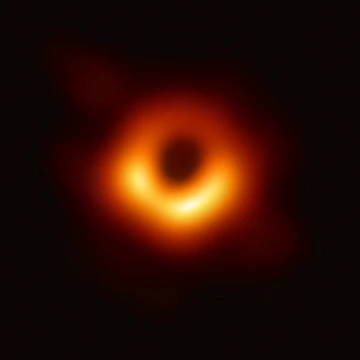
Ansky (black hole)
First supermassive black hole observed awakening in real time.

Ansky is the nickname for a supermassive black hole in the galaxy SDSS J133519.91+072807.4, also called SDSS1335+0728. It sits about 300 million light-years away in the Virgo constellation. The black hole first drew attention in December 2019, when it suddenly brightened in optical light, marking the first time astronomers had ever seen a supermassive black hole come to life in real time. Quasi-periodic eruptions (QPEs) of X-ray radiation were detected later, starting around 2022–2023.
The galaxy SDSS1335+0728 had been quiet for two decades before suddenly brightening in December 2019. The Zwicky Transient Facility (ZTF) picked up the optical brightening and gave it the designation ZTF19acnskyy—the nickname "Ansky" comes from the "acnskyy" part of that identifier. The initial brightening was flagged by the ALeRCE machine learning system, which automatically classifies astronomical events. Over the following years, the galaxy kept varying in optical light, and X-ray emissions were detected starting in 2020 or later. The black hole itself is estimated to have a mass of about one million times that of the Sun. Its host galaxy, SDSS1335+0728, is an early-type galaxy at a redshift of 0.024, and it is now classified as a galaxy with an active galactic nucleus.
In February 2024, astronomers detected recurring X-ray flares from Ansky, marking the start of its unprecedented quasi-periodic eruptions. These eruptions are extreme: each one lasts about 1.5 days and repeats every 4.5 days—the longest interval ever seen for any QPE source. Each burst releases roughly 10^48 ergs, which is far more energetic than typical QPEs (which range from 10^42 to 10^44 ergs), making them some of the most luminous on record. There is also a longer 25-day cycle that contains cascades of five consecutive eruptions. Ansky is the first supermassive black hole observed waking up from dormancy, and its QPEs are the most energetic and longest-lasting on record. Notably, there is no sign of a recent star being torn apart, which suggests that QPEs can arise from newly formed accretion flows, not just from stellar disruption events.
Multiple space telescopes have kept watch on Ansky since it activated. NASA’s NICER telescope monitored it from May to July 2024, observing about 16 times a day.
- Type
- Supermassive black hole
- Mass
- Approximately 10^6 solar masses
- Distance
- 300 million light-years
- Host galaxy
- SDSS1335+0728
- Constellation
- Virgo
- Discovery year
- 2019
- Known for
- First observed supermassive black hole awakening in real time; most energetic and longest-duration QPEs on record
Lore & Background
The galaxy SDSS1335+0728 remained inactive for two decades before suddenly brightening in December 2019. The Zwicky Transient Facility (ZTF) detected this optical brightening and assigned the designation ZTF19acnskyy. The nickname 'Ansky' derives from the suffix 'acnskyy' in this original identifier. The initial brightening was discovered through the ALeRCE machine learning classification system. Following the 2019 event, the galaxy exhibited optical variability, and X-ray emissions were detected starting in 2020 or later. The central black hole has an estimated mass of approximately 10^6 solar masses, and the host galaxy is classified as an early-type galaxy at redshift z=0.024, now classified as a galaxy with active galactic nucleus.
Reader's Guide
Ansky is significant as the first supermassive black hole observed transitioning from dormancy to activity in real time, providing a unique laboratory for studying black hole awakening and accretion physics. Its quasi-periodic eruptions (QPEs), first detected in February 2024, are the most energetic and longest-duration QPEs on record, with each burst releasing approximately 10^48 ergs—100 times more energy than typical QPEs. The eruptions repeat every 4.5 days, the longest interval observed for any QPE source, and involve the ejection of approximately one Jupiter mass of material at velocities reaching 15% of the speed of light. The source lacks evidence of recent stellar destruction, suggesting QPEs can occur through newly formed accretion flows rather than only after star disruption events. Multiple space-based telescopes, including NASA's NICER, ESA's XMM-Newton, NASA's Swift Observatory, and NASA's Chandra X-ray Observatory, have monitored Ansky, detecting 165 QPE events during the initial monitoring period and capturing 12 near-consecutive flares over a 60-day campaign. Since activation, Ansky has shown systematic changes across the electromagnetic spectrum, including ultraviolet brightening, mid-infrared doubling in brightness, and the onset of extreme X-ray emissions. Its legacy lies in challenging existing models of black hole feeding and QPE origins, and in demonstrating that supermassive black holes can awaken on human timescales.
Classification and Cataloguing
Ansky is identified in astronomical literature as a supermassive black hole or probable candidate, a designation that places it among the most massive compact objects known in the universe. It appears in a comprehensive catalog of black holes and stars considered likely candidates for such objects, a list that is systematically organized by mass. This particular catalog includes entries with both determined and undetermined masses, reflecting the ongoing nature of astrophysical measurement. The list provides Messier and New General Catalogue designations wherever such identifiers are available, though Ansky itself is referenced through its association with the SDSS1335+0728 galaxy rather than through those classical designations. Its placement in the supermassive category distinguishes it from intermediate-mass and stellar-mass black holes, which are catalogued separately. The supermassive grouping also encompasses quasars and hypothetical hypercompact stellar systems organized around such objects, underscoring the breadth of phenomena associated with these extraordinarily dense gravitational wells.
Galactic Home
Ansky is situated within the SDSS1335+0728 galaxy, a designation that follows the naming conventions of the Sloan Digital Sky Survey. In the broader catalog where Ansky is listed, some entries are not individual black holes per se but rather entire galaxies or star clusters that are believed to be organized around a central black hole. Ansky's entry reflects this relationship: it is the black hole associated with SDSS1335+0728, meaning the galaxy's structure and dynamics are understood to be governed by this supermassive object at its core. The SDSS designation, with its specific coordinates encoded in the name, situates the galaxy within a well-mapped region of the sky. Unlike many of its peers in the supermassive list, which carry familiar Messier or New General Catalogue numbers, Ansky is identified primarily through its survey designation, suggesting it may be a more recently characterized or less traditionally catalogued object. The galaxy itself serves as the observable host, while the black hole remains the invisible gravitational anchor around which the stellar population orbits.
Among the Supermassive
Within the supermassive black hole and candidate list, Ansky occupies a position alongside a remarkable array of objects spanning a wide range of known and estimated masses. Neighbors in this catalog include Ton 618, a quasar possibly harboring the largest black hole ever found at an estimated 66 billion solar masses, and S5 0014+81, described as a compact hyperluminous quasar estimated at 40 billion solar masses. Other entries range from well-known galaxies like Messier 31 (the Andromeda Galaxy), Messier 87 (Pōwehi), and the Sombrero Galaxy, to radio galaxies such as 4C +37.11, which is believed to host binary supermassive black holes. The list also includes objects with undetermined masses, reflecting the challenges of measuring such extreme gravitational sources. Ansky's inclusion among these entries confirms its classification as a supermassive object, though its specific mass is not stated in the available catalog data. The diversity of the list, from quasars to quiescent galaxies to blazars like Q0906+6930, illustrates the many astrophysical contexts in which supermassive black holes manifest themselves.
Taxonomic Position
Ansky's placement in the supermassive black hole category situates it within a clearly defined tier of the broader black hole taxonomy. Below it in mass lie intermediate-mass black holes, such as those found in the Cigar Galaxy, the Sculptor Galaxy, and the Triangulum Galaxy, as well as objects like M82 X-1 and HLX-1. Further down the scale are stellar-mass black holes, including famous examples like Cygnus X-1, the first object widely accepted as a black hole, and more recent discoveries such as Gaia BH1, Gaia BH2, and Gaia BH3. The supermassive category to which Ansky belongs also encompasses specific object types: quasars, supermassive black holes proper, and hypothetical hypercompact stellar systems organized around such cores. Ansky does not appear in the binary or trinary black hole system lists, nor among the gravitational wave detection events recorded by LIGO. Its singular listing as a black hole in the SDSS1335+0728 galaxy, without mention of a companion or merger event, distinguishes its current observational status from the more dynamically complex systems catalogued elsewhere in the same reference.
Frequently Asked Questions
What is Ansky (black hole)?
Ansky is the fan-given nickname for a supermassive black hole residing in the galaxy SDSS J133519.91+072807.4, located roughly 300 million light-years away in the constellation Virgo. It has a mass on the order of a million solar masses.
How did Ansky (black hole) first get noticed by astronomers?
In December 2019 the host galaxy, which had been essentially silent for about twenty years, abruptly flared in optical light. That sudden brightening caught the attention of the Zwicky Transient Facility and made headlines because it was the first time anyone watched a supermassive black hole stir from dormancy in real time.
What are the quasi-periodic eruptions (QPEs) linked to Ansky (black hole)?
Beginning around 2022–2023, observers detected rhythmic bursts of X-ray radiation from the system, a phenomenon called quasi-periodic eruptions. These QPEs added a second, distinct layer of activity on top of the original 2019 optical outburst.
Why is Ansky (black hole) considered a milestone in black-hole astronomy?
Before Ansky, astronomers had only ever caught supermassive black holes already in their active or dormant phases. Watching this object snap to life in real time gave researchers a rare, direct look at the transition mechanism that powers on an otherwise quiet supermassive black hole.
Where can I find Ansky (black hole) in the sky?
The host galaxy sits in the direction of the Virgo constellation, about 300 million light-years from Earth. Because of that distance, it is visible only through professional telescopes and survey instruments, not the naked eye.
More in Black holes 1-24
Spotted an error? Know more?
Reader corrections go straight into our review queue. Suggest an edit · How this site is sourced