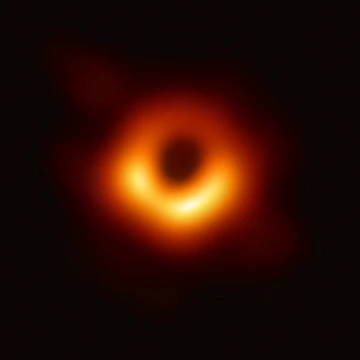
Black hole thermodynamics
A model linking black holes to thermodynamics via entropy and temperature.

Black hole thermodynamics describes a set of relationships between a black hole's properties that mirror the classical laws of thermodynamics. In this analogy, a black hole's entropy is represented by the area of its event horizon, and its temperature is represented by the surface gravity at that horizon. Because temperature implies thermal emission, this framework predicts that black holes must emit radiation—specifically, Hawking radiation. Although there is currently no way to directly test black hole thermodynamics, it remains the most accepted model uniting general relativity, quantum field theory, and thermodynamics. Some indirect support comes from gravitational wave observations, which have already tested Hawking's area law.
The idea began in 1972, when Jacob Bekenstein proposed that black holes should possess an entropy proportional to their event horizon area. That same year, he also introduced the no-hair theorem. In 1973, Bekenstein suggested a specific constant of proportionality: ln(2) divided by 8π, roughly 0.0276. The following year, Stephen Hawking demonstrated that black holes emit thermal radiation at a specific temperature, now called the Hawking temperature. Using the thermodynamic link between energy, temperature, and entropy, Hawking confirmed Bekenstein's conjecture and corrected the constant to 1/4. This gave the Bekenstein–Hawking formula: S_BH = (k_B * A) / (4 * ℓ_P²), where A is the event horizon area, k_B is the Boltzmann constant, and ℓ_P is the Planck length (√(Għ/c³)). The subscript BH stands for either "black hole" or "Bekenstein–Hawking."
The fact that black hole entropy equals the maximum entropy allowed by the Bekenstein bound was key to developing the holographic principle. This area–entropy relationship was later generalized to arbitrary regions through the Ryu–Takayanagi formula, which links the entanglement entropy of a boundary conformal field theory to a specific surface in its dual gravitational theory. In the early 1990s, Gerard 't Hooft and Leonard Susskind extended the connection between a black hole's surface area and its entropy to all of spacetime, forming an early version of the holographic principle. This principle states that the area surrounding any volume limits the information it can contain, meaning the number of degrees of freedom in any volume is finite.
- Field
- Physics
- Known for
- Bekenstein–Hawking formula, laws of black hole mechanics, holographic principle
- Key concepts
- Black hole entropy, Hawking radiation, surface gravity, event horizon area
Lore & Background
In 1972, Jacob Bekenstein conjectured that black holes should have an entropy proportional to the area of the event horizon, and proposed the no-hair theorem. In 1973 he heuristically suggested ln2/(8π) ≈ 0.0276 as the constant of proportionality. The next year, in 1974, Stephen Hawking showed that black holes emit thermal Hawking radiation corresponding to a certain temperature, and using the thermodynamic relationship between energy, temperature and entropy, confirmed Bekenstein's conjecture and fixed the constant of proportionality at 1/4, yielding the Bekenstein–Hawking formula: S_BH = k_B A / (4 ℓ_P^2). This formula is often referred to as the Bekenstein–Hawking formula, and the fact that black hole entropy is also the maximal entropy obtainable by the Bekenstein bound led to the holographic principle. In the early 1990s Gerard 't Hooft and Leonard Susskind generalized the relationship between a black hole's surface area and its entropy, applying to all of spacetime, an early form of the holographic principle.
Reader's Guide
Black hole thermodynamics is significant because it provides the most widely accepted physical model that combines general relativity, quantum field theory, and thermodynamics, despite having no known way to be verified. The Bekenstein–Hawking formula established a direct proportionality between black hole entropy and event horizon area, which was a key insight leading to the holographic principle. The four laws of black hole mechanics—zeroth, first, second, and an implied third law—mirror classical thermodynamics, with surface gravity analogous to temperature and horizon area analogous to entropy. The second law, stating that horizon area is a non-decreasing function of time, was confirmed by analyses of gravitational waves emitted by GW250114. While string theory calculations by Andrew Strominger and Cumrun Vafa in 1995 successfully derived the Bekenstein–Hawking entropy for supersymmetric black holes, the relationship for Schwarzschild black holes remains uncharacterized. Loop quantum gravity offers a geometric explanation of entropy finiteness and area proportionality. The legacy of black hole thermodynamics lies in its role as a cornerstone of quantum gravity research, linking geometry, information, and thermodynamics.
Did You Know?
- The Bekenstein–Hawking formula sets black hole entropy proportional to the event horizon area, with constant 1/4.
- Hawking's area law, stating that black hole horizon area is non-decreasing, was confirmed by gravitational wave analysis of GW250114.
- In 1995, Andrew Strominger and Cumrun Vafa calculated black hole entropy for supersymmetric black holes using string theory, matching the Bekenstein–Hawking formula.
- The holographic principle, an early form of which was generalized by Gerard 't Hooft and Leonard Susskind, relates the area surrounding any volume to the information content of that volume.
More in Black holes 1-24
Spotted an error? Know more?
Reader corrections go straight into our review queue. Suggest an edit · How this site is sourced