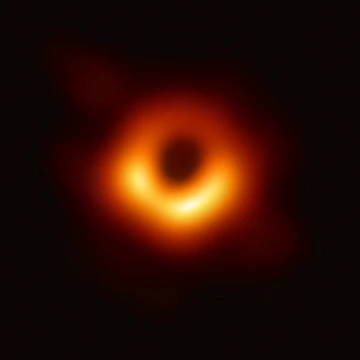
Black hole stability conjecture
Conjecture that perturbed black holes settle back to a black hole state.

The black hole stability conjecture posits that if a black hole solution to the Einstein field equations is disturbed, it will eventually return to a black hole state. The relevant solutions include the Kerr metric for isolated rotating black holes and the Kerr–Newman–de–Sitter metric for charged, rotating black holes in an expanding cosmos. The conjecture's mathematical basis rests on work by French mathematician Yvonne Choquet-Bruhat in 1952, who demonstrated that the initial value problem for the Einstein field equations is well-posed. The idea is that small changes to a black hole's initial conditions will dissipate over time, while its mass, angular momentum, and charge stabilize at new values.
The stability of the Schwarzschild metric under tiny perturbations was first studied by Tullio Regge and John Archibald Wheeler in 1957, and later by Frank Zerilli, leading to the Regge–Wheeler–Zerilli equations. After Roy Kerr discovered the Kerr metric in 1963, research expanded to rotating black holes through the work of Saul Teukolsky, C. V. Vishveshwara, Robert Wald, Bernard Whiting, and others.
Peter Hintz proved the conjecture for Kerr black holes in 2026, covering all subextremal cases—those with an event horizon. For the Kerr metric, subextremality means the absolute value of the angular momentum parameter a is less than the mass M. The superextremal (or overextreme) Kerr spacetime, where |a| exceeds M, lacks an event horizon and instead represents a naked singularity, not a black hole. A series of papers culminating in 2022 by Elena Giorgi, Sergiu Klainerman, and Jérémie Szeftel provided a proof for slowly rotating Kerr black holes, where |a| is much smaller than M. In 2021, Mihalis Dafermos, Gustav Holzegel, Martin Taylor, and Igor Rodnianski proved the stability of Schwarzschild spacetime for all perturbations that result in a black hole with zero angular momentum. Klainerman and Szeftel published a stability result for Schwarzschild spacetime under perturbations with special symmetries in 2017. A 2016 paper by Peter Hintz and András Vasy proved the stability of slowly rotating Kerr black holes in de Sitter space.
- Field
- General relativity, mathematical physics
- Key figures
- Yvonne Choquet-Bruhat, Tullio Regge, John Archibald Wheeler, Frank Zerilli, Roy Kerr, Saul Teukolsky, C. V. Vishveshwara, Robert Wald, Bernard Whiting, Peter Hintz, Elena Giorgi, Sergiu Klainerman, Jé
- First proved for
- Kerr black holes (2026, Peter Hintz)
- Partial proofs
- Slowly rotating Kerr (2022, Giorgi–Klainerman–Szeftel); Schwarzschild stability (2021, Dafermos–Holzegel–Taylor–Rodnianski); Schwarzschild with symmetries (2017, Klainerman–Szeftel); slowly rotating K
Lore & Background
The stability of the Schwarzschild metric under infinitesimal perturbations was first investigated by Tullio Regge and John Archibald Wheeler in 1957, and Frank Zerilli, who discovered the Regge–Wheeler–Zerilli equations. Following the discovery of the Kerr metric by Roy Kerr in 1963, these investigations were extended to rotating black holes by Saul Teukolsky, C. V. Vishveshwara, Robert Wald, Bernard Whiting and others.
Reader's Guide
The black hole stability conjecture is a central problem in mathematical general relativity, asserting that small perturbations of a black hole's initial conditions disperse over time while the black hole's parameters (mass, angular momentum, charge) settle to new values. The conjecture was proved for all subextremal Kerr black holes (|a| < M) by Peter Hintz in 2026. Earlier partial results include a 2022 proof for slowly rotating Kerr black holes (|a| ≪ M) by Elena Giorgi, Sergiu Klainerman and Jérémie Szeftel, and a 2021 proof of Schwarzschild stability for perturbations yielding vanishing angular momentum by Mihalis Dafermos, Gustav Holzegel, Martin Taylor and Igor Rodnianski. A 2016 paper by Peter Hintz and András Vasy proved stability for slowly rotating Kerr black holes in de Sitter space. The superextremal case (|a| > M) does not describe a black hole but a naked singularity.
Did You Know?
- The mathematical foundation for the conjecture is work by Yvonne Choquet-Bruhat from 1952 on the well-posedness of the Einstein field equations.
- A series of papers culminating in 2022 by Giorgi, Klainerman and Szeftel gave a proof for slowly rotating Kerr black holes.
- The superextremal Kerr spacetime (|a| > M) does not possess an event horizon and is an example of a naked singularity.
More in Black holes 1-24
Spotted an error? Know more?
Reader corrections go straight into our review queue. Suggest an edit · How this site is sourced