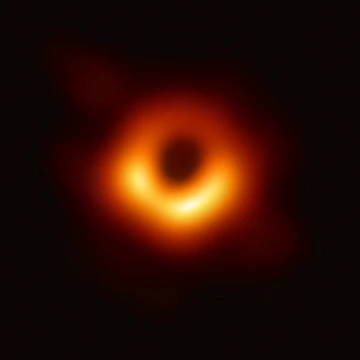
Black hole information paradox
A paradox questioning information loss in black hole evaporation.

The black hole information paradox is a puzzle in physics that remains unsolved. It emerges when the rules of quantum mechanics and general relativity are applied together. General relativity predicts black holes, regions of spacetime so dense that nothing, not even light, can escape. In the 1970s, Stephen Hawking used a semiclassical method—quantum field theory in curved spacetime—to study these objects. He found that an isolated black hole would emit radiation, now called Hawking radiation, and argued that this radiation's specific form would not depend on the black hole's initial state, only on its mass, electric charge, and angular momentum.
The paradox arises when a black hole forms from a physical process and then completely evaporates via Hawking radiation. Hawking's calculation indicated that the final radiation would carry information only about the black hole's total mass, charge, and angular momentum. Because many different initial states can share the same mass, charge, and angular momentum, this suggests that many possible starting states could lead to the same final state. Consequently, details of the initial state would be permanently lost. This loss, however, breaks a core quantum principle called unitarity. In quantum mechanics, a system's state is described by a wave function, and its evolution is governed by a unitary operator. This operator is bijective, meaning the wave function at any time can be used to determine the wave function in both the past and the future. Hawking radiation, as originally calculated, seems to contradict this.
In 1993, Don Page argued that if a black hole begins in a pure quantum state and evaporates completely through a unitary process, the von Neumann entropy of the Hawking radiation would first increase and then decrease back to zero once the black hole is gone. This pattern is known as the Page curve. It is now widely accepted that information is preserved during black hole evaporation. For many researchers, deriving the Page curve is equivalent to solving the information puzzle. However, opinions differ on exactly how Hawking's original semiclassical calculation should be corrected. In recent years, several new versions of the paradox have been explored. Together, these puzzles about black hole evaporation have implications for how gravity and quantum mechanics must be unified.
- Field
- Theoretical physics, quantum gravity
- Known for
- Highlighting a conflict between quantum mechanics and general relativity regarding information preservation in black hole evaporation
- Key concepts
- Hawking radiation, unitarity, von Neumann entropy, Page curve
Lore & Background
The paradox emerged from Stephen Hawking's 1970s application of quantum field theory in curved spacetime to black holes, which predicted that isolated black holes emit radiation (Hawking radiation). Hawking argued that this radiation depends only on the black hole's mass, electric charge, and angular momentum, not on the details of the initial state that formed it. This suggests that many different initial states could evolve into the same final state, leading to permanent information loss.
In quantum mechanics, the evolution of a system's wave function is governed by a unitary operator, which ensures that information about the initial state is preserved and can be reconstructed from the final state. Hawking's calculation thus appeared to violate unitarity, creating the paradox. In 1993, Don Page argued that if a black hole starts in a pure quantum state and evaporates unitarily, the von Neumann entropy of the radiation initially increases and then decreases back to zero—a pattern now called the Page curve.
Today, many researchers believe that information is preserved in black hole evaporation, and deriving the Page curve is often seen as solving the puzzle. However, views differ on how Hawking's original semiclassical calculation should be corrected. The paradox remains an active field of research in quantum gravity, with implications for how gravity and quantum mechanics must be combined.
Reader's Guide
The black hole information paradox is significant because it exposes a fundamental tension between two pillars of modern physics: general relativity and quantum mechanics. Hawking's semiclassical calculation suggested that black hole evaporation leads to microscopic irreversibility, contradicting the unitarity principle that underlies quantum theory. This paradox has driven decades of theoretical work, including the development of the holographic principle and AdS/CFT duality, which some physicists believe demonstrate that information is preserved. The Page curve, proposed by Don Page, provides a testable signature of unitary evaporation. While the paradox remains unsolved, it has deepened our understanding of quantum gravity and continues to guide research into how spacetime and quantum mechanics must be unified. The debate underscores that even well-established theories may require revision when applied to extreme conditions like black holes.
More in Black holes 1-24
Spotted an error? Know more?
Reader corrections go straight into our review queue. Suggest an edit · How this site is sourced