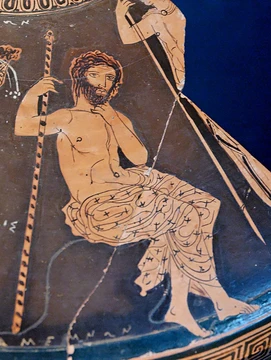
The Contention of Ajax and Ulysses
A Caroline interlude on the fate of Achilles' armour.

The Contention of Ajax and Ulysses for the Armour of Achilles is a short comedic play from the Caroline era, described as a 'Dramatic Interlude' in three scenes. It was written by James Shirley, likely performed privately (if at all) during the Interregnum, and first published in 1659. The story draws on a classic theme from Greek literature: what happened to Achilles' armour after his death. In the canonical myth, Achilles was killed by Paris (with Apollo's aid) shooting an arrow into his heel, not by Hector. Shirley likely used Book 13 of Ovid's *Metamorphoses* as his main source, along with Thomas Heywood's play *The Iron Age*. The poem that closes the final scene, "The glories of our blood and state", has been set to music multiple times.
The play was first printed in an octavo volume by the bookseller John Crooke, which also included another Shirley play, *Honoria and Mammon*. The title page says *The Contention* was "nobly represented by young gentlemen of quality, at a private entertainment of some persons of honour." No details about the stage history of either play have survived, though both may have been written for schoolboys Shirley taught after the theatres closed at the start of the English Civil War in 1642.
While not one of Shirley's most notable works, the third and final scene includes a funeral dirge spoken by the seer Calchas for Ajax, who kills himself in a rage after Ulysses alone is awarded Achilles' armour. The poem begins "The glories of our blood and state / Are shadows, not substantial things," and has often been excerpted and reprinted, sometimes under the title "Death the Leveller." It appears in collections of familiar quotations and is the most famous and popular work in Shirley's canon; Louisa May Alcott quotes its concluding line in *Little Women*.
The play is set in the Greek camp outside Troy during the Trojan War, soon after Achilles' death. It opens with the pages of Ajax and Ulysses, Lycippus and Dydimus, arguing over which master is better. Their dispute turns into an exchange of insults and then a fight, which is broken up by Calchas, the famous seer. He clears the pages away for the upcoming debate: Ajax and Ulysses will contend for Achilles' armour. The Greek generals and officers, led by Agamemnon and including Menelaus, Nestor, Thersander, and Diomedes, enter and sit to hear the debate. Ajax and Ulysses follow.
- First performed
- Private performance during the Interregnum (theatres closed 1642–1660); no specific date recorded
Lore & Background
The play was first printed in an octavo volume issued by the bookseller John Crooke, containing both The Contention and another play by Shirley, Honoria and Mammon. The title page states that The Contention was 'nobly represented by young gentlemen of quality, at a private entertainment of some persons of honour.' No specific data about the stage history of either piece has survived; both may have been works that Shirley prepared for performance by the schoolboys he taught after the theatres closed with the start of the English Civil War in 1642.
Reader's Guide
While not one of Shirley's most notable stage works, the third and final scene of The Contention contains a funeral dirge spoken by the seer Calchas for Ajax who has committed suicide while consumed with rage that Ulysses alone had been awarded the armour of Achilles. The poem begins 'The glories of our blood and state / Are shadows, not substantial things,' which has been often excerpted and reproduced, sometimes under the title of 'Death the Leveller.' Included in collections of familiar quotations, the poem is the most famous and popular work in Shirley's canon; Louisa May Alcott quotes its concluding line in Little Women. The dirge was set to music at the time by Edward Coleman, first printed in The Musical Companion of 1667, and published a number of times thereafter. It was well known as a song — King Charles II was reportedly fond of it, as performed by the versatile bass singer John Bowman. Hubert Parry made a setting of the poem for chorus and orchestra in 1883, published in 1885 as The Glories of our Blood and State. Granville Bantock set the poem for 4-part male chorus and piano, published in 1910 'In Memoriam Edward VII'.
Origins and Literary Lineage
James Shirley composed this brief three-scene comedic interlude during the Caroline period, with performances taking place between 1654 and 1658. The text saw its first print edition in 1659, issued in octavo format by the bookseller John Crooke, who paired it with another Shirley play, Honoria and Mammon. The title page credits the production to young gentlemen of quality performing at a private gathering of persons of honour, though no detailed stage records have survived. Scholars have speculated that Shirley may have staged both pieces with the schoolboys he tutored after the English Civil War forced the theatres to shut their doors in 1642. The subject matter—what becomes of Achilles' legendary armour after the hero falls, struck in the heel by Hector—was a well-worn thread in Greek classical storytelling. Shirley appears to have drawn most directly on Book 13 of Ovid's Metamorphoses, supplemented by Thomas Heywood's earlier dramatic treatment, The Iron Age.
Dramatic Structure and the Debate
Set in the Greek encampment before the walls of Troy, the play opens in the immediate aftermath of Achilles' death. Two pages, Lycippus and Dydimus, representing their respective masters Ajax and Ulysses, begin a quarrel over whose lord is the greater warrior. The dispute escalates from verbal sparring into a physical brawl, only to be interrupted by the seer Calchas, who ushers the pages aside to prepare for the formal contest. The assembled Greek command—Agamemnon at the head, with Menelaus, Nestor, Thersander, and Diomedes among them—takes its seats as a jury. Ajax speaks first, delivering lengthy, self-aggrandising orations about his martial prowess while simultaneously belittling his rival's character and eloquence. Ulysses, speaking second, proves far more incisive, wielding Ajax's own bombast as a weapon against him. The panel ultimately sides with Ulysses. In the second scene, the pages reconcile and mock a politician named Polybrontes, while Ajax, driven mad by his defeat, kills Polybrontes, mistakes Calchas for his rival, and takes his own life. The final scene presents Calchas delivering a funeral lament as Ajax's body is borne toward the temple.
The Dirge and Its Literary Afterlife
Although the play itself never ranked among Shirley's most celebrated theatrical works, the funeral lament that Calchas speaks over Ajax's corpse in the third scene achieved a fame far exceeding its dramatic context. Opening with the lines that describe the glories of blood and state as mere shadows rather than substantial things, the poem has been excerpted and reprinted so frequently that it is sometimes encountered under the alternate title "Death the Leveller." It has become a staple of quotation collections and remains the single most recognised piece in Shirley's entire body of work. Its resonance extends well beyond the seventeenth century: Louisa May Alcott wove its concluding line into the narrative of Little Women, introducing the verse to generations of readers who may never have encountered the full play. The poem's meditation on mortality and the levelling power of death gave it a universal appeal that transcended its original Caroline-era stage setting, ensuring its survival in the English literary consciousness long after the interlude itself faded from performance.
Musical Settings Across the Centuries
The dirge's melodic potential was recognised almost immediately. Edward Coleman composed a musical setting that was first printed in The Musical Companion of 1667 and went on to be published repeatedly in the decades that followed. The song enjoyed royal patronage: King Charles II was reportedly a keen admirer of the piece, particularly as rendered by the versatile bass vocalist John Bowman. The poem's musical life continued into the nineteenth and twentieth centuries. In 1883, Hubert Parry crafted a grander arrangement for chorus and orchestra, which was published in 1885 under the title The Glories of our Blood and State. A generation later, Granville Bantock set the text for four-part male chorus with piano accompaniment, publishing his version in 1910 under the dedication "In Memoriam Edward VII." These successive settings demonstrate how a single passage from a short Caroline-era interlude could sustain a rich tradition of musical interpretation spanning more than two and a half centuries.
Frequently Asked Questions
Who wrote 'The Contention of Ajax and Ulysses' and what type of work is it?
James Shirley penned this brief three-scene comedic interlude during the Caroline period. It falls into the category of dramatic interludes rather than full-length plays, and its lighthearted tone sets it apart from more serious treatments of the same subject.
What is 'The Contention of Ajax and Ulysses' about?
The piece dramatizes the dispute over who should inherit the armor of Achilles following the hero's death, pitting Ajax against Ulysses in a comedic contest. It takes the well-known Greek mythological episode and reframes it as a short, humorous theatrical sketch.
When and where was 'The Contention of Ajax and Ulysses' first performed?
No public staging is recorded, as all London theatres were shuttered between 1642 and 1660 during the Interregnum. Shirley most likely presented it in a private setting, and the text did not appear in print until 1659.
What classical source did Shirley rely on for this interlude?
The primary inspiration appears to be Book 13 of Ovid's Metamorphoses, where the poet retells the armor contest. Shirley also drew on the broader Homeric tradition, though his version treats the material with a distinctly comic sensibility.
Why do fans of the Agamemnon cycle care about this interlude?
It offers a rare comedic lens on one of the most consequential moments in the Trojan War narrative—the distribution of Achilles' gear after his death. As a Caroline-era work, it also shows how seventeenth-century English dramatists reimagined classical mythology for private, courtly audiences.
More in Agamemnon 1-24
Spotted an error? Know more?
Reader corrections go straight into our review queue. Suggest an edit · How this site is sourced