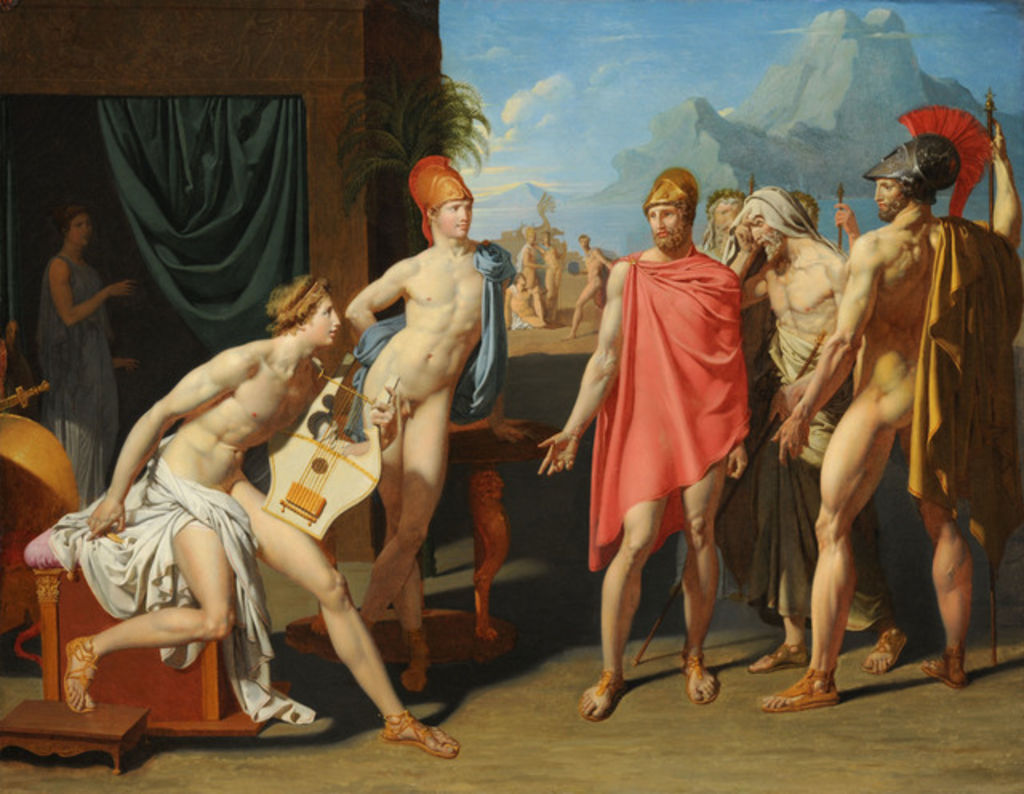
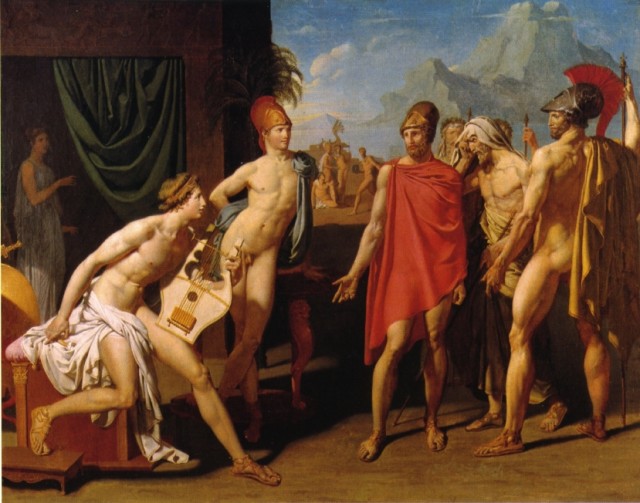
The Ambassadors of Agamemnon in the tent of Achilles
Ingres' 1801 Prix de Rome painting of Achilles refusing Agamemnon's envoys.

Jean-Auguste-Dominique Ingres · Public domain
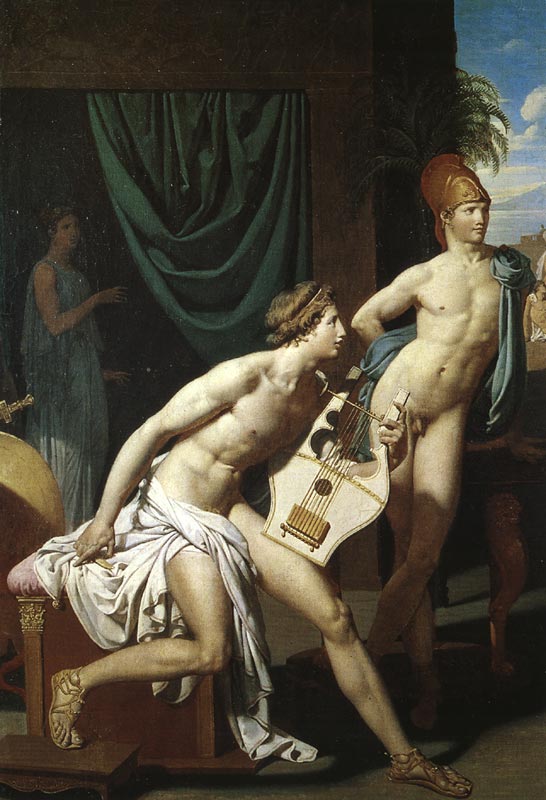
Painted in 1801, Jean-Auguste-Dominique Ingres’s *The Ambassadors of Agamemnon in the tent of Achilles* is an oil-on-canvas work created for the Prix de Rome competition. It now resides at the École nationale supérieure des beaux-arts in Paris. The scene comes from Homer’s *Iliad*, showing the moment Achilles rejects the envoys Agamemnon sent to persuade him to rejoin the Trojan War. For the 1801 Prix de Rome, the assigned subject was a procession of warriors heading into battle; Ingres instead focused on psychological tension rather than physical action. The painting demonstrates his skill with the human figure in classical history painting—Odysseus, for instance, wears a red cloak based on a sculpture by Pseudo-Phidias. Stylistically neo-classical, the work belongs to the school of Jacques-Louis David, under whom Ingres trained, but also shows new influences from John Flaxman, whose work had just been exhibited in Paris for the first time. A small oil-on-wood sketch for the painting is held by the Nationalmuseum of Sweden.
- Artist
- Jean-Auguste-Dominique Ingres
- Year
- 1801
- Medium
- oil-on-canvas
- Subject
- episode from Homer's Iliad
- Style
- neo-classical
- Location
- École nationale supérieure des beaux-arts, Paris
Lore & Background
The topic assigned for the artists competing for the Prix de Rome in 1801 was the warriors' procession toward battle; Ingres' interpretation of the subject characteristically emphasized a moment of psychological drama instead of physical action. The work was intended as a demonstration of Ingres' mastery of the human figure in classical history painting – Odysseus is shown in a red cloak derived from a sculpture by Pseudo-Phidias. The painting is in the neo-classical style and belongs to the school of Jacques-Louis David, in whose studio Ingres had trained. It also shows new influences from John Flaxman, whose work had just had its first Parisian exhibition. A small oil-on-wood sketch for the painting is in the collection of the nationalmuseum of Sweden.
Reader's Guide
The Ambassadors of Agamemnon in the tent of Achilles marks a key early work in Ingres' career, created for the prestigious Prix de Rome competition. Its significance lies in its departure from the assigned theme of physical action toward a focus on psychological tension, a hallmark of Ingres' mature style. The painting demonstrates his training under Jacques-Louis David and his absorption of neo-classical principles, while also incorporating influences from John Flaxman, whose work had recently been exhibited in Paris. The depiction of Odysseus in a red cloak derived from a sculpture by Pseudo-Phidias illustrates Ingres' engagement with classical sources. The work remains in the collection of the École nationale supérieure des beaux-arts in Paris, and a preparatory sketch exists in the nationalmuseum of Sweden, providing insight into his creative process. Its legacy is as an early example of Ingres' skill in history painting and his ability to reinterpret classical narratives through a dramatic, introspective lens.
Defying the Brief: Ingres at the 1801 Prix de Rome
The 1801 Prix de Rome competition presented its contestants with a straightforward directive: depict a warriors' procession marching toward battle. Jean-Auguste-Dominique Ingres, however, saw the assignment not as a call for choreographed movement but as an invitation to excavate the emotional core of Homer's Iliad. Rather than staging a parade of armored figures, he zeroed in on the charged silence of Achilles' tent, where the great hero flatly refuses the envoys dispatched by Agamemnon to drag him back into the Trojan War. The result is a scene built almost entirely on psychological tension—bodies arranged in stillness, faces locked in defiance and pleading—rather than on the physical spectacle of combat. This deliberate pivot from kinetic action to interior drama became a signature move in Ingres' career, signaling early on that his interest lay in the gravity of a held breath rather than the sweep of a sword. The painting, executed in oil on canvas, stands as a bold reinterpretation of a prescribed subject, proving that a single frozen moment of refusal could carry more narrative weight than an entire marching column.
Between David and Flaxman: A Neo-Classical Crossroads
The painting sits firmly within the neo-classical tradition that dominated French academic art in the early nineteenth century, and its stylistic DNA traces directly to the studio of Jacques-Louis David, under whose tutelage Ingres had trained. David's emphasis on clean contours, restrained palettes, and the moral seriousness of historical subject matter all permeate the composition. Yet the work also carries a fresh current of influence: the British draughtsman John Flaxman, whose engravings and illustrations had just received their first Parisian exhibition, left a visible imprint on Ingres' handling of line and decorative simplification. The interplay between these two sources—the monumental gravity of David's French academy and the spare, almost architectural linearity of Flaxman—gives the canvas a distinctive tension. Ingres absorbed both traditions without fully surrendering to either, producing a work that honors the neo-classical canon while quietly introducing a more personal, more sculptural sensibility. The result is a painting that feels both thoroughly rooted in its academic lineage and subtly ahead of it, a hallmark that would define his subsequent career at the École des Beaux-Arts and beyond.
Sculpture in Oil: The Classical Figure as Central Concern
From the outset, Ingres conceived the painting as a showcase for his command of the human form in the tradition of classical history painting. Every figure in the composition is rendered with an almost sculptural precision, the bodies built up with careful attention to anatomical structure and drapery fall. One particularly telling detail anchors the work in the ancient world: the figure of Odysseus is wrapped in a vivid red cloak whose form is derived from a sculpture attributed to Pseudo-Phidias, the so-called Phidian type of classical statuary. By borrowing directly from a known ancient source, Ingres signals that his ambition is not merely to illustrate a passage from Homer's Iliad but to reconstruct the visual vocabulary of antiquity itself. The oil-on-canvas medium allows him to model flesh and fabric with a smoothness that echoes marble while retaining the warmth of pigment. This fusion of painterly technique with sculptural reference positions the work as a deliberate exercise in what the French academy valued most: the ability to render the idealized human body with both intellectual rigor and visual power.
From Paris to Stockholm: Provenance and Scholarly Afterlife
The finished canvas now hangs in the collection of the École nationale supérieure des beaux-arts in Paris, the very institution whose competitive traditions produced it, making the painting both a product of and a monument to the French academy system. A smaller preparatory sketch, executed in oil on wood, survives in the collection of the Nationalmuseum in Sweden, offering scholars a glimpse into Ingres' early compositional thinking and the iterative process behind the final work. The painting has continued to attract serious scholarly attention well into the modern era. Daniel Ternois devoted a monograph to Ingres in 1980, published by Fernand Nathan in Paris, while Patricia Condon, Marjorie B. Cohn, and Agnes Mongan contributed to the 1983 exhibition catalogue In Pursuit of Perfection: The Art of J.-A.-D. Ingres at the J. B. Speed Art Museum in Louisville. These studies, among others, have ensured that the Ambassadors of Agamemnon remains a touchstone for understanding how a young Ingres negotiated the expectations of his teachers, the demands of a competition brief, and his own emerging vision of classical grandeur.
Gallery
Frequently Asked Questions
Who painted 'The Ambassadors of Agamemnon in the tent of Achilles' and when?
Jean-Auguste-Dominique Ingres produced this oil-on-canvas painting in 1801 as his submission to the Prix de Rome competition. It is a neo-classical work drawn from an episode in Homer's Iliad.
What moment from the Iliad does the painting show?
It captures the scene in which Achilles turns away the envoys Agamemnon sent to coax him back into the Trojan War. Rather than staging a dramatic action, Ingres concentrated on the charged silence and psychological standoff between the figures.
Why did Ingres's choice of subject stand out in the 1801 Prix de Rome?
The official brief called for a procession of warriors marching into battle, but Ingres deliberately shifted the focus to a moment of refusal and emotional tension. This unconventional reading showcased his talent for conveying inner conflict through composition rather than physical movement.
What makes this painting significant to fans of Ingres and classical art?
It is one of the earliest works where Ingres demonstrated his signature ability to distill a narrative moment into a study of psychological drama. The painting foreshadowed the controlled, emotionally restrained neo-classical style that would define his later career.
More in Agamemnon 1-24
Spotted an error? Know more?
Reader corrections go straight into our review queue. Suggest an edit · How this site is sourced